
IVF egg numbers and live birth: how much difference might one additional mature egg make?
In a study of 6,507 couples, each additional mature egg was associated with 5.4% higher odds of having a first child.
The odds of having two children were 6.5% higher per additional mature egg. This does not mean a 5.4-percentage-point increase in the live birth rate.
For women undergoing in-vitro fertilization, or IVF, the first thing they hear on egg retrieval day is often a number. “We retrieved five eggs.” “This time, there were six.” One more egg may sound like a small difference to someone else. For an older patient or someone with a poor ovarian response who struggles to obtain even one or two eggs each time, that difference can feel considerable.
How much, then, does one additional egg change the chance of having a child?
A study presented at the 2026 annual meeting of the European Society of Human Reproduction and Embryology, or ESHRE, examined this question numerically. Among 6,507 couples undergoing IVF, each additional mature egg was associated with 5.4% higher odds of having one child and 6.5% higher odds of having two children within three years. Odds describe the ratio of the probability of an outcome occurring to the probability of it not occurring.
The study counted mature eggs, not every egg retrieved
The egg count in this analysis did not simply include every egg collected on retrieval day.
Some retrieved eggs are still immature. The researchers focused on metaphase-II, or MII, oocytes: eggs that have matured sufficiently to be used for fertilization.
The study included 6,507 couples treated with IVF at one fertility center between 2010 and 2020. Follow-up covered up to three years and up to six egg retrieval cycles. The women’s median age was 38, and their median anti-Müllerian hormone, or AMH, level—a marker of ovarian reserve—was 1.6 ng/mL.
The researchers compared live birth outcomes across groups with totals of 1–2, 3–4, 5–7, 8–12, 13–19, and at least 20 mature eggs obtained during treatment.
More mature eggs were associated with more live births
The pattern was relatively clear.
As the number of mature eggs increased, so did the proportion of women who had at least one child within three years. Depending on egg count, that proportion ranged from approximately 24% to 70% among women younger than 38, from approximately 15% to 55% among those aged 38–39, and from approximately 3–5% to as much as 30% among women aged 40 or older.
The association with each additional egg remained after the researchers accounted for age and other factors.
Each additional mature egg was associated, on average, with a 5.4% increase in the odds of having one child. The odds of having two children, including a second child, were 6.5% higher on average per additional mature egg.
An extra egg can therefore represent more than a count changing from five to six. It provides another opportunity for fertilization and another candidate for embryo development. Some of those embryos may develop well, be transferred, result in pregnancy, and eventually lead to a live birth. A small difference can accumulate through those stages.
What does “5.4% higher odds” mean?
The figure that requires particular care in this study is 5.4%.
It should not be interpreted as “one more egg raises the live birth rate by 5.4 percentage points.”
The researchers estimated odds, rather than the probability of a live birth itself. Put simply, odds are the ratio of the probability of success to the probability of no success.
For example, if the probability of a live birth were 20%, the probability of no live birth would be 80%. The odds would be 20 to 80, or 0.25. Increasing those odds by 5.4% gives approximately 0.264. Converting that back into a probability gives approximately 20.9%.
In this hypothetical example, an additional egg would not move the probability from 20% to 25.4%. The corresponding change would be from approximately 20% to 20.9%.
This is only a simple mathematical example to explain odds. It does not predict that an individual patient’s live birth probability will necessarily change in this way.
The actual chance of having a child depends on many factors, including age, egg quality, sperm characteristics, fertilization, embryo development, and chromosome status. One additional egg does not add the same probability of a live birth for every woman.
Five eggs versus ten is not simply double the chance
This is part of what makes the study interesting.
In IVF, obtaining more eggs does not cause the chance of having a child to increase in a fixed proportion to the egg count. Each egg must pass several hurdles, from fertilization to embryo development, implantation, and live birth.
Conversely, a small number of eggs does not mean there is no possibility of success. Three eggs may produce a good embryo, while ten eggs may leave relatively few embryos suitable for transfer.
The study therefore does not establish an absolute threshold for how many eggs are needed to achieve a pregnancy. It shows a tendency for cumulative live birth prospects to improve as additional usable, mature eggs are obtained.
Why one egg can matter so much with a poor ovarian response
These findings may be especially relevant to patients who struggle to obtain one or two, or three or four, eggs per retrieval, rather than those who obtain many eggs each time.
Retrieving three eggs does not mean treatment has failed, and retrieving ten does not guarantee a live birth. Looking beyond a single retrieval, however, the mature eggs obtained across several treatment cycles can accumulate, along with opportunities that may lead to a child.
The meaning of egg numbers may also differ depending on whether someone hopes for one child or two. This is why the researchers took a family-building perspective, considering how many children patients hope to have rather than focusing solely on a single successful pregnancy.
There are limitations. This was a retrospective study of patients treated over 11 years at one fertility center, rather than a randomized clinical trial. In particular, relatively few women aged 38 or older had two children, so estimates concerning a second child require cautious interpretation.
Even so, the study offers a practical message.
After retrieval, it can be disappointing to think, “We only got one more egg this time.” In IVF, however, that one egg is more than a number. It represents another possibility for fertilization and another potential embryo.
Those individual opportunities can accumulate toward the chance of eventually having a child.
For related context, read about why ovarian responses and egg yields vary and how egg quantity and quality shape IVF probabilities.
Research source
This article is based on the ESHRE 2026 conference abstract “A family-building perspective in IVF: the contribution of each additional oocyte to cumulative live birth rate,” published in the July 2026 supplement of Human Reproduction. The retrospective analysis included 6,507 couples undergoing IVF. This report is a conference abstract, rather than a full randomized clinical trial. DOI: 10.1093/humrep/deag083.1059.
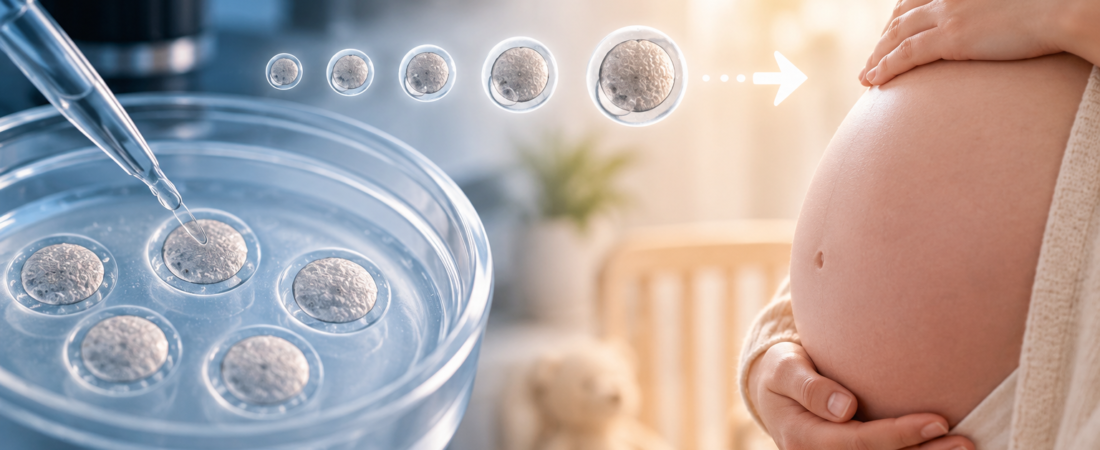
The image used in this article was created using generative artificial intelligence (ChatGPT, OpenAI). Any people depicted are fictional, not real individuals.
Copyright © 2026 Fertility Information TokTok Fertility News | THE FERTILITY NOTES. All rights reserved. Unauthorized republication, reproduction, redistribution, scraping, AI training, and data use of any content, including articles, photographs, and images, are strictly prohibited. Violations may result in legal liability.