
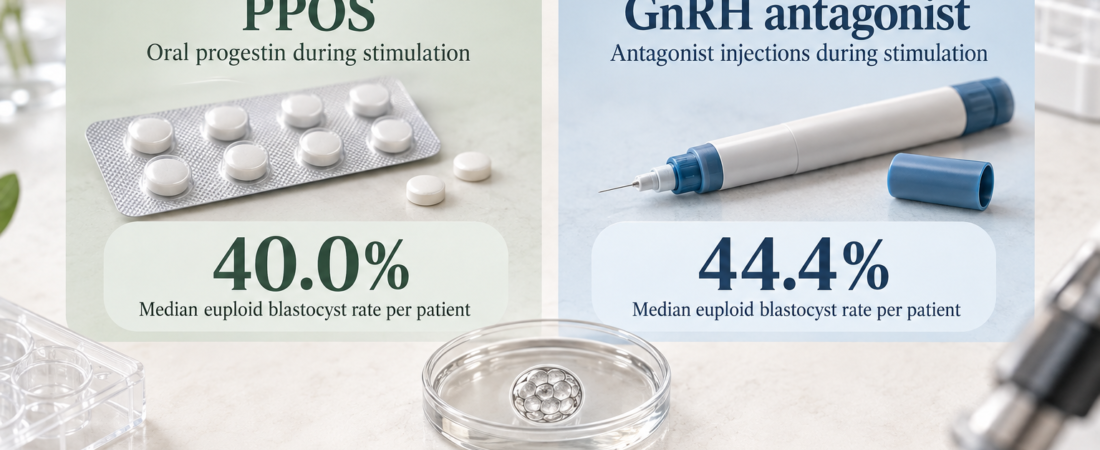
Does taking a progestin during ovarian stimulation reduce the number of chromosomally normal embryos? A randomized trial of 400 women undergoing preimplantation genetic testing for aneuploidy (PGT-A) found no statistically significant difference between progestin-primed ovarian stimulation (PPOS) and a conventional GnRH antagonist protocol.
The median euploid blastocyst rate was 40.0% with PPOS and 44.4% with the antagonist protocol. Egg numbers, blastocyst numbers and live-birth outcomes after the first transfer also did not differ significantly.
During IVF, ovarian-stimulation injections help several eggs develop at once. Medication is also used to prevent ovulation before the eggs can be retrieved. Traditionally, this often involves injections of a gonadotropin-releasing hormone (GnRH) antagonist. PPOS instead uses a progestin, a medication with progesterone-like activity.
Patients may reasonably ask whether exposure to progestin during stimulation affects eggs or embryos, particularly the hard-won embryos with a normal chromosome count. For someone having PGT-A, convenience alone would not be a sufficient advantage if the stimulation method reduced the number of euploid embryos.
The trial directly addressed this concern by randomly assigning 400 women to PPOS or a GnRH antagonist protocol. It did not find evidence that PPOS reduced the euploid blastocyst rate in the population studied.
How progestin prevents ovulation before egg retrieval
PPOS stands for progestin-primed ovarian stimulation. Progestins are synthetic hormones designed to have effects similar to progesterone, which is produced naturally in the body.
IVF stimulation uses follicle-stimulating hormones and related medication to grow several follicles. During this process, luteinizing hormone (LH) can rise suddenly. An LH surge may trigger ovulation before the planned egg retrieval.
Preventing premature ovulation is therefore as important as helping follicles grow. A widely used approach is to suppress the LH rise with a GnRH antagonist. In PPOS, progestin serves this role during ovarian stimulation, helping prevent a premature LH surge and ovulation.
For patients, this may simplify treatment and reduce costs. The remaining question has been whether exposing growing follicles to progestin could adversely affect egg chromosomes and ultimately reduce the number of euploid embryos produced.
Four hundred women younger than 43 were randomly assigned
The investigators recruited 400 women younger than 43 who were undergoing PGT-A, assigning 200 to PPOS and 200 to the GnRH antagonist protocol.
Randomization helps compare the treatment methods themselves because investigators do not choose a protocol according to a patient's individual characteristics.
Reasons for PGT-A included advanced maternal age, recurrent miscarriage, recurrent implantation failure, or a previous pregnancy affected by a fetal chromosomal abnormality.
The primary outcome was the euploid blastocyst rate per patient. Euploid embryos have a normal chromosome number. Human cells normally have 46 chromosomes, but errors in chromosome separation during egg or sperm formation can produce embryos with too many or too few. Such numerical abnormalities are an important cause of implantation failure and miscarriage.
The embryos were cultured to the blastocyst stage, a sample of cells was biopsied, and next-generation sequencing (NGS) was used for chromosome testing.
Euploid blastocyst rates: 40.0% versus 44.4%
The median patient-level euploid blastocyst rate was 40.0% in the PPOS group and 44.4% in the antagonist group.
Although the antagonist group's figure was 4.4 percentage points higher, the difference was not statistically significant (P=0.192). The study therefore did not establish that PPOS lowered the euploid blastocyst rate.
The number of euploid blastocysts obtained per patient was also similar: a median of one in each group.
Earlier stages of embryo development showed no major differences either. The numbers of retrieved eggs, fertilized eggs, cleavage-stage embryos and blastocysts were comparable. The trial did not find that PPOS led to fewer eggs or poorer progression to the blastocyst stage.
Outcomes after the first frozen transfer were similar
After PGT-A, 136 women in the PPOS group and 152 in the antagonist group underwent their first frozen embryo transfer.
Clinical pregnancy, ongoing pregnancy, miscarriage, ectopic pregnancy and live-birth rates after that transfer did not differ significantly between the groups.
An important practical feature of PPOS remains. Because progestin is used during stimulation, fresh embryo transfer in that same cycle is generally unsuitable: the endometrium and embryo may no longer be synchronized.
Eggs are therefore retrieved and fertilized, embryos are frozen, and the endometrium is prepared in a later cycle for frozen embryo transfer. In other words, a freeze-all approach is normally required.
PPOS may consequently be unsuitable for a patient who wants a fresh transfer immediately after retrieval. This drawback matters less when embryos will already be frozen for PGT-A, or when eggs are being frozen for fertility preservation.
No significant difference does not mean the methods are identical
The results require careful interpretation. Failure to find a statistically significant difference in euploid blastocyst rates does not prove that the two protocols are identical in every respect.
The sample size was designed to detect a difference of approximately 10% in euploidy rates. It cannot completely exclude smaller differences.
Not every participant completed embryo transfer. Pregnancy and birth outcomes primarily reflect the first frozen transfer, rather than the cumulative chance of a live birth after using all available embryos. The study therefore does not establish equal cumulative live-birth rates.
Caution is also needed when extending the findings to other progestins, all ages, or patients with different patterns of ovarian response.
One answer to the concern about a simpler stimulation protocol
This trial does not show that PPOS is a better stimulation method than a GnRH antagonist. It addresses a narrower question: does using progestin to prevent premature ovulation adversely affect the chromosome status of the resulting embryos?
Among 400 women undergoing PGT-A, no significant differences were found in euploid blastocyst rates or the number of euploid embryos per patient. Egg numbers, blastocyst numbers and live-birth outcomes after the first frozen transfer were also comparable.
At least in this trial, the findings did not support the concern that PPOS reduces euploid embryos.
However, the need to freeze all embryos means PPOS is not automatically the most convenient approach for every IVF patient. The decision should account for PGT-A plans, whether fresh transfer is intended, ovarian reserve and expected ovarian response.
This article is based on research from the University of Hong Kong, Fudan University and collaborating institutions, published online in Human Reproduction Open on September 15, 2026. The trial is registered as NCT04414748.
This article explains recent research for general information. It does not guarantee treatment effects or replace individual diagnosis or care. Fertility treatment and medication choices depend on personal health and test results and should be decided with the treating clinical team.
Research references
Comparing the euploidy rate between the progestin-primed and gonadotrophin releasing hormone antagonist protocols in preimplantation genetic testing for aneuploidy: a randomized controlled trial. Human Reproduction Open, published September 15, 2026. ClinicalTrials.gov NCT04414748. DOI: 10.1093/hropen/hoag081.
Related reading
- Understanding euploid and mosaic embryo-transfer decisions
- Why a freeze-all strategy should be chosen for the patient
The images used in this article were created using generative AI (ChatGPT, OpenAI). Any people depicted are fictional, not real individuals. The medication visuals are conceptual illustrations, not photographs or instructions for actual medication products.
Copyright © 2026 Fertility Information TokTok Fertility News | THE FERTILITY NOTES. All rights reserved. Unauthorized republication, reproduction, redistribution, scraping, AI training, or use of any content, including articles, photographs, and images, as data is strictly prohibited. Violations may result in legal liability.