
“Should We Freeze Everything Even When Only a Few Eggs Are Retrieved?”… The ‘Freeze-All’ Rule Shaken in Low-Prognosis IVF
- Re-evaluating the ‘freeze-all’ dogma in women with low oocyte yields or diminished ovarian reserve
- Multicenter RCT of 838 low-prognosis patients: Live birth rate was 32% for freeze-all vs. 40% for fresh transfer; 1-year cumulative rate reached 44% vs. 51%
- “Freezing is not a universally superior strategy”: Protocol selection must be individualized based on ovarian response, endometrial environment, and OHSS risk
“We only got a couple of eggs—do we really need to freeze all the embryos?”
This is a recurring question among women undergoing In Vitro Fertilization (IVF). Online patient communities frequently reinforce the belief that “frozen embryo transfer (FET) always yields higher success rates than a fresh transfer” and that “it is always better to let the uterus rest for a month or two after egg retrieval.”
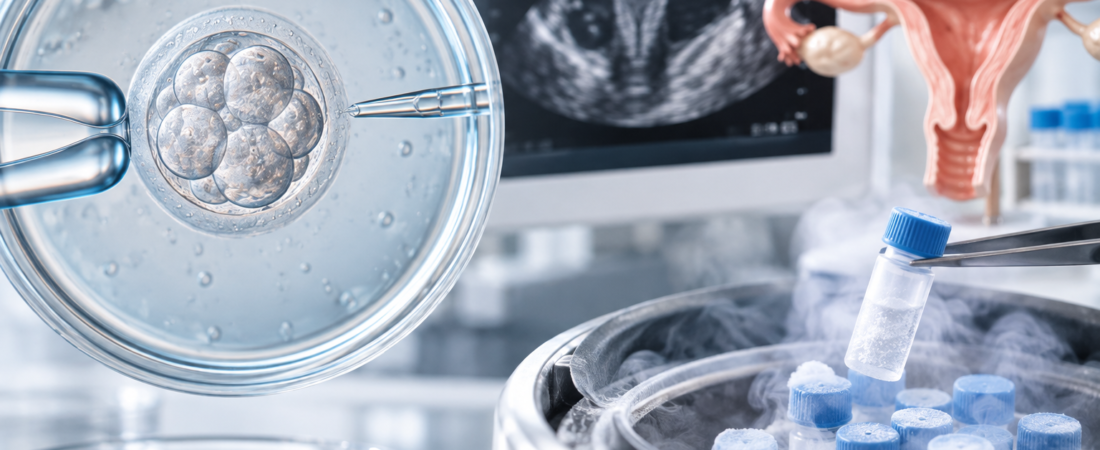
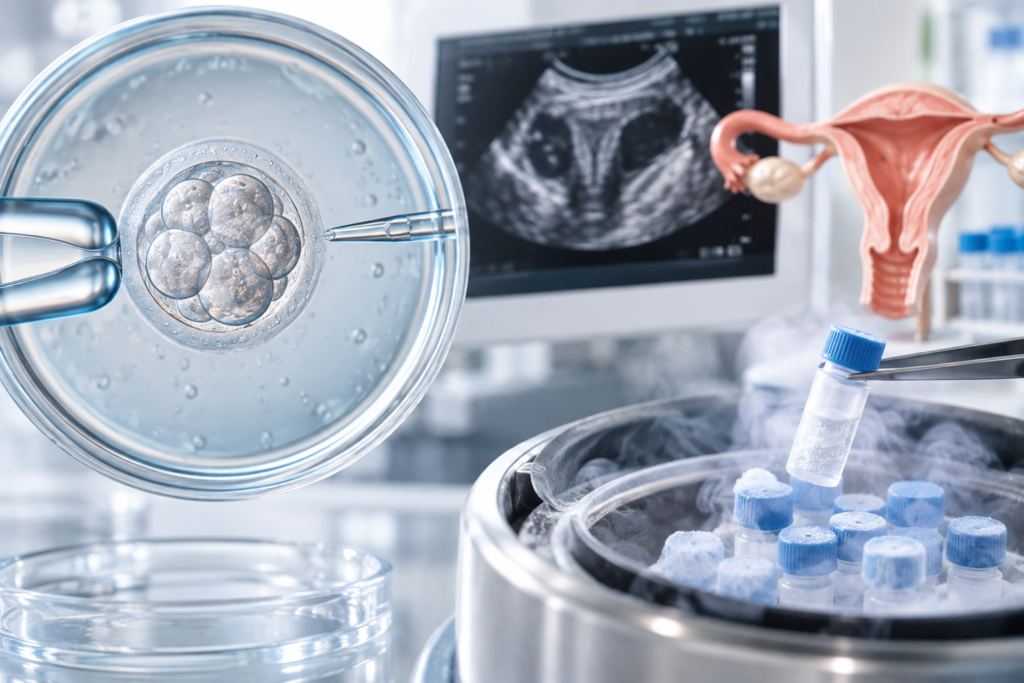
In clinical practice, the “freeze-all” strategy—cryopreserving the entire cohort of embryos during the retrieval cycle and postponing transfer to a subsequent unmedicated or programmed cycle—has indeed become widespread.
Yet, does applying a universal “freeze-all” policy to a woman who retrieved only two or three eggs offer the same clinical advantages as it does for a woman who retrieved twenty? Emerging research indicates that for “low-prognosis” patients with low ovarian reserve or few retrieved eggs, the clinical equation changes dramatically.
Re-evaluating ‘Freeze-All’ in Low-Prognosis Women
A study published online on September 3, 2026, in the international journal Reproductive BioMedicine Online (RBMO) compared freeze-all versus fresh embryo transfer strategies specifically in low-prognosis women. The researchers utilized a target trial emulation framework—analyzing real-world clinical data under rigorous methodological parameters that emulate the design of a prospective randomized controlled trial.
The premise of the study is straightforward: questioning whether the documented benefits of the freeze-all strategy apply equally across all patient phenotypes. In particular, the authors sought to determine whether freezing the entire embryo cohort and delaying transfer offers any tangible advantage to women who have very few embryos available from the start.
The freeze-all policy originally gained widespread adoption for clear physiological reasons. When multiple follicles develop in response to controlled ovarian hyperstimulation, circulating serum estradiol and progesterone concentrations can surge to supraphysiological levels. This hormonal spike can advance endometrial histology out of sync with embryonic development, narrowing or shifting the receptive implantation window. Furthermore, in high responders, elective cryopreservation of all embryos followed by a GnRH agonist trigger is the single most effective clinical tool for eliminating Ovarian Hyperstimulation Syndrome (OHSS).
However, poor ovarian responders and low-prognosis patients face an entirely different physiological reality: their systemic endocrine response to gonadotropins is modest, and their retrieved egg and usable embryo counts are strictly limited. Whether routinely deferring transfer in these patients translates into higher birth rates has remained an open question.
838 Patients Randomized: Live Birth Rate Reached 32% (Frozen) vs. 40% (Fresh)
Robust randomized evidence addressing this question came from a large-scale, multicenter randomized controlled trial conducted across nine reproductive medicine centers in China, published in The BMJ. The investigators randomized 838 women with a low prognosis for IVF into either a freeze-all group or a fresh embryo transfer group. Study eligibility included women with 9 or fewer retrieved oocytes, fewer than 5 antral follicles, or low baseline AMH levels.
Half of the cohort (419 women) had all viable embryos cryopreserved for subsequent frozen transfers, while the other 419 underwent a fresh embryo transfer during the retrieval cycle.
The trial’s findings diverged sharply from the popular assumption that “frozen is always superior”:
- Live Birth Rate: 32% in the freeze-all group vs. 40% in the fresh transfer group
- Clinical Pregnancy Rate: 39% in the freeze-all group vs. 47% in the fresh transfer group
This disparity was not confined to the first transfer attempt. When tracking the 1-year cumulative live birth rate—pooling all fresh and frozen transfer cycles resulting from that single retrieval over a 12-month period—the fresh transfer strategy maintained its lead at 51% versus 44% in the freeze-all arm.
For low-prognosis women, the rule that “freezing everything and letting the uterus rest automatically improves outcomes” did not hold up.
Why Low Oocyte Numbers Shift the Balance
These findings do not mean that cryopreservation damages embryos. Modern vitrification techniques boast post-thaw survival rates exceeding 95%, and frozen embryo transfer remains a cornerstone of modern assisted reproduction.
The critical variable is the patient’s individual endocrine and ovarian response.
In normal and high responders, marked follicular development drives estradiol and progesterone to levels that can cause endometrial advancement, while elevating OHSS risk. In that setting, deferring transfer until the hypothalamic-pituitary-ovarian axis resets offers distinct biological benefits.
In poor responders, however, ovarian stimulation produces only mild shifts in circulating steroid hormones, meaning the native endometrium is far less likely to suffer from hyperstimulation-induced dyssynchrony. Furthermore, these patients often have only one or two usable cleavage-stage embryos or blastocysts. Under these circumstances, electively freezing every embryo and delaying transfer adds procedural time, emotional strain, and cumulative costs without conferring a measurable biological benefit—while exposing a vulnerable, limited embryo pool to even a minor risk of post-thaw attrition.
Ultimately, evaluating assisted reproduction as a simplistic contest of “fresh vs. frozen” misses the mark; the real priority is matching the right strategy to the right patient.
A Low Egg Count Does Not Mean Fresh Transfer for Everyone
These findings should not be oversimplified into a mandate that every low-prognosis patient must undergo a fresh transfer.
A frozen embryo transfer remains medically indicated if specific clinical contraindications to a fresh transfer arise:
- Premature Progesterone Elevation: Late follicular progesterone rise (> 1.5 ng/mL on the day of trigger) accelerating endometrial secretory changes
- Endometrial Factors: Thin endometrial stripe (< 7 mm), intracavitary fluid, untreated endometrial polyps, or active chronic endometritis
- Tubal Pathology: Untreated hydrosalpinx leaking toxic fluid into the uterine cavity
- Preimplantation Genetic Testing: Performing PGT-A or PGT-SR, which requires cryopreservation while biopsy samples undergo high-throughput sequencing
The central takeaway from recent trials is that the fertility field must move away from assuming that “frozen transfers are universally superior for every patient.”
The optimal embryo transfer protocol must be individualized by weighing baseline ovarian reserve, maternal age, retrieved oocyte numbers, embryo cohort size, endometrial pattern, late follicular hormone levels, and the potential need for genetic screening.
For low-prognosis patients who retrieve only a small cohort of eggs, the clinical question should shift: rather than asking “Is frozen transfer better?”, patients and clinicians should ask “Is there a clear, documented medical reason to freeze all of my embryos in this specific cycle?”
When dealing with one or two precious embryos, deciding when to transfer is not merely a matter of waiting an extra month—it is about maximizing the biological odds that a single retrieval cycle will culminate in a healthy baby.
※ This article was written based on the study “Freeze-all versus fresh embryo transfer strategies in low-prognosis women: An emulated target trial study,” published in Reproductive BioMedicine Online (RBMO) on September 3, 2026, and the multicenter randomized controlled trial “Frozen versus fresh embryo transfer in women with low prognosis for in vitro fertilisation treatment: pragmatic, multicentre, randomised controlled trial” conducted across nine fertility centers and published in The BMJ (encompassing 838 low-prognosis women). It does not replace individualized clinical diagnosis or medical care, and specific treatment decisions should always be made in consultation with a qualified reproductive specialist.
※ The images associated with this article were generated using generative AI (ChatGPT, OpenAI) as illustrative visual references and do not depict real individuals.
※ Copyright © 2026 THE FERTILITY NOTES. All rights reserved. Unauthorized reproduction, duplication, distribution, scraping, AI training, or data utilization of all content, including articles, photos, and images, is strictly prohibited and may result in legal liability.