
An uncomfortable truth that is neither strictly normal nor absolutely abnormal. It stands not as a subject for definitive judgment, but as a source of profound clinical dilemma.
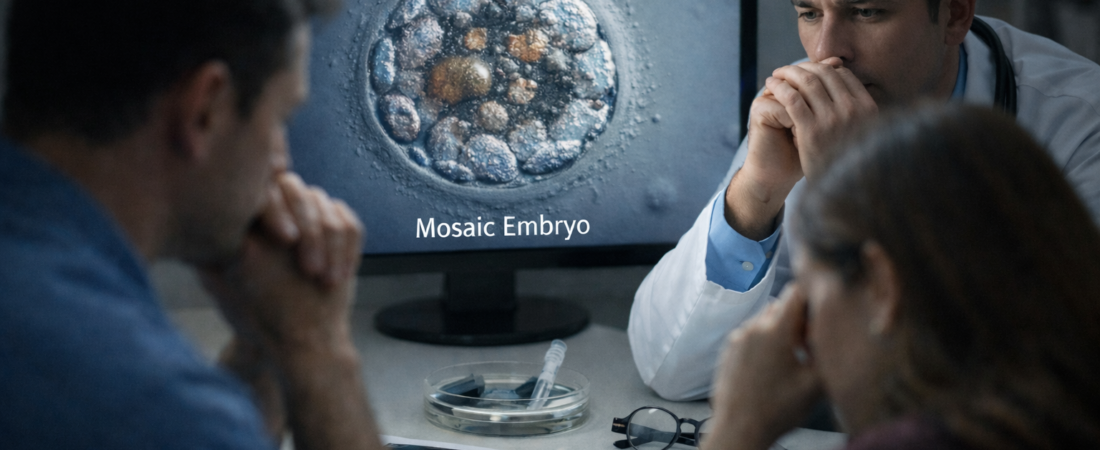
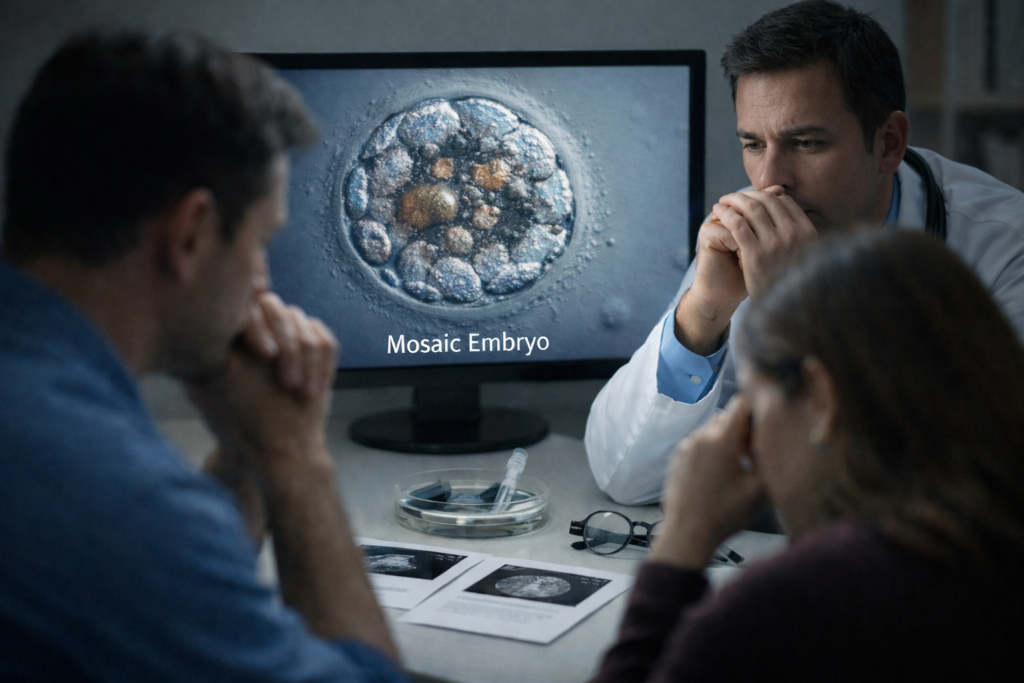
In front of a solitary embryo, the air inside the consultation room momentarily freezes. To classify it as premium feels highly hesitant, yet to discard it entirely feels like an absolute waste. Consequently, a mosaic embryo operates not as a subject for clear-cut medical judgment, but as a source of deep anxiety and contemplation.
This awkward middle ground—trapped between normal and abnormal parameters—holds the patient’s mind hostage for the longest duration.
The core challenge is far more uncomfortable than most realize. The issue with this specific embryo is not a simple binary question of whether it is inherently dangerous or perfectly safe. The true problem is that no one within the scientific community knows precisely how dangerous it actually is.
While they are lumped together under the singular umbrella term of “mosaicism,” these embryos encompass radically different biological profiles. Certain lines lean heavily toward a normal euploid progression, while others are severely compromised and destined for complete reproductive failure. Yet, the patient receives this highly complex cellular spectrum as a single, flat line on a laboratory report.
Contemporary clinical research fails to resolve this profound confusion; in fact, it frequently amplifies it. Certain longitudinal data sets suggest that mosaic embryos yield live birth rates that are remarkably comparable to those of certified euploid embryos.
Conversely, parallel studies demonstrate a statistically significant drop in initial implantation rates alongside a stark escalation in early miscarriages. Facing the exact same embryo classification, the verdicts of “perfectly viable” and “highly hazardous” co-exist simultaneously. This is not a mere difference of clinical opinion among specialists; it is a definitive signal that this biological territory remains unmapped and poorly defined.
A more fundamental limitation operates beneath the surface: the test result itself is inherently incomplete. The technology does not comprehensively evaluate the global architecture of the embryo; it analyzes strictly a minute subset of cells harvested from the exterior. Out of a mass exceeding one hundred cells, only a tiny handful are evaluated to project the fate of the whole. It is structurally equivalent to diagnosing the health of an entire forest by examining a couple of stray leaves.
Consequently, an embryo that is functionally normal can easily be misclassified as a mosaic, while a critical chromosomal defect can be completely missed. This protocol functions less as an absolute, precision test and far more as a highly sophisticated estimation.
Driven by these incomplete testing parameters, patients are forced to make an immediate, binary choice: Do you transfer or discard? Do you wait for another cycle, or do you take the risk now? This is a choice that raw data cannot make on your behalf.
Ultimately, a human being must bear the full weight of the decision. That is precisely why the process operates with a unique cruelty. If the choice results in a failure, the clinical consequence is permanently documented; even if it succeeds, absolute certainty is never truly achieved.
The practical progression of an IVF cycle is remarkably simple. If a certified euploid embryo is available, the dilemma immediately evaporates. This ambiguous, agonizing alternative only enters the conversation when no normal embryos remain. As maternal age advances, as the biological clock runs out, and as recurrent transfer failures compound, the pendulum inevitably swings toward taking the risk. The core diagnostic question shifts from “Should we wait for a better embryo?” to “Must we move forward with what we currently have?” At this exact junction, reproductive medicine ceases to be a calculus of ideal possibilities and becomes a strict discipline of timing.
Therefore, the conversation invariably stalls at the exact same question:
“Is it safe to transfer this embryo?”
A definitive biological answer to this question does not exist. Instead, only individual benchmarks remain: To what threshold are you willing to tolerate absolute uncertainty? To what degree can you emotionally accept the probability of a failed cycle? This transcends laboratory metrics; it is a fundamental choice of attitude and endurance.
A mosaic embryo is less an inherently dangerous cell and far more a deeply uncomfortable one. A clinician cannot definitively state that it is defective, nor can they responsibly assure the patient that everything will be safe. This lack of clarity is what makes the path so arduous. A calculated medical risk can be evaluated through statistics, but absolute uncertainty must be quietly endured by the individual alone.
Ultimately, while this journey initiates as a complex medical evaluation, it is fulfilled only through an act of profound human courage. And that human decision is never flawlessly perfect. For this reason, the exact same scene plays out repeatedly within fertility clinics worldwide: a couple and their physician standing before a single embryo, caught in a brief, heavy silence where no one speaks first. That short silence represents the exact boundary that modern reproductive science has yet to fully explain.
📚 Medical References
- Zore et al.
- “Clinical outcomes following transfer of mosaic embryos.”
- Journal of Assisted Reproduction and Genetics, 2023.
- Significance: A comprehensive tracking of live birth rates and longitudinal development patterns following the clinical transfer of verified mosaic blastocysts.
- Greco et al.
- “Healthy births after transfer of mosaic embryos.”
- New England Journal of Medicine, 2015.
- Significance: The landmark medical study that shook the reproductive field by documenting the successful birth of healthy children from embryos previously flagged as abnormal or mosaic.
Editor’s Note: This content is an analytical commentary prepared by a specialized fertility journalist through the collection and evaluation of domestic and international reproductive medicine research, clinical policies, and statistical data. All medical diagnoses and treatment decisions must exclusively be established through direct consultation with a qualified medical professional.
Image Source: AI-generated (ChatGPT, OpenAI) / Provided solely as a supplemental visual aid for conceptual understanding.