
Scar Tissue Left Behind by Prostatitis or Epididymitis Blocks the Sperm’s Path The Formula ‘Azoospermia = Infertility’ Has Been Broken
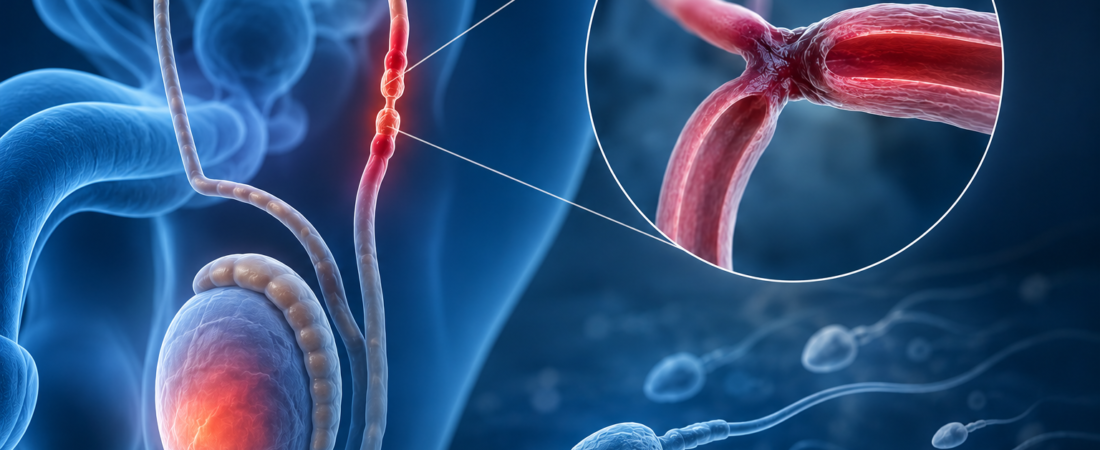
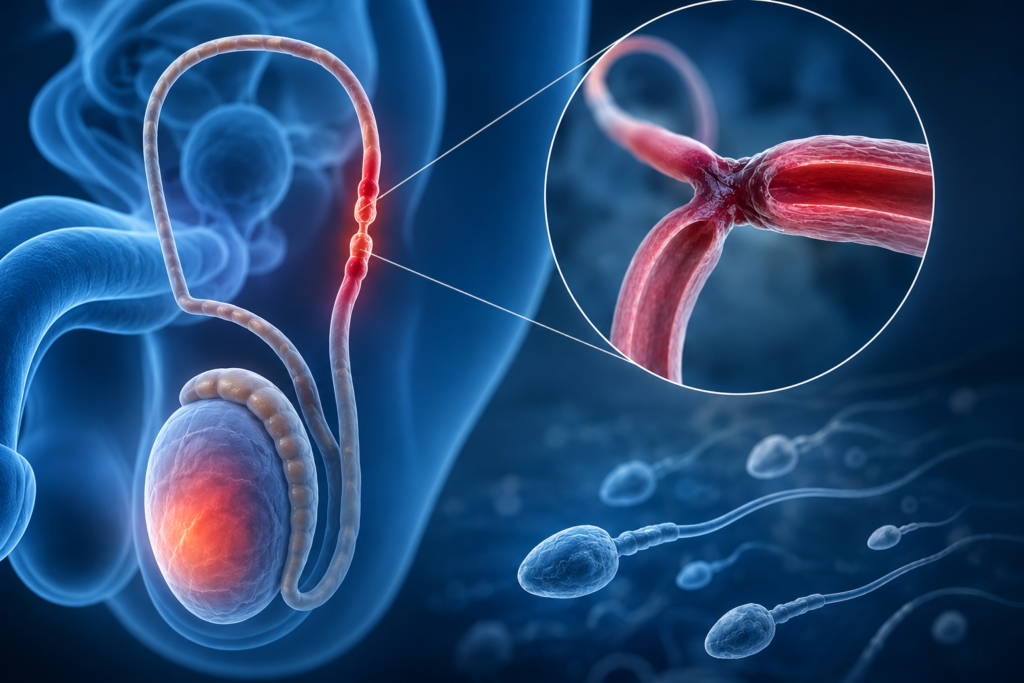
When people think of male infertility, most imagine low sperm count or poor motility. However, the urology community is recently paying attention to a completely different cause: obstructive azoospermia, a condition where sperm are produced normally in the testicles but cannot be ejaculated because the passage they travel through is blocked.
In the past, this was known primarily as a congenital condition (missing vas deferens) or a side effect of vasectomies. However, recent research is revealing that acquired inflammation and micro-scarring are significant causes of obstructive azoospermia. The paradigm of male infertility is shifting; azoospermia is no longer an untreatable condition. Depending on the cause, it can often be treated, and many men are now able to father children using their own sperm.
What is Obstructive Azoospermia?
Obstructive azoospermia occurs when there is no problem with testicular function, but one of the passages—the epididymis, vas deferens, or ejaculatory duct—is blocked. Most men feel no symptoms and have no issues with sexual function, so the condition is often discovered only after marriage when pregnancy fails to occur.
Approximately 40% of all azoospermia cases are known to be obstructive. Unlike non-obstructive azoospermia, it is considered a condition with a high possibility of pregnancy if treated appropriately.
The Culprit: Scar Tissue from Inflammation
The most notable cause identified by specialists is scar tissue left by inflammation. Even after an episode of epididymitis, prostatitis, urinary tract infection, or sexually transmitted infections (STIs) like chlamydia or gonorrhea is treated, micro-scars can remain in the internal tissue.
These scars slowly narrow the path for sperm over several years, eventually leading to a complete blockage. In essence, an inflammation once dismissed as minor can become the cause of infertility years later. In particular, chronic prostatitis is known to be associated with ejaculatory duct obstruction. While it sometimes presents with reduced semen volume or blood in the semen, it is not uncommon for it to be discovered only as azoospermia without any specific symptoms.
Surgery can also be a cause. If adhesions or damage occurred around the vas deferens after childhood surgeries—such as inguinal hernia repair, scrotal surgery, or pelvic surgery—it can lead to obstructive azoospermia over time. Many patients forget they even had surgery decades ago, only learning of the cause during fertility tests. Rarely, tubercular infections have also been reported to cause the condition by blocking the vas deferens or epididymis.
A New Era of Precision Medicine
In the past, a diagnosis of azoospermia was practically a sentence of infertility. However, advancements in medical technology are changing this perception.
Because sperm are produced normally in the testicles, specialists can perform vasovasostomy (reconnecting the vas deferens) or vasoepididymostomy (connecting the vas deferens to the epididymis) using a microscope to bypass the blockage. If reconstruction is difficult, sperm can be extracted directly from the epididymis or testicles and used for Intracytoplasmic Sperm Injection (ICSI). In fact, many patients are now achieving pregnancy using their own sperm.
Recent studies are also expanding the understanding of congenital causes. While CFTR gene mutations were traditionally known as the representative cause of congenital vas deferens absence, the discovery of the ADGRG2 gene as a significant causative factor is broadening the scope of genetic diagnosis. Consequently, there is a growing consensus that young azoospermic patients should undergo genetic and precision imaging tests in addition to basic semen analysis.
Expert Advice: Don’t Ignore Minor Symptoms
Specialists emphasize that men must also receive active testing while preparing for pregnancy. In Korea, infertility testing tends to focus on women, but male-factor infertility accounts for nearly half of all cases. Obstructive azoospermia, in particular, is a problem of the pathway rather than the production capability; therefore, early detection significantly widens treatment options.
The urology community advises that men planning for marriage or pregnancy should not dismiss repeated episodes of prostatitis or epididymitis lightly. It is crucial to undergo basic semen analysis and consult with a specialist.
The old common knowledge that “azoospermia equals infertility” has already been broken. Now, the key is not the result that there are no sperm, but accurately finding out why they aren’t coming out. Treatment for male infertility is entering an era of precision medicine—finding the blocked path and reopening it, rather than just focusing on sperm production technology.
※ This article was written based on the latest research published in international academic journals, overseas clinical guidelines, and medical reviews by domestic urology specialists. It does not replace a specific individual’s diagnosis or treatment, and actual medical judgment must be made through consultation with a specialist.
※ Images: Created using generative AI (ChatGPT, OpenAI); depicts fictional individuals, not real people.