
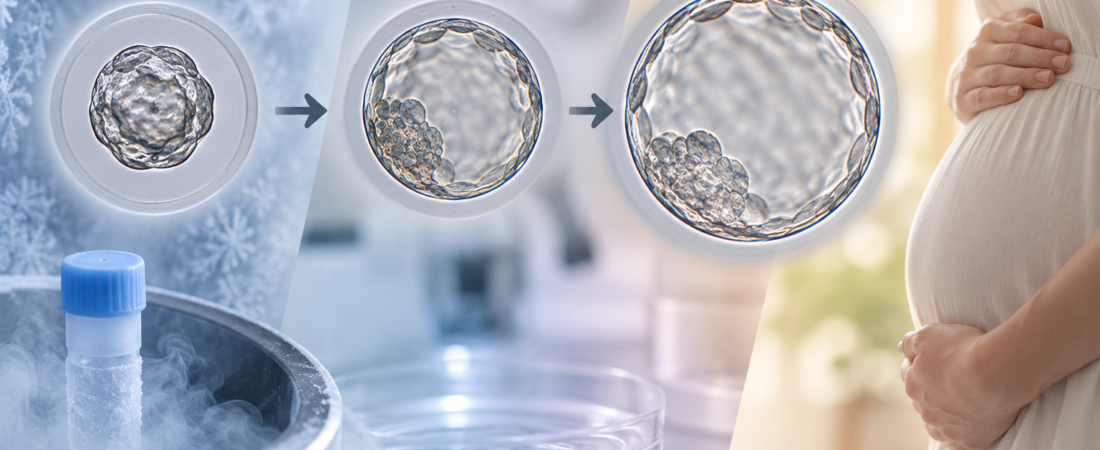
- Clinical pregnancy rate reached 28.5% in post-warming re-expanded blastocysts vs. 15.8% in collapsed blastocysts
- Pre-freezing morphological grade and maternal age significantly influenced reproductive outcomes
- “Lack of full re-expansion does not mean pregnancy is impossible”
“The embryo warmed well and is actively re-expanding.”
For fertility patients preparing for a frozen embryo transfer (FET), this is one of the most reassuring updates they can hear from the embryology lab.
Conversely, hearing that “the embryo hasn’t quite re-expanded yet” triggers immediate anxiety. Why do vitrified blastocysts collapse and shrink in the first place, and why do they swell back up? More importantly, does an embryo’s degree of re-expansion immediately prior to transfer correlate with the actual likelihood of pregnancy?
Recent research demonstrates that whether a vitrified blastocyst re-expands its blastocoele cavity by the time of transfer is significantly associated with clinical pregnancy rates. However, investigators emphasized that viable pregnancies still occurred from collapsed embryos, warning that re-expansion should never be treated as an absolute binary pass/fail criterion.
Why Embryos Shrink During Cryopreservation
By day 5 or 6 of in vitro culture, a developing blastocyst forms a large central fluid-filled cavity known as the blastocoele.
As the blastocyst matures, fluid pumps into this cavity, causing the embryo to expand like a balloon. Lining the outer rim are the trophectoderm cells (which will eventually form the placenta), while clustered to one side is the inner cell mass (ICM), which develops into the fetus.
However, an expanded blastocyst cannot be frozen in that fluid-loaded state without risking intracellular ice crystal formation. During modern vitrification, osmotic shifts rapidly draw water out of the cells as cryoprotectants enter, causing the blastocoele cavity to collapse and the embryo to temporarily shrink.
Consequently, an embryo looking deflated immediately post-thaw does not indicate cellular damage.
Once placed back into physiological culture medium, the warmed embryo begins a recovery process. As cellular metabolic pumps (notably $Na^+/K^+$-ATPase) reactivate, fluid re-accumulates within the blastocoele cavity, and the embryo regains its spherical architecture—a biological phenomenon termed re-expansion.
In simple terms, re-expansion represents the process by which a temporarily shrunken embryo takes up water again and restores its baseline volume.
Re-expanded Embryos: 28.5% Clinical Pregnancy vs. 15.8% in Collapsed Embryos
Researchers from McMaster University and ONE Fertility in Canada analyzed whether this re-expansion status at the moment of transfer correlates with clinical pregnancy outcomes.
The investigators reviewed clinical records of patients undergoing frozen embryo transfers between 2005 and 2012. Among 5,996 patients, 165 (approximately 2.8%) transferred a blastocyst that remained collapsed at the time of transfer.
The research team age-matched these 165 patients against 330 controls who received fully re-expanded blastocysts.
The clinical findings showed a clear divergence:
- Re-expanded Blastocyst Group: Clinical pregnancy rate reached 28.5%
- Collapsed Blastocyst Group: Clinical pregnancy rate was 15.8%
Statistical analysis confirmed that transferring a re-expanded blastocyst yielded significantly higher odds of clinical pregnancy compared to a collapsed embryo, with an odds ratio (OR) of 2.145. A statistically significant association was established between blastocoele re-expansion status and clinical pregnancy.
A Dynamic Biomarker Beyond Static Morphology
What makes this finding clinically compelling is that it adds a dynamic, functional parameter to traditional embryo evaluation.
Embryos are conventionally graded before vitrification based on static morphology—evaluating the degree of blastocyst expansion and assigning grades to the inner cell mass and trophectoderm. However, conventional grading represents a single snapshot frozen in time.
In contrast, post-thaw re-expansion reflects a functional recovery process, demonstrating how effectively an embryo overcomes the cellular stress of cryopreservation and warming.
Prior studies have repeatedly observed that blastocysts exhibiting rapid post-thaw re-expansion yield superior implantation and delivery rates. A 2025 study evaluating 742 single vitrified-warmed blastocyst transfers reported that embryos showing immediate post-thaw re-expansion achieved a clinical pregnancy rate of 69.83% and a live birth rate of 55.75%, compared to 54.82% and 45.43% in embryos that did not immediately re-expand.
Earlier time-lapse and morphokinetic investigations have similarly reported higher implantation rates in transfer cycles utilizing rapidly re-expanding embryos.
‘Failure to Re-expand’ Does Not Equal a Non-Viable Embryo
Crucial caveats must be kept in mind when interpreting these observations.
In the McMaster study, 15.8% of patients transferring collapsed blastocysts still achieved a clinical pregnancy. Viable, ongoing pregnancies regularly occur even when blastocysts appear shrunken at transfer.
The authors noted that “viable clinical pregnancies remain achievable even with collapsed blastocysts.” Particularly in cases where maternal age is young and pre-vitrification morphological grades were high, a lack of immediate re-expansion should not lead to the premature assumption that the transfer is doomed.
Furthermore, re-expansion was not the sole determinant of reproductive success. Multivariate modeling confirmed that pre-freeze embryo quality and maternal age remained independently and significantly correlated with clinical pregnancy rates.
Literature on this topic also contains varying predictive weights. Some past cohorts found that the post-warming expansion grade alone was not an independent predictor of sustained pregnancy once baseline embryo quality and euploidy were controlled for.
Re-expansion serves as an informative indicator of immediate physiological recovery, but it is not a rigid pass/fail verdict that supersedes chromosomal euploidy, pre-freeze grade, maternal age, or endometrial receptivity.
Surviving the Thaw Has Multiple Dimensions
For patients, the phrase “the embryo survived the thaw well” can sometimes be confusing.
When an embryology laboratory evaluates an embryo post-thaw, embryologists look beyond simple outer shape. They evaluate how many blastomeres survived intact, the percentage of degenerated cells, whether the trophectoderm membrane is reforming, and the pace at which the cavity is refilling with fluid.
Therefore, “survival” and “full re-expansion” are not synonymous.
An embryo can be completely intact and viable yet take longer to re-expand, with cavity swelling occurring later after uterine transfer. Conversely, an embryo that re-expands rapidly demonstrates swift metabolic resilience against cryopreservation stress.
The primary takeaway is that a vitrified embryo is not defined solely by the static morphological score stamped on it prior to freezing; the dynamic physiological recovery process observed after warming holds valuable biological clues regarding developmental competence.
Because this study was a retrospective observational analysis evaluating transfer cycles from 2005 to 2012, its findings reflect earlier vitrification protocols and culture environments. Significant technical advancements in cryopreservation media, laser-assisted artificial shrinkage, and closed vitrification systems have occurred since. As such, re-expansion status alone should never be used as a stand-alone justification to cancel a scheduled transfer or discount an embryo’s potential.
Medical Source & Study Reference
- Journal: Journal of Gynecology Obstetrics and Human Reproduction, Volume 55, Issue 7 (Published September 2026).
- Study Title: Blastocoele re-expansion at time of frozen embryo transfer affects clinical outcome following vitrification and warming
- Lead Institutions: McMaster University, Hamilton; ONE Fertility, Burlington, Ontario, Canada.
- Sample Size: 165 patients transferring collapsed blastocysts age-matched to 330 patients transferring re-expanded blastocysts (from a base cohort of 5,996 FET cycles, 2005–2012).
- Article ID: 103196 | DOI: 10.1016/j.jogoh.2026.103196 | PMID: 42035894
※ This article provides general scientific and medical information and does not replace individualized clinical diagnosis or care. Medical decisions regarding embryo viability and transfer candidacy must be determined by the attending reproductive endocrinologist and clinical embryology team by evaluating morphological grade, developmental stage, post-thaw survival, and the patient’s individual clinical profile.
※ The images associated with this article were generated using generative AI (ChatGPT, OpenAI) as illustrative visual references and do not depict real individuals.
※ Copyright © 2026 THE FERTILITY NOTES. All rights reserved. Unauthorized reproduction, duplication, distribution, scraping, AI training, or data utilization of all content, including articles, photos, and images, is strictly prohibited and may result in legal liability.