


Follicular Fluid Re-examined for 582 Patients Across 4️ IVF Centers—Additional Eggs Discovered in 316 Patients That Initial Tests Missed 583 Total Eggs Recovered, with Some Fertilized and Developed into Embryos; Resulted in a Baby Born from Additional Eggs New Possibilities for Diminished Reserve or Elderly Patients Where Every Single Egg Is Desperate… “Additional Validation Needed Before Becoming Standard Care”
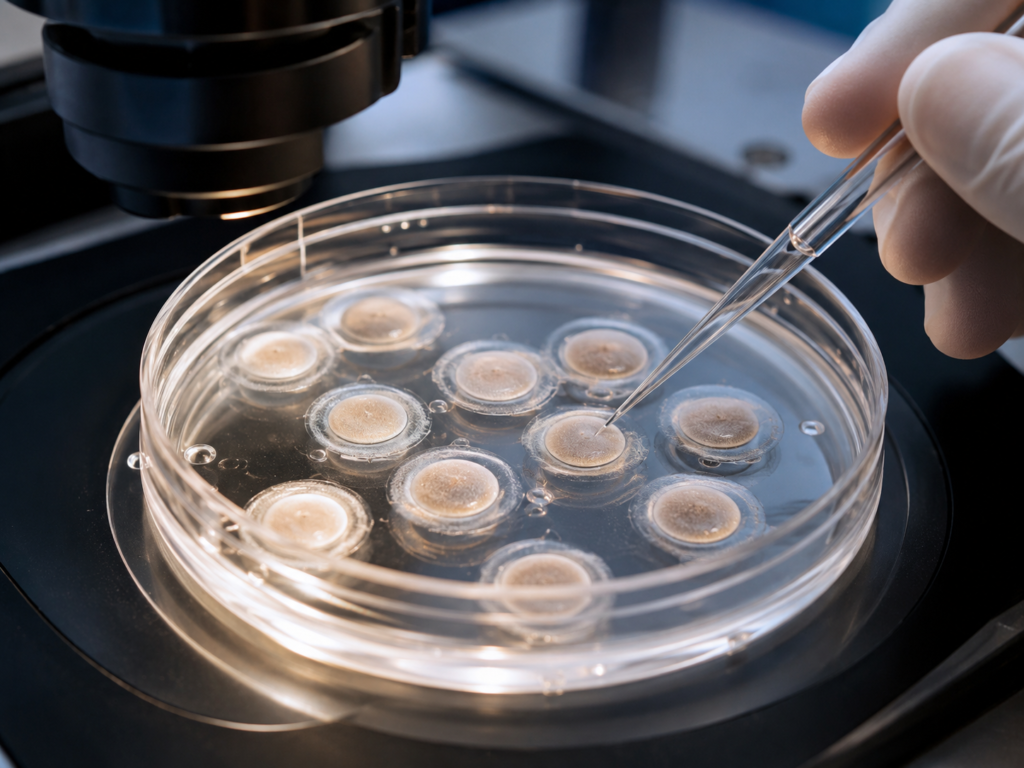
When egg retrieval concludes in In Vitro Fertilization (IVF), the follicular fluid aspirated by the fertility specialist is immediately transferred to the embryology lab. The embryologist searches through the follicular fluid under a microscope to locate the eggs. Once they determine that all eggs have been found, the remaining follicular fluid is no longer used for treatment. This has been the familiar routine of IVF for decades.
Yet, were all the eggs truly found?
Published this year in the international journal Nature Medicine, the FIND-Chip study challenges this self-evident premise. When researchers re-examined follicular fluid—already thoroughly checked once by skilled embryologists—using a microfluidic device, unrecovered eggs were additionally found in over half of the patients.
The FIND-Chip Study: Uncovering Hidden Eggs
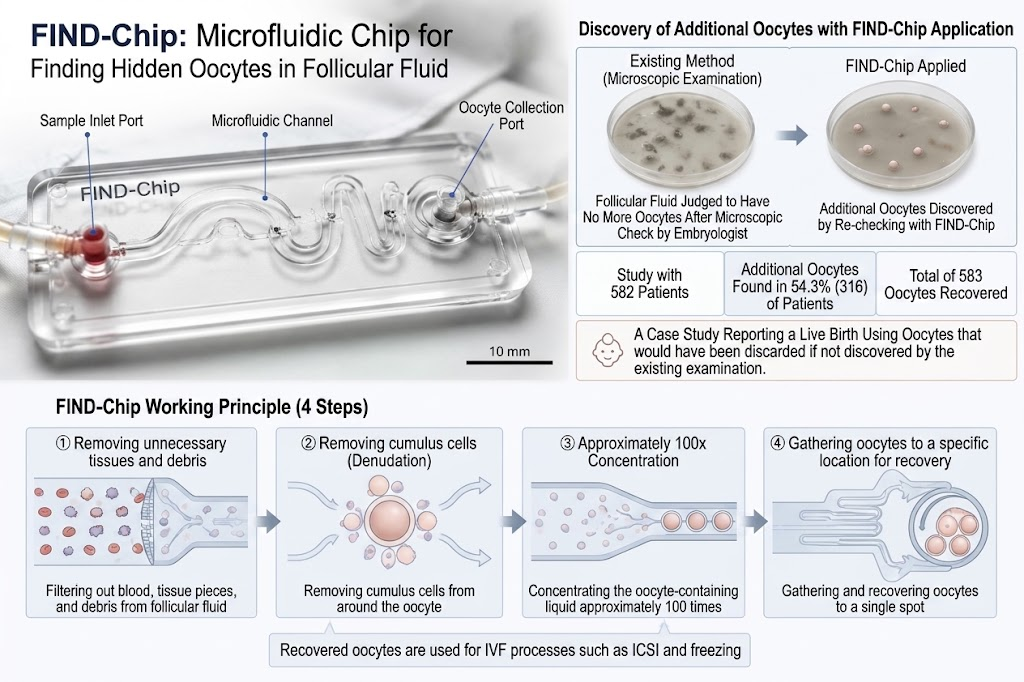
The research team tested the residual follicular fluid of 582 patients who underwent egg retrieval at four U.S. IVF centers using FIND-Chip. FIND-Chip is a microfluidic device that automatically detects eggs that humans might miss during the IVF egg retrieval process—essentially an ‘automated follicular fluid egg scanner.’ The device flows follicular fluid through its system, separating eggs from blood, cells, and tissue based on size and fluid dynamics differences, and concentrates the eggs in a single location.
The results surpassed expectations. Among all 582 patients, additional eggs—at least one or more—were found in 316 patients, or 54.3%, who had not been detected during initial standard checks. A total of 583 additional eggs were confirmed. Roughly one in two patients had eggs recovered from follicular fluid previously judged to have yielded “all of them.”
More importantly, the discovered eggs were not merely immature or damaged oocytes. 41.2% of the additional eggs were mature MII-stage oocytes suitable for fertilization. MI-stage eggs accounted for 9.1%, GV-stage immature eggs for 36.3%, and 13.4% were altered or damaged, rendering them unsuitable for ICSI.
In other words, while not every egg found by FIND-Chip could be utilized for treatment, a significant portion consisted of eggs capable of leading to actual fertilization and embryo generation.
From Discovery to a Healthy Birth
The researchers went a step further. For a subset of 19 patients, eggs were first retrieved via standard methods, and the remaining follicular fluid was subsequently re-tested using FIND-Chip.
Among the 19 patients, a total of 23 additional eggs were recovered from 11 individuals. Of these, 12 were confirmed as mature eggs and actually utilized in Intracytoplasmic Sperm Injection (ICSI). The fertilization rate of the eggs found via FIND-Chip was 66.7%, showing no significant difference from the 70.3% fertilization rate of eggs found through conventional methods.
The decisive moment came next.
For some patients, the eggs recovered through FIND-Chip successfully developed into embryos. One patient, in addition to 6 embryos secured via traditional methods, successfully obtained 3 extra frozen embryos from the eggs discovered by FIND-Chip. After the embryos obtained through conventional means were transferred first and resulted in a failed pregnancy, an embryo created from an egg found by FIND-Chip was transferred.
This time, pregnancy occurred. And a baby was born.
An egg that otherwise might have vanished alongside the discarded follicular fluid under traditional methods was fertilized, became an embryo, and ultimately culminated in the birth of a child.
Implications for Low-Responder and Older Patients
This study commands attention particularly because its impact resonates more profoundly with patients for whom a single egg is a matter of desperation, rather than those who yield high numbers.
Even within the patient cohort that secured only 0 to 5 eggs using conventional methods, additional eggs were discovered in 35% of cases. One patient had 3 eggs found during standard checks, but using FIND-Chip yielded 5 more. Among patients who retrieved 6 to 11 eggs, additional eggs were confirmed in 51.5%.
Finding one more egg when 20 have already been retrieved carries a different clinical weight compared to gaining one more when only 1 to 3 eggs emerge.
For patients with low ovarian reserve or advanced maternal age where securing eggs is intrinsically difficult, a single egg can represent a single chance at fertilization, and a single embryo a single chance at transfer. Depending on the scenario, it could represent the decisive factor determining whether another grueling retrieval cycle must be undertaken.
Why Do Skilled Embryologists Miss Eggs?
Why might skilled embryologists miss eggs?
Retrieved follicular fluid is far from a clear liquid. Blood, blood clots, follicular wall tissue, cells, and various debris are mixed together. The morphology of the cumulus cells surrounding the eggs also varies widely. Embryologists must scrutinize this follicular fluid manually to isolate the eggs.
FIND-Chip moves away from relying purely on human visual identification of egg morphology, automatically separating them using the physical differences between eggs and surrounding tissues. Even in hospitals where embryologists double-check follicular fluid for patients yielding fewer eggs, deploying FIND-Chip successfully uncovered additional eggs.
Limitations and Future Outlook
However, these results should not be immediately misinterpreted to mean that “vast quantities of eggs are being discarded in standard IVF procedures.”
In the 582-patient study, not all follicular fluid from every patient was analyzed in full, and clinical trials utilizing FIND-Chip-recovered eggs for actual treatment involved a mere 19 patients. Furthermore, the single case of a confirmed live birth from a FIND-Chip-derived egg is currently limited to this paper. Whether the additionally recovered eggs meaningfully elevate cumulative pregnancy or live birth rates must be verified through larger-scale clinical trials.
Conflicts of interest must also be noted. A significant portion of the paper’s authors hold shares in AutoIVF, the U.S. company that developed FIND-Chip, and some are company employees. Patents concerning the related technology have also been filed.
Even so, the question this study casts upon the IVF landscape is far from trivial.
Until now, the race in egg retrieval has primarily centered around the ovary. Which hyperstimulation medication to use, how high to increase the dosage, when to administer the trigger shot, and how many hours later to retrieve the eggs were paramount. The objective remained unchanged: to harvest even a single extra egg.
The FIND-Chip study shifts that inquiry inside the laboratory incubator:
“Before striving to manufacture more eggs in the ovary, are we truly failing to leave behind a single egg of those already retrieved?”
For infertile patients waiting anxiously for numbers on every retrieval day because only one or two eggs emerged, this is far from a minor question. Whether FIND-Chip will establish itself as standard equipment in IVF remains to be seen.
One reality, however, has solidified: the technology to track down and rescue every single acquired egg without discarding it—rather than solely focusing on technologies that stimulate more egg production—is emerging as a novel competitive frontier capable of transforming IVF success rates.
※ This article was synthesized based on the paper “Microfluidic Automation Technology for Enhancing Oocyte Recovery Rate from Follicular Fluid in In Vitro Fertilization Patients,” published in the international journal Nature Medicine in 2026. It does not replace a specific individual’s diagnosis or treatment, and actual medical judgment must be made through consultation with a specialist.
※ The images used in this article were generated using generative AI (ChatGPT, OpenAI) as visual references to aid understanding and do not depict real individuals.