
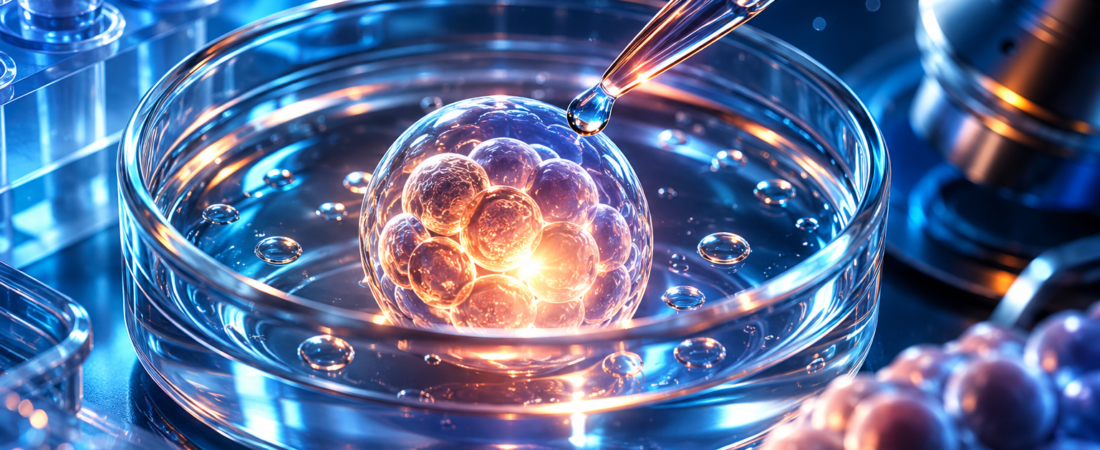
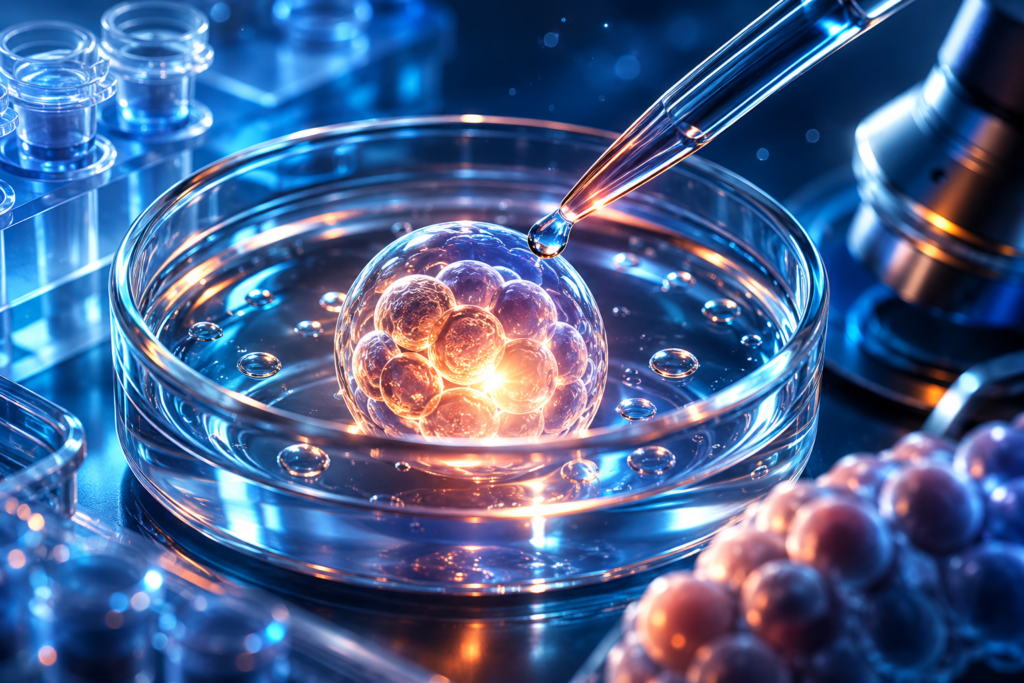
When we think of In Vitro Fertilization (IVF), our minds often go to the high-profile procedures: ovarian stimulation, egg retrieval, and embryo transfer. However, the true “battlefield” of modern fertility medicine lies in a place most patients never see: the embryology laboratory. At the heart of this laboratory is embryo culture media—the specialized fluid that serves as an artificial womb for the developing embryo.
The Media as an Artificial Womb In the human body, the fallopian tubes and the uterus provide a dynamic environment of nutrients, growth factors, and regulatory signals. In the IVF laboratory, the culture medium must replicate these complex functions. As recent reproductive research consistently demonstrates, the environment in which an embryo develops is just as critical to its viability as its genetic makeup.
The Rise of Chemically Defined Media The field is moving away from biological additives—such as serum or complex protein extracts—toward “chemically defined media.” By precisely controlling every ingredient—from glucose and amino acids to minerals, vitamins, and antioxidants—scientists are creating a more stable, predictable, and “clean” environment. Every micro-component is balanced to support the embryo’s intense metabolic demands as it undergoes rapid cell division.
Evolution of Embryonic Care: From Observation to Stability The paradigm of embryo culture has shifted from frequent monitoring to a “hands-off” philosophy. In the past, embryologists would frequently remove embryos from the incubator to monitor development and replace the media. Today, “single-step culture” is the gold standard. By keeping the embryo in a consistent environment from day one through the blastocyst stage (day five) without media changes, clinics minimize exposure to temperature fluctuations and oxygen stress.
As one embryology expert aptly summarized, “IVF is no longer about technology; it is about environmental design.”
The Global Competitive Landscape The market for culture media is currently witnessing significant investment from multinational pharmaceutical and biotech firms. The objective is clear: to mimic the maternal environment with unprecedented precision. The focus has moved beyond the simple goal of achieving fertilization to creating a “cradle” that optimizes the developmental trajectory of the embryo.
Conclusion: A New Era of Micro-Caring The trajectory of IVF innovation is shifting. We have reached a point where the competitive edge is no longer just about how many eggs can be retrieved, but how delicately we can care for the beginning of human life within a single drop of fluid. The future of reproductive medicine lies in this micro-scale refinement—ensuring that the artificial environment is as close to the natural maternal cradle as human ingenuity can achieve.
Sources: Guidelines from the Korean Society for Reproductive Medicine (KSRM), ESHRE, ASRM, and WHO IVF Laboratory Manuals; research from ‘Human Reproduction’, ‘Fertility and Sterility’, and ‘Reproductive BioMedicine Online’.
Disclaimer: This content is provided for informational purposes, based on clinical research and standards in reproductive medicine. Medical judgments and treatment decisions must always be made in consultation with professional medical personnel. Image: AI-generated (ChatGPT, OpenAI) / Visual reference for illustrative purposes only.