
A Good Embryo Alone Was Not Enough
For a long time, the criteria for success in In Vitro Fertilization (IVF) were clear: create healthier embryos and select the best one for uterine transfer.
As technologies observing embryos under microscopes, grading them with artificial intelligence (AI), and even analyzing chromosomes advanced remarkably, the competitive edge of IVF has focused heavily on the ’embryo.’
However, the global landscape of fertility research is rapidly shifting. Researchers are now looking inside the uterus before turning their attention to the embryo. At the center of this movement is the ‘uterine microbiome’ (microbial community), which has received almost no attention until recently.
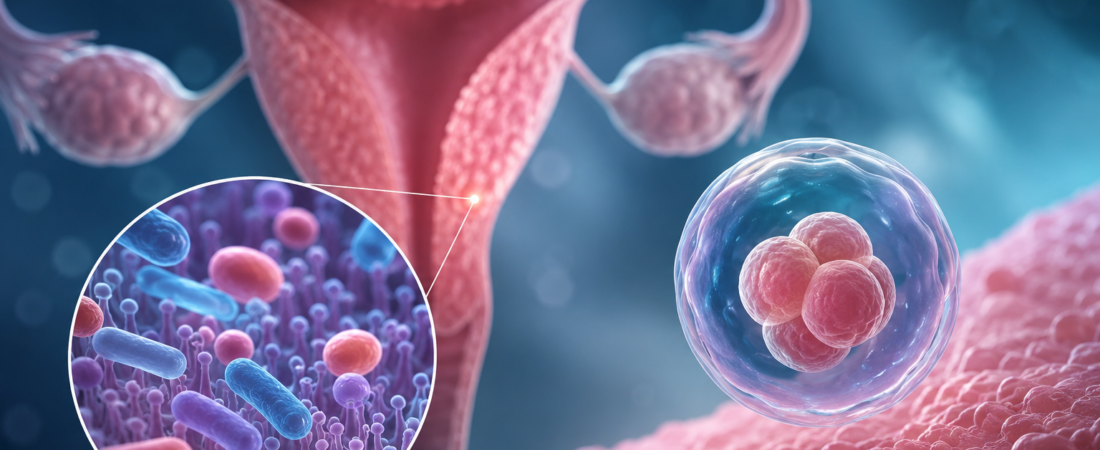
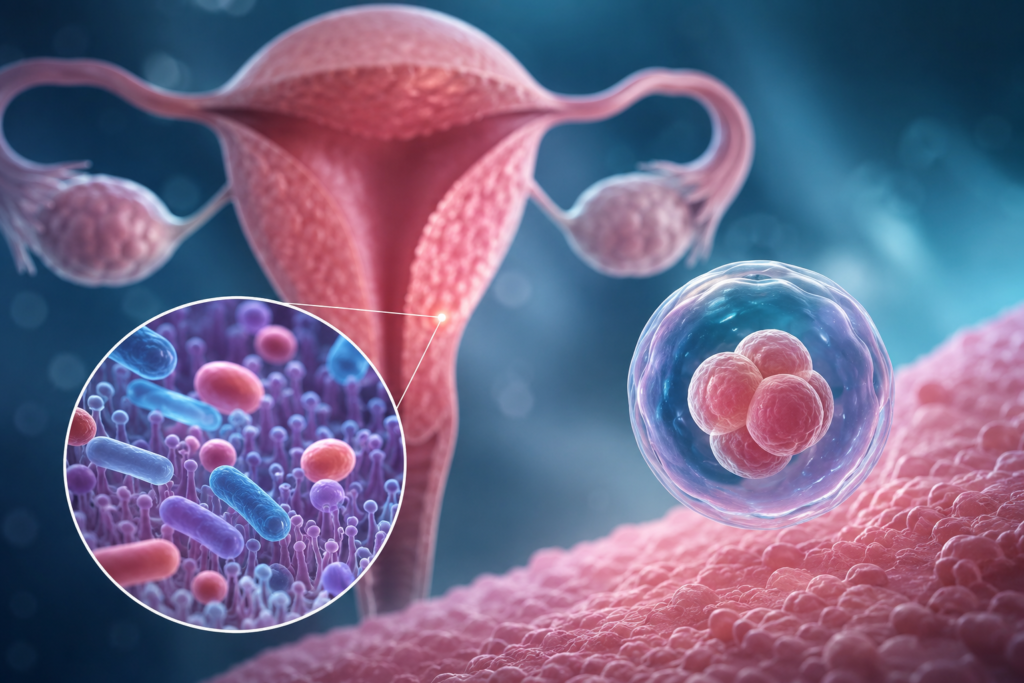
The uterine microbiome refers to the ecosystem of microorganisms inhabiting the interior of the uterus.
In the past, the uterine cavity was considered virtually sterile. However, with the advancement of next-generation sequencing (NGS) technology, it has been successively confirmed that various microbes reside inside the uterus, influencing the endometrium’s immune responses, inflammation, and implantation environment. In other words, no matter how superior the embryo is, pregnancy may not begin if the environment for it to land is not properly prepared.
This possibility was highlighted in a prominent study recently published by Irish researchers.
The research team analyzed the endometrial microbial composition of women undergoing IVF treatment and found that the microbial makeup differed distinctly between women who succeeded in getting pregnant and those who did not.
Notably, women who successfully achieved pregnancy tended to show a dominance of Lactobacillus, whereas an increase in various other bacteria was associated with implantation failure.
Unanticipated Insights into Endometrial Receptivity
An even more intriguing finding emerged.
Until now, higher gene expression confirming that the endometrium is ready to accept implantation was thought to yield higher success probabilities. However, this study revealed that these genetic signals were actually stronger in women who failed to achieve pregnancy.
The researchers suggested that specific microbes might distort the biological signals of the endometrium, preventing it from accurately reflecting actual implantation capacity. This implies that even existing evaluation criteria used to determine the timing of embryo transfer in IVF may need to be re-examined.
Similar studies are following one after another around the world.
Different microbial compositions have been observed in the endometrium of patients with recurrent implantation failure compared to women with normal pregnancies, and some studies have reported potential improvements in pregnancy rates after modifying the endometrial microbial environment.
This marks the beginning of a novel approach—moving beyond an era where the causes of infertility were sought solely in embryos, hormones, or uterine structures, and viewing the uterine ecosystem itself as a therapeutic target.
A New Paradigm for IVF
Because of this, experts predict that the paradigm of IVF will change significantly moving forward.
While ‘technologies to create better embryos’ have historically been the core competitive edge, ‘technologies to create a favorable uterine environment’ may emerge as another crucial pillar. In fact, some international fertility centers are already conducting research on personalized treatment possibilities by simultaneously performing endometrial microbiome testing and chronic endometritis screening.
Of course, considerable challenges remain. Uterine microbiome research is still in its early stages.
Sample sizes vary across studies, testing methodologies have not yet been standardized, and academic discussions are ongoing regarding which specific microbes constitute an ideal environment.
Unlike early findings suggesting that a higher presence of Lactobacillus is universally beneficial, results showing that microbial diversity can sometimes exert positive effects have also been reported. Consequently, experts agree that further large-scale clinical studies are required.
Conclusion
Nevertheless, one fact is becoming clear: IVF success can no longer be explained by the embryo alone.
If the embryo is a seed, the uterus is the soil in which that seed takes root. No matter how healthy a seed is, it struggles to sprout in parched earth. Conversely, fertile soil can nurture even a tiny seed into life.
For decades, IVF has advanced technologies to craft better embryos. Now, global fertility research is taking a step further to understand the uterus that shelters the embryo.
The fact that a tiny ecosystem created by invisible microorganisms can determine the inception of new life demonstrates that the future of IVF no longer rests solely within the embryo under a microscope.
The next innovation in fertility treatment may well begin with the smallest life forms inside the uterus.
※ This article was synthesized based on uterine microbiome research by Irish researchers and findings recently published in international reproductive medicine journals. It does not replace a specific individual’s diagnosis or treatment, and actual medical judgment must be made through consultation with a specialist.
※ Images: Created using generative AI (ChatGPT, OpenAI); depicts fictional individuals, not real people.