
“Warm your body, and you will conceive.” This age-old adage has persisted for generations, bridging the gap between traditional wisdom and the modern struggle of infertility. Even in the era of advanced In Vitro Fertilization (IVF), many couples find themselves torn between the high-tech precision of reproductive clinics and the holistic promises of herbal medicine.
The Biological Argument for Complementary Approaches In recent years, researchers have moved beyond vague claims of “warming the body,” attempting to analyze herbal remedies through the rigorous lens of modern biology. Studies are investigating whether certain compounds can influence mitochondrial function, mitigate oxidative stress, or modulate inflammatory responses. There is preliminary evidence, primarily in animal models and small-scale human trials, suggesting that some herbal combinations may positively correlate with improved oocyte quality or sperm parameters.
The Clinical Reality: “Supportive,” Not “Definitive” Despite these observations, the global reproductive medicine community remains cautious. The consensus in major academic journals—from the ASRM to ESHRE—is consistent: while some herbal approaches show “potential,” they are far from being recognized as standard, definitive care.
The fundamental hurdles are twofold:
- Standardization: Unlike pharmaceutical-grade drugs with precise, consistent dosages, natural herbal compounds vary based on harvest time, soil conditions, and drying processes. This makes it nearly impossible to predict the exact chemical composition or replicate results across different patient populations.
- Safety and Toxicity: The term “natural” is not synonymous with “safe.” History has documented cases of drug-induced liver injury, heavy metal contamination, and dangerous interactions with prescribed fertility medications. The perception of herbal medicine as “gentle” can lead patients to underestimate the physiological toll of unregulated compounds.
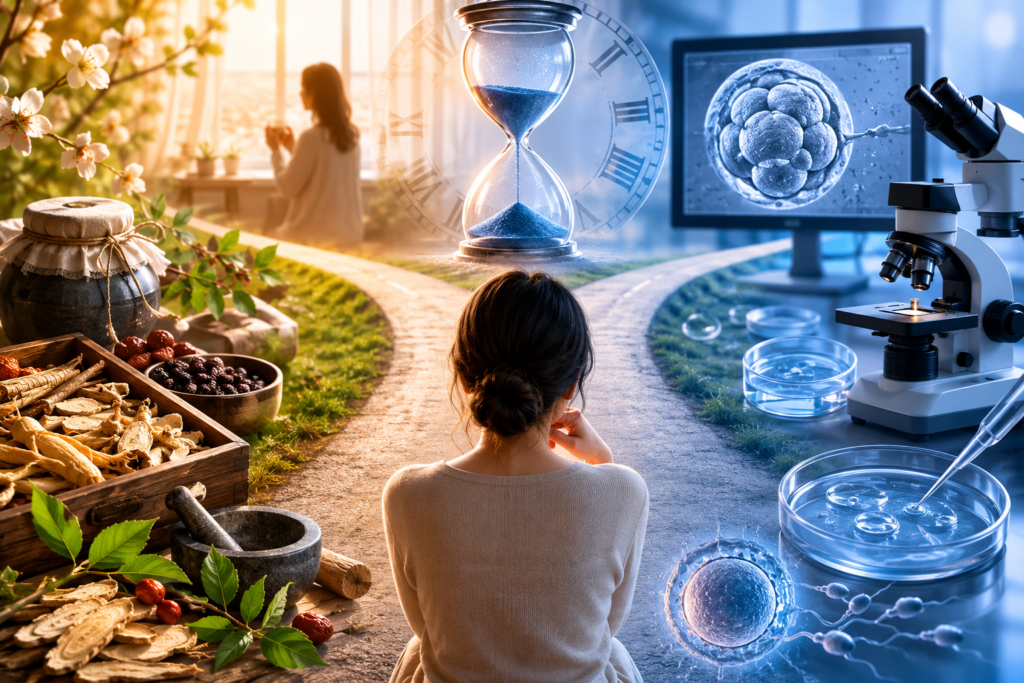
The Cost of Time The most profound risk in the infertility journey is not necessarily the treatment itself, but the loss of time. Female fertility is a finite resource governed by the biological clock. For patients with structural issues—such as blocked fallopian tubes, severe endometriosis, or male factor infertility—relying solely on holistic “balance” can be a strategic error. When these complex conditions are framed merely as “imbalances” to be fixed by tea or tinctures, patients risk missing the narrow window for effective IVF intervention.
The Power of Role Definition Infertility is an emotionally taxing journey, and the appeal of holistic medicine often stems from a deep human need for a sense of control and “natural” healing.
Some international clinics have begun to incorporate acupuncture, meditation, and stress-reduction techniques as “complementary care.” In this model, these therapies serve to mitigate the psychological burden—the anxiety and burnout—that accompanies IVF. When utilized as a support system, they offer value. When utilized as a substitute for standard medicine, they risk patient health.
Conclusion: Hope Must Be Anchored in Reality Hope is essential for any couple facing infertility, but it is most effective when anchored in reality. There is a place for complementary medicine as a supportive, auxiliary tool, provided it is managed under strict medical supervision and does not replace evidence-based care.
The biological clock of human reproduction is cold and unyielding; it does not wait for natural remedies to take effect. If you are exploring complementary approaches, be transparent with your reproductive endocrinologist. The best approach is not to choose between science and tradition, but to ensure that the pursuit of “balance” never comes at the expense of your best chance at success.
Sources: ASRM and ESHRE clinical guidelines; meta-analyses on complementary medicine in infertility; research on drug-induced liver injury (DILI).
Disclaimer: This content is provided for informational purposes. Medical judgments and treatment decisions—including the use of herbal medicine—must always be made in consultation with professional medical personnel.