
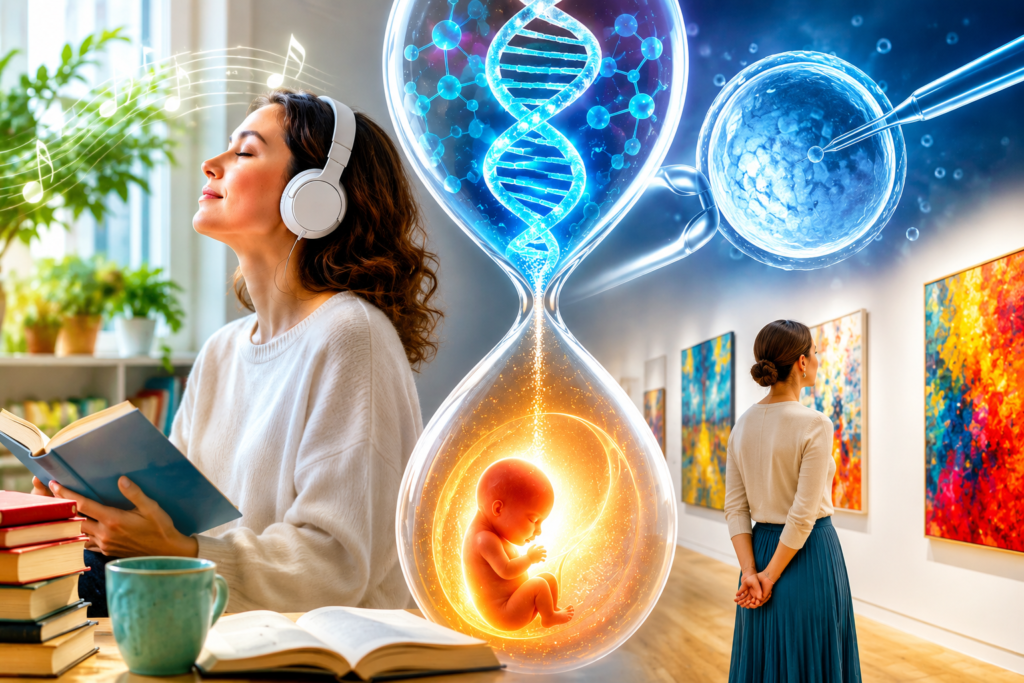
For couples navigating the rigorous journey of In Vitro Fertilization (IVF), life often shrinks to the dimensions of a “pregnancy project.” Days are governed by ovulation windows, injection schedules, and clinical appointments. In this process, the very habits that connect us to the world—reading a book, attending a concert, or visiting a gallery—are often the first sacrifices made. Yet, emerging research suggests that this “total focus” may be counterproductive.
The Epigenetic Link: Beyond “Feeling Good” A study from University College London (UCL), published in the journal Innovation in Aging, has provided a provocative insight: cultural engagement may be linked to slower biological aging. Analyzing DNA methylation patterns in 3,556 adults, the research found that individuals who engaged in cultural activities at least once a week exhibited a biological age roughly one year younger than their peers, with an aging rate slowed by up to 4%.
The significance lies in the mechanism: DNA methylation. These chemical “switches” on our genes dictate which segments remain active and which are suppressed. Chronic stress and persistent inflammation disrupt these patterns, accelerating the biological clock. Conversely, cultural engagement appears to act as a stabilizer.
Cultural Activity as a Biological Stabilizer How does art affect blood? Cultural engagement is increasingly linked to the stabilization of the HPA axis (the hypothalamus-pituitary-adrenal axis).
- Neurological Impact: Literature and music stimulate reward pathways, releasing dopamine and serotonin.
- Physiological Impact: Art and performance observation are correlated with reduced cortisol levels, stabilized heart rates, and a reduction in systemic inflammatory cytokines.
The New IVF Paradigm: Managing the “Soil” This research resonates deeply with recent shifts in reproductive medicine. IVF has historically functioned as a “selection technology”—obsessed with picking the best embryo. Today, reproductive specialists are shifting their gaze to the “biological landscape”—the maternal and paternal environments that harbor the embryo.
We now understand that chronic stress and inflammation can disturb the HPA and HPO (hypothalamus-pituitary-ovarian) axes, disrupting the rhythmic release of reproductive hormones like GnRH, LH, and FSH. For men, stress-induced oxidative stress is increasingly recognized as a driver of DNA fragmentation in sperm.
The Integrated Biological Network The human body is not a disjointed collection of organs; it is a unified biological network. When the mind is trapped in a state of chronic high-alert, the immune system and the vascular system follow suit.
- The Endometrial Ecology: The uterus is a complex biological ecosystem composed of immune cells, cytokines, and a microbiome. Chronic stress modulates these local environments, potentially creating an “implantation-hostile” climate.
- Epigenetic Stability: The quality of gametes is increasingly linked to epigenetic stability, which is highly sensitive to the individual’s overall inflammatory status.
A Holistic Definition of Infertility Care To be clear: reading a book or listening to music is not a medical cure for infertility. Infertility remains a complex clinical challenge requiring expert intervention. However, the evidence is becoming impossible to ignore: a person’s emotional state, social engagement, and life stimuli are not “peripheral” to their reproductive success. They are fundamental inputs into the epigenetic and physiological systems that dictate whether a pregnancy succeeds.
As reproductive medicine continues to evolve, we are moving away from the narrow view of clinical intervention and toward a broader, holistic perspective. A successful pregnancy is not just the result of a scientific collision of cells—it is a physiological event that requires the entire body to be in a state of balance and receptivity. In this context, cultural engagement is not a luxury; it is a strategic tool for biological maintenance.
Sources: University College London (UCL) research; Daisy Fancourt et al., “Arts and Cultural Engagement and Biological Aging” (Innovation in Aging); Recent studies in reproductive medicine on stress, microbiome, and inflammation.
Disclaimer: This content is provided for informational purposes, based on recent research in reproductive medicine and epigenetics. Medical judgments and treatment decisions must always be made in consultation with professional medical personnel. Image: AI-generated (ChatGPT, OpenAI) / Visual reference for illustrative purposes only.