
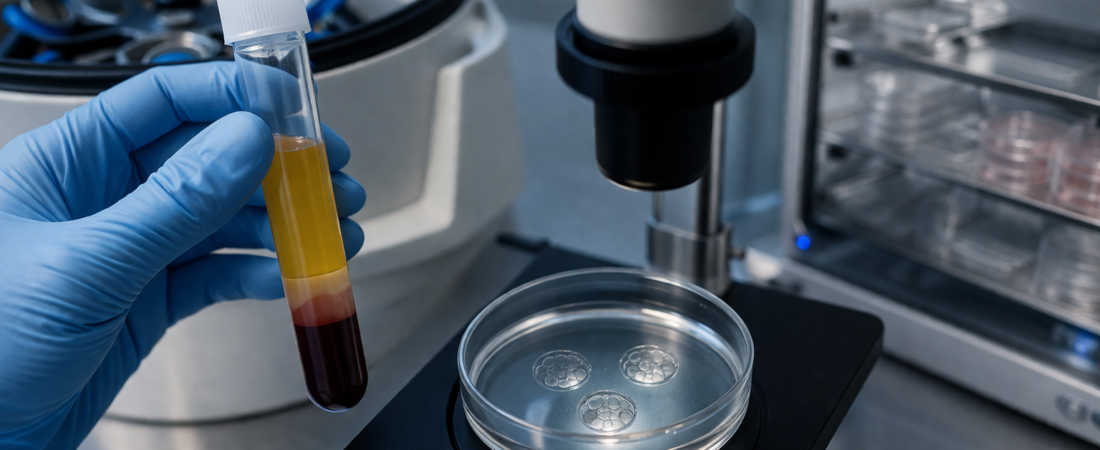
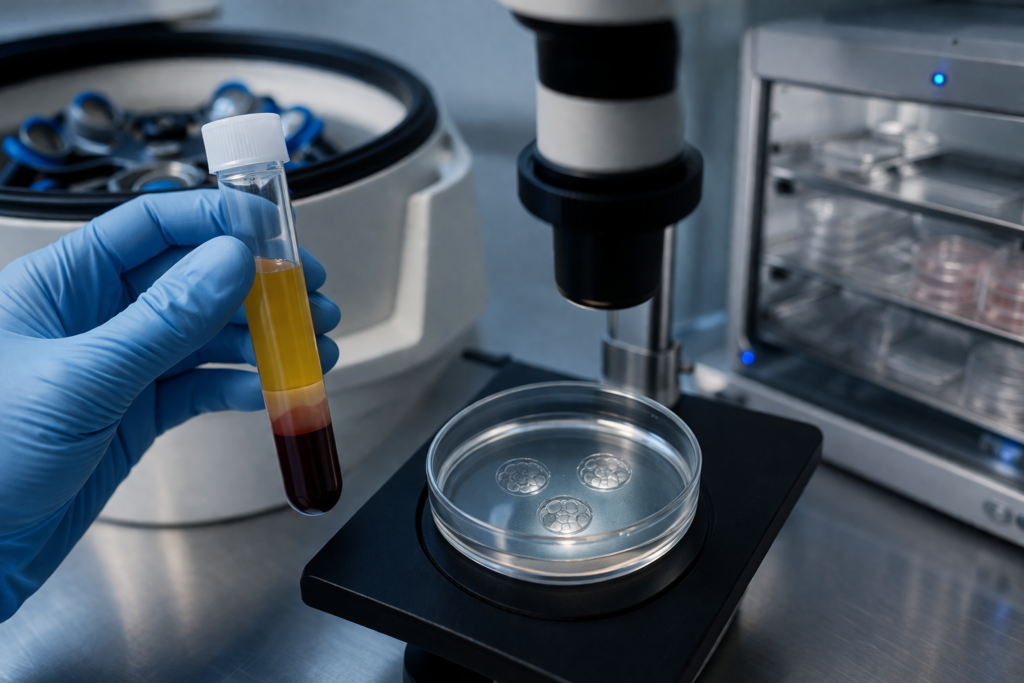
Recently, the fertility landscape has been buzzing with a new promise: “PRP-assisted embryo culture.” The narrative is compelling—by incorporating Platelet-Rich Plasma (PRP) derived from the patient’s own blood into the embryo culture medium, clinical centers claim to create a more “biocompatible” environment. Reports citing a 1.8-fold increase in pregnancy success rates for patients with repeated implantation failure (RIF) have fueled significant interest. However, to frame this as a “paradigm shift” is to prematurely celebrate what remains an unverified hypothesis.
The “Plausibility” Gap The logic behind PRP culture is simple: replace chemically standardized culture media with a cocktail of patient-derived growth factors and cytokines. It sounds intuitive. Yet, there is a vast canyon between “biologically plausible” and “clinically proven.” PRP is not a uniform product; its composition, concentration, and activity fluctuate wildly based on the donor’s health, collection methods, and processing protocols. Consequently, under the umbrella of “PRP culture,” patients are likely receiving widely different formulations, rendering the procedure more of an experimental concept than a standardized medical technology.
The Evidence Problem While a “1.8-fold increase” in success sounds miraculous, we must scrutinize the data. Most supporting studies are either small-scale observational trials or limited to narrow cohorts (such as patients with severe RIF). Extrapolating results from such a restricted group to the general IVF population is statistically and clinically flawed. In a field where even established technologies like PGT-A face ongoing debates regarding efficacy, labeling PRP culture as a “game-changer” is less about science and more about marketing.
The Outsourcing of Risk There is a fundamental ethical dilemma: the costs and risks of these procedures are borne by the patient, while the benefits remain largely speculative. In the absence of large-scale, randomized controlled trials (RCTs) or standardized protocols, the widespread promotion of this technology feels less like a technological advancement and more like the “outsourcing of risk” onto patients. If a procedure is not proven superior to standard care, the financial and emotional burden on patients raises serious questions.
A Call for Rigorous Verification It is not necessary to reject PRP culture entirely. It represents an interesting, potentially useful exploratory avenue in reproductive biology. However, potential must not be confused with proof. What is needed now is not “expanded adoption,” but “precise verification.”
We lack the necessary large-scale randomized controlled trials, standardized manufacturing protocols, and long-term follow-up data to justify the current speed of clinical integration. Speed, in this context, prioritizes market demand over clinical caution.
Ultimately, the question is not whether PRP culture can work, but whether we are currently consuming unverified hopes rather than objective solutions. Infertility is a field defined by the pursuit of hope. For that very reason, hope must be anchored in evidence. If PRP culture is to become a legitimate answer for patients, it must first survive a much more rigorous interrogation of its scientific foundations.
Sources: Marx RE, “Platelet-rich plasma: evidence to support its use” (2004); Chang Y et al., “Autologous platelet-rich plasma improves pregnancy outcomes in women with repeated implantation failure” (Reprod Sci, 2019); Eftekhar M et al., “Intrauterine infusion of platelet-rich plasma…” (2018); ESHRE Guideline: Recurrent implantation failure (2023).
Disclaimer: This content is provided for informational purposes, based on reporting on infertility and various public data. Medical judgments and treatment decisions must always be made in consultation with professional medical personnel. Image: AI-generated (ChatGPT, OpenAI) / Visual reference for illustrative purposes only.