

In 15 semen samples, marker-positive sperm measured 16.0% after density-gradient centrifugation, 11.8% after ZyMōt and 10.0% after Felix.
These laboratory results do not establish better pregnancy or live birth rates.
Sperm selection before IVF or ICSI may influence the proportion of sperm showing a DNA-damage-associated marker. A small study found lower marker positivity after ZyMōt or Felix selection than after conventional density-gradient centrifugation.
Good motility and normal appearance do not guarantee intact genetic material: DNA damage can exist even when count, movement and morphology fall within reference ranges.
A Japanese study published in JBRA Assisted Reproduction on October 2, 2026, compared these three preparation methods to investigate that distinction.
Different selection methods, different principles
Fertility laboratories prepare semen to select sperm suitable for fertilization rather than using the original sample unchanged.
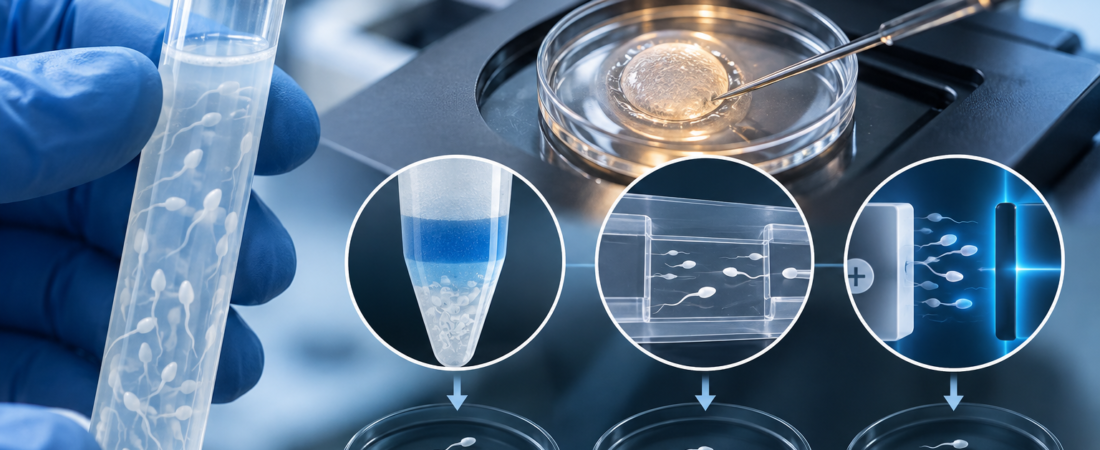
Density-gradient centrifugation, or DGC, spins semen through solutions of different densities. It can recover relatively large numbers of sperm, although potential oxidative stress during centrifugation has raised questions about genetic integrity.
Oxidative stress involves reactive oxygen species and related processes that can damage cellular function or DNA.
Newer methods aim to avoid centrifugation.
ZyMōt separates sperm that move through small channels, using their movement to select a suitable population.
Felix uses an electrophoretic approach. Both operate differently from conventional centrifugation.
Marker positivity ranged from 16.0% to 10.0%
The researchers compared the methods in 15 fresh semen samples collected between January and June 2025.
They assessed gamma-H2AX, or γH2AX, a protein marker of the cellular response associated with DNA double-strand damage.
At least 200 sperm from each sample were examined for marker positivity.
After DGC, 16.0% of sperm were marker-positive.
The proportion was 11.8% with ZyMōt and 10.0% with Felix.
These were 4.2 and 6.0 percentage points lower than DGC, respectively. Both differences were statistically significant.
The percentages refer to a DNA-damage-associated protein signal, not direct counts of DNA breaks. They do not mean either method repairs damaged DNA or reduces DNA damage itself by those exact amounts.
Recovery, motility and processing time favored different methods
A lower DNA-damage marker did not make one method best on every measure.
The researchers also compared recovery, motility and preparation time.
DGC had the highest recovery, meaning that it retained more sperm potentially available for fertilization.
ZyMōt produced the best total motility, while Felix had the shortest processing time.
The most suitable approach may therefore depend on the sample and the purpose of treatment.
When sperm counts are very low, recovering enough sperm can matter alongside marker results.
The experiment does not establish one technique as the best option for every patient.
Does a lower marker mean more pregnancies?
Sperm DNA damage is an important research area because routine semen analysis cannot fully assess genetic integrity.
Potential effects on embryo development and pregnancy have prompted investigation of both testing and selection methods.
A critical distinction is necessary here.
The study measured differences in marker positivity after selection, not pregnancy or birth outcomes.
Only 15 samples were examined. Embryo development, implantation, pregnancy, miscarriage and live birth were not evaluated.
It also cannot establish whether centrifugation directly increased damage or whether the methods selected different proportions of sperm that already had lower damage signaling.
Clinical comparisons are needed to determine whether ZyMōt or Felix produces better pregnancy outcomes.
Looking beyond movement without assuming an add-on is necessary
The research supports considering genetic integrity alongside movement when evaluating sperm preparation.
Selection is particularly relevant to ICSI, in which a single sperm is injected into an egg.
Concern about DNA damage does not mean every couple needs a newer selection method. Count, motility, the infertility diagnosis and previous outcomes remain relevant.
Evidence is still insufficient to assume that a particular technique improves pregnancy or birth for couples with repeated fertilization or embryo-development problems.
The contribution of this study is narrower: newer methods may enrich for sperm with lower DNA-damage-associated signaling compared with DGC.
Larger clinical studies need to compare fertilization, embryo development, pregnancy and live birth.
Sperm selection research is expanding from recovering more sperm or more active sperm to assessing the genetic condition of the cells used for fertilization.
Study source
Japanese researchers compared DNA double-strand-damage-associated measures after DGC, ZyMōt and Felix sperm selection in JBRA Assisted Reproduction on October 2, 2026. DOI: 10.5935/1518-0557.20260078.
The illustration was generated using ChatGPT (OpenAI). Any people depicted are fictional.
Related reading
High sperm DNA fragmentation: what laboratory sperm preparation can change
Copyright © 2026 THE FERTILITY NOTES. All rights reserved. Unauthorized reproduction, copying, redistribution, scraping, AI training, or data use of any content, including articles, photographs, and images, is strictly prohibited. Violations may result in legal liability.