
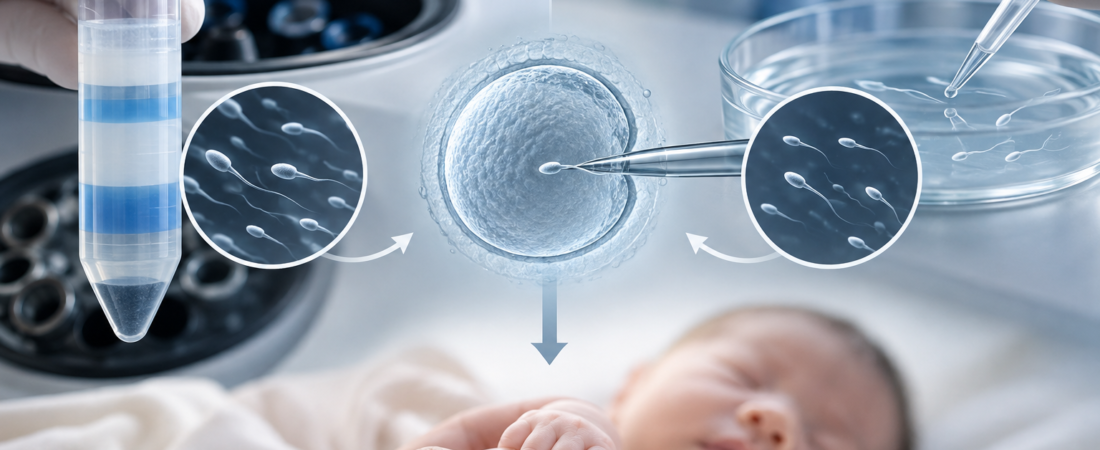
For couples facing high sperm DNA fragmentation, selecting better sperm seems an obvious priority. But does density gradient centrifugation (DGC) or swim-up actually lead to more babies? A study of 1,769 couples with a sperm DNA fragmentation index (DFI) of at least 20% found no significant cumulative live birth difference between the methods after matching 279 cycles in each group.
Some men have reassuring sperm count and motility results yet receive a high DFI result. It is natural to ask whether a particular sperm-selection technique could improve IVF success when more sperm carry DNA damage.
DGC and swim-up are both widely used. The study published online in Andrology on September 21, 2026, compared their effects on pregnancy and birth rather than assuming that a better laboratory number guarantees a better clinical outcome.
A study of 1,769 couples with DFI of at least 20%
DFI reflects the extent of sperm DNA fragmentation. Standard semen analysis focuses mainly on count, motility and morphology, whereas this test examines the condition of genetic material within sperm.
Interest has grown as studies have linked elevated DFI to male infertility and poorer outcomes in some assisted-reproduction settings.
The researchers examined 1,769 couples undergoing their first IVF or ICSI cycle using their own eggs and sperm, with the man's DFI at least 20%. The central comparison was how sperm were prepared for fertilization.
DGC separates sperm through solutions of different densities using centrifugation, selecting a relatively motile, favorable population. Swim-up instead uses the ability of motile sperm to swim upward into culture medium.
To reduce baseline differences, the researchers used propensity score matching. The final comparison included 279 DGC cycles and 279 swim-up cycles.
No significant difference in cumulative live birth
The study did not merely compare DFI before and after sperm preparation. Its main outcome was cumulative live birth: whether embryos from one egg retrieval led to a baby through fresh transfer and subsequent frozen transfers. This is closer to the outcome patients ultimately want to know.
Cumulative live birth did not differ significantly between DGC and swim-up. The adjusted odds ratio was 1.06, with a 95% confidence interval of 0.76–1.49.
Live birth per embryo transfer also showed no significant difference: adjusted odds ratio 1.16, 95% confidence interval 0.89–1.52.
Fertilization, good-quality embryo rate, good-quality blastocyst rate and blastocyst formation likewise showed no statistically clear differences. The overall pattern was similar when results were grouped by abstinence duration—under three days, three to five days, or more than five days—or by normal versus abnormal baseline semen findings.
High DFI does not automatically identify a winning method
The results do not prove that the techniques are identical. More precisely, this evidence did not show that either DGC or swim-up improved live birth over the other in men with high DFI.
This was a retrospective study at one institution, not a randomized trial. Matching reduced measured differences but could not control every variable. The swim-up group had longer abstinence and more conventional IVF, whereas ICSI was more common in the DGC group.
The investigators also noted the wide confidence intervals and limited precision, and called for adequately powered prospective research.
The goal is a baby, not just a better DFI number
The study invites a reconsideration of how sperm-selection methods are judged. A fall in DFI after preparation can be informative, but an improved test result does not necessarily mean better fertilization, embryo development and eventual live birth.
The question for couples is therefore not only which technique lowers DFI more, but whether that technique increases the chance of having a baby. Here, the difference in final cumulative live birth was not established.
The comparison concerned two conventional techniques. It did not establish the relative merits of other approaches, such as microfluidic sperm selection.
Rather than assuming that high DFI demands one particular method, treatment decisions need to consider sperm count, motility, morphology and DNA damage alongside whether conventional IVF or ICSI is planned and the other treatment conditions.
The value of selecting apparently better sperm ultimately lies in whether fertilization and embryo development lead to birth. On that outcome, this study did not identify a superior method between DGC and swim-up in the population studied.
Study source
This article is based on “Density Gradient Centrifugation Versus Swim-Up for Cumulative Live Birth in IVF/ICSI Cycles With High Sperm DNA Fragmentation: A Propensity Score Matching Analysis,” by Ziyu Luo, Xiangfeng Bai, Sufang Gui and colleagues at the First Affiliated Hospital of Kunming Medical University, China. It was published online in Andrology on September 21, 2026. PMID: 42765472. DOI: 10.1111/andr.70377.
Related reading
The illustration was created with generative AI (ChatGPT, OpenAI). Any people depicted are fictional.
Copyright © 2026 THE FERTILITY NOTES. All rights reserved. Unauthorized reproduction, copying, redistribution, scraping, AI training, or data use of any content, including articles, photographs, and images, is strictly prohibited. Violations may result in legal liability.