
Together rather than alone: the remarkable sperm survival strategy shaped by 500 million years of evolution.
Is the age of the “fastest sperm” over? Looking for the secrets of reproduction in cooperation rather than competition.
For a long time, fertilization has been explained through a single story: hundreds of millions of sperm race toward an egg, and only the fastest and strongest becomes the one that starts a new life. It is a race for speed. Yet the history of life has proved far more complex.
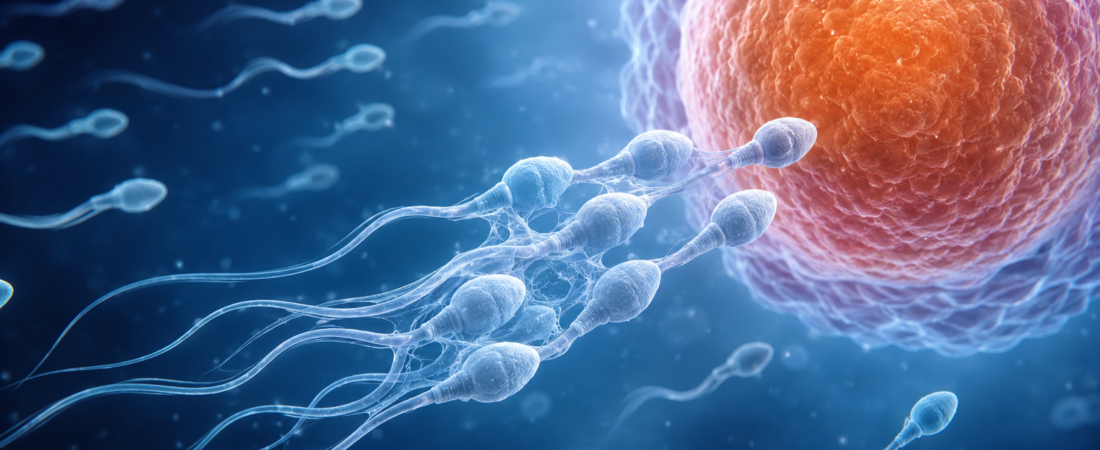
In some animals, sperm have adopted a strategy of joining forces and moving together rather than competing against one another. This cooperation has emerged repeatedly across nearly 500 million years of evolution.
A study recently published in the international journal Nature Communications invites us to reconsider conventional views of fertilization.
After analyzing 621 species of arthropods and closely related animals, the researchers found that “sperm conjugation”—the formation of groups by multiple sperm—is not simply an unusual occurrence that arose by chance in particular animals. It is a strategy that has independently emerged and disappeared dozens of times during evolution.
The joint research team, from Syracuse University in the United States, the University of Siena in Italy, and the University of Szeged in Hungary, traced changes in reproductive strategies by comparing sperm structures and evolutionary family trees across diverse animals, including insects, spiders, crustaceans, and centipedes.
The findings were unexpected. After first appearing approximately 450 million to 500 million years ago, sperm conjugation was lost around 45 times and independently reappeared around 45 times during subsequent evolution. In other words, evolution repeatedly arrived at the same solution in different lineages.
Why did this happen?
The researchers explain that forming groups may help sperm travel more efficiently through the complex environment of the female reproductive tract. The benefit may extend beyond speed: groups may maintain direction or transport particular substances together, performing tasks that would be difficult for individual sperm.
In some animals, multiple sperm do travel while connected in a bundle. A specialized structure known as sperm-associated material (SAM) plays an important role in this process.
The researchers suggest that this material may originally have evolved to protect sperm and later taken on an additional role in binding multiple sperm together.
Interestingly, there were also numerous cases in which SAM appeared before sperm conjugation. This may be a classic example of an evolutionary structure arising and, over time, being put to an entirely different use.
The study also challenges longstanding assumptions about reproduction.
Fertilization has often been described as a competition in which the best sperm survives. In nature, however, competition and cooperation can operate at the same time, and collective behavior itself may be an important factor in improving reproductive success.
“Sperm are among the fastest-evolving cells in living organisms,” the researchers explained. “Diverse strategies have continually been selected to survive in the highly complex environment of the female reproductive tract.”
Of course, this study does not directly explain human fertilization, nor does it mean that human sperm cooperate in the same way. The researchers nevertheless believe that a more accurate understanding of fertilization will require examining not only sperm motility but also interactions between sperm and their surrounding biological environment.
The findings also suggest new possibilities beyond reproductive research, including in agriculture.
The researchers are interested in the spotted lanternfly, an invasive pest that causes substantial agricultural damage in the United States. Its sperm do not connect to one another, but they are surrounded by a thick layer of SAM.
If this material plays an essential role in reproduction, selectively disrupting it could potentially lead to a new, environmentally friendly method of pest control. This remains a hypothesis, however, and requires further testing.
Life has not always been driven by competition alone. Across hundreds of millions of years, evolution has sometimes favored the groups that cooperate best rather than the fastest individuals. This study shows that even at the minute starting point of a new life—fertilization—a strategy of surviving together has been an important force in evolution.
This article was written to help general readers understand the subject, drawing on clinical experience in obstetrics, gynecology, and reproductive medicine, together with recent research. It is not a substitute for individual diagnosis or treatment. Medical decisions should be made in consultation with a qualified specialist.
Image: AI-generated using ChatGPT, OpenAI. Provided as an illustrative visual aid to support understanding.
Copyright © 2026 Fertility News | THE FERTILITY NOTES. All rights reserved. Unauthorized republication, reproduction, redistribution, scraping, AI training, and data use of any content, including articles, photographs, and images, are strictly prohibited. Violations may result in legal liability.