
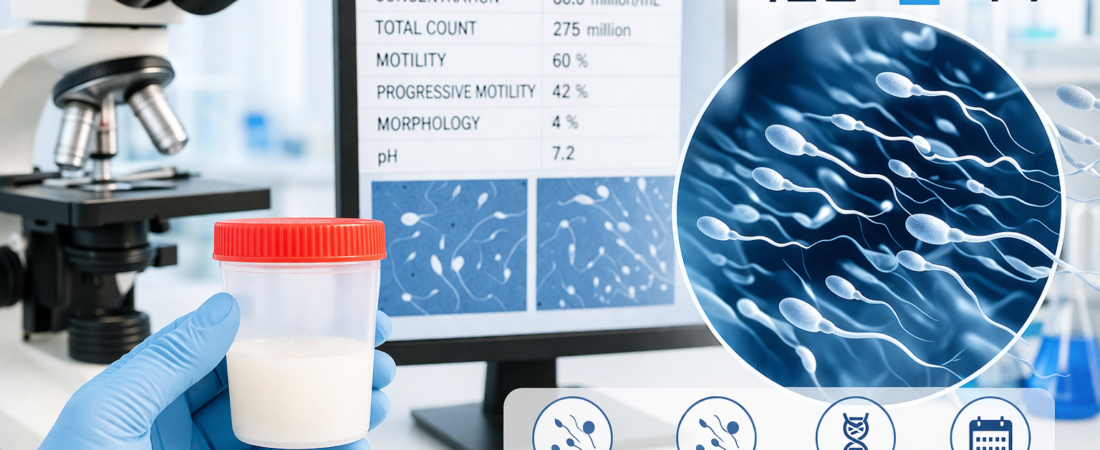
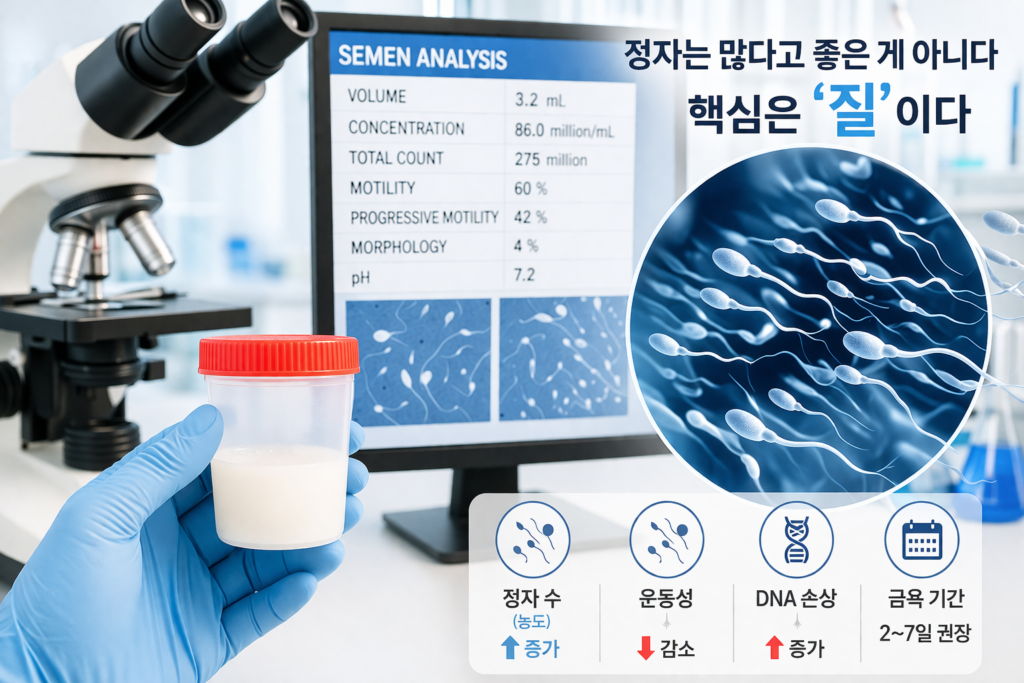
The belief that “abstaining from ejaculation leads to more sperm” is true. However, the assumption that this equates to better fertility is one of the most persistent misconceptions in reproductive health. Sperm are not merely “inanimate objects” that accumulate in a container; they are dynamic, biological cells that undergo functional degradation over time. While their quantity may increase with abstinence, their quality is never guaranteed.
The Biology of Aging Sperm Sperm are continuously produced in the testes and undergo a maturation process of approximately 70–80 days before being stored in the epididymis. The storage phase is where the risk arises. As storage time increases, sperm are exposed to oxidative stress, leading to accumulated DNA damage and a decline in motility. In simple terms, prolonged storage produces a higher number of sperm, but with a diminished capacity to perform.
The Gap Between “Test Standards” and “Pregnancy Reality” The World Health Organization (WHO) recommends an abstinence period of 2 to 7 days for diagnostic semen analysis, primarily because this window tends to maximize sperm concentration. However, this is a “testing standard,” not an “optimal fertility strategy.” In clinical practice, the two diverge significantly.
Data consistently confirms that as the abstinence period lengthens, while the sperm count increases, motility declines and the rate of DNA fragmentation rises. Beyond 7 days of abstinence, the trend becomes stark: the ejaculate becomes crowded with “slow and damaged” sperm. In this context, the numerical count and functional performance become decoupled.
The IVF Paradigm: Quality Over Volume In the context of Assisted Reproductive Technology (ART) and IVF, the priority is not volume, but the acquisition of healthy sperm capable of achieving successful fertilization. Health is defined primarily by motility and genetic stability. Emerging research suggests that sperm collected at intervals of 2 to 3 days often exhibit lower rates of DNA damage and are associated with superior pregnancy outcomes compared to those collected after prolonged abstinence.
The persistence of the “abstinence myth” stems from the obsession with diagnostic numbers. Longer abstinence produces an impressive concentration on a lab report, but pregnancy is not a numerical competition; it is a functional one. A sperm that cannot reach or fertilize the egg is functionally nonexistent, regardless of how high the count on a semen analysis report may be.
Lifestyle: The Real Driver The impact of prolonged abstinence is exacerbated by individual health factors. In men who suffer from advanced age, obesity, smoking, sleep deprivation, or chronic stress, oxidative damage and DNA fragmentation occur at an accelerated rate. For these individuals, prolonged abstinence results in the continued accumulation of damaged sperm.
Sperm is not a “static storage asset”—it is a “rotating asset.” It is far more advantageous to maintain a cycle of continuous production than to rely on stale accumulation. For couples planning a pregnancy, there is no clinical benefit to prolonged abstinence. A 2- to 3-day interval is the most realistic and clinically sound choice.
Ultimately, the statement “abstaining produces more” is only half true. And it misses the most critical half: “More does not mean better.”
Sources: World Health Organization (WHO), “Laboratory Manual for the Examination and Processing of Human Semen,” 6th Edition (2021).
Disclaimer: This content is provided for informational purposes, based on reporting on infertility and various public data. Medical judgments and treatment decisions must always be made in consultation with professional medical personnel. Image: AI-generated (ChatGPT, OpenAI) / Visual reference for illustrative purposes only.