

By Seungjoo Lee
Sperm DNA methylation may help explain some differences in time to pregnancy that routine semen analysis does not capture. In a study of 372 couples trying to conceive naturally, higher epigenetic variability was associated with lower fecundability. The research measure, EVOS, is not an established clinical male-infertility test.
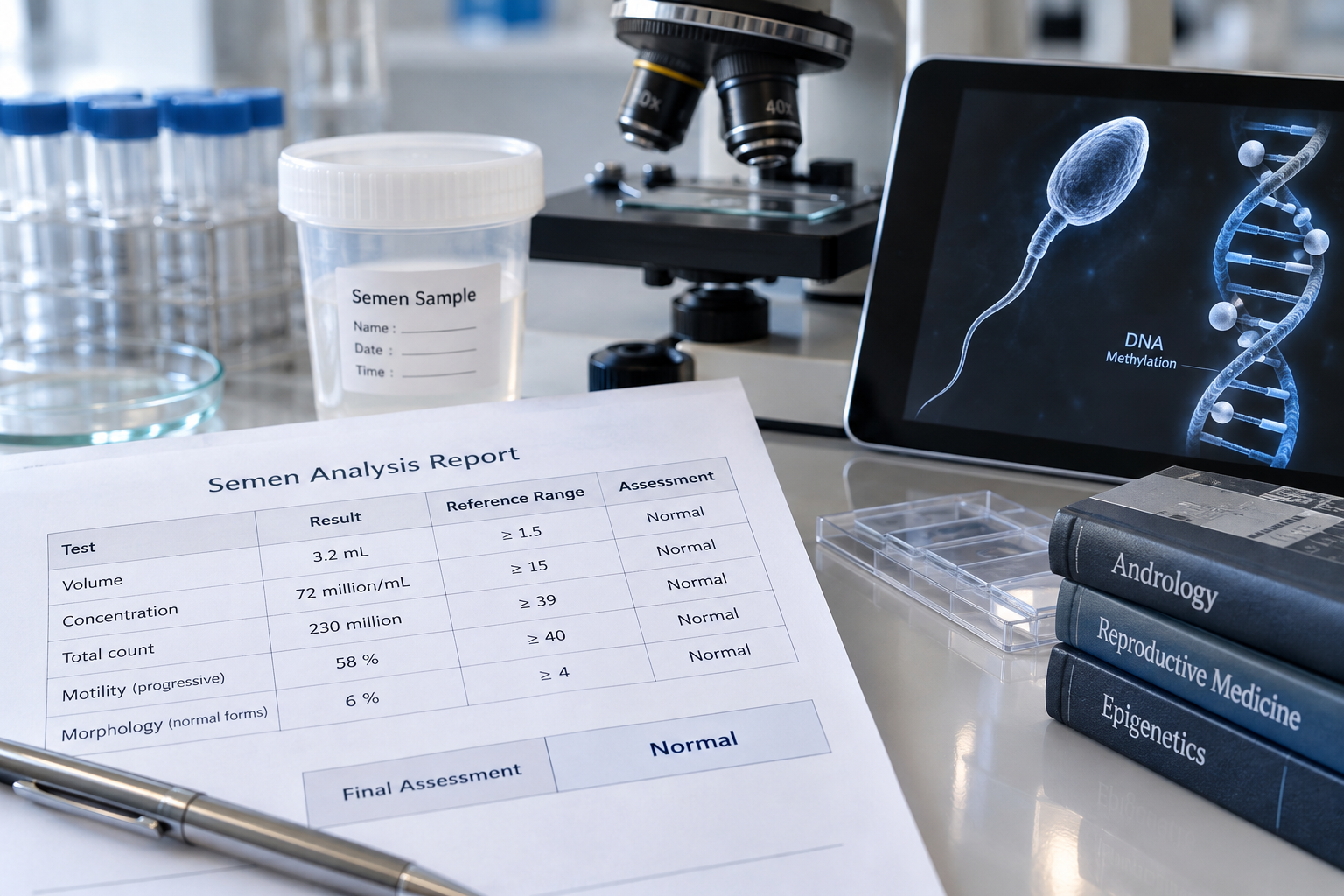
A man may have a reassuring sperm count and normal morphology, yet a couple may struggle to conceive. Does a normal semen analysis mean every aspect of sperm biology is normal? New research suggests that epigenetic variation—difficult to detect through routine semen testing—may be relevant.
The study, published in Human Reproduction on September 25, 2026, involved researchers at Wayne State University and collaborating institutions. They examined sperm DNA methylation in 372 couples attempting natural conception.
DNA methylation is a form of biological regulation
DNA methylation is an epigenetic process that helps regulate gene activity without changing the DNA sequence. If DNA is a book of genetic information, methylation resembles marks or switches influencing which parts are read and used.
The investigators measured how far an individual’s sperm methylation pattern departed from the typical distribution. Their measure was called Epigenetic Variability Outliers and Stochasticity, or EVOS.
Unusually high or low methylation at particular CpG sites was counted as an outlier, and the accumulated burden was calculated for each man. The median EVOS count was 673, with substantial differences between individuals.
Predicted pregnancy within 12 months ranged from 86% to 66%
The lowest-EVOS group had a predicted 86% probability of pregnancy within 12 months, compared with 81% in the middle group and 66% in the highest group.
Couples in which the male partner had greater sperm methylation variability therefore tended to take longer to conceive. In adjusted analyses across all 372 couples, higher EVOS was associated with lower per-cycle fecundability, with a fecundability odds ratio (FOR) of 0.79.
The association remained in men with otherwise normal semen findings
Among the men, 285 met the study’s normospermia definition based on WHO 2010 reference criteria. Analyses restricted to this group still associated greater EVOS with reduced fecundability: FOR 0.82 overall.
Comparing the highest and lowest EVOS groups within this subgroup, the highest group had approximately 45% lower per-cycle odds of conception (FOR 0.55; 95% confidence interval 0.37–0.83). This is an odds comparison, not a 45-percentage-point reduction in pregnancy probability.
Routine semen analysis measures characteristics such as volume, concentration, total sperm count, motility and morphology. It does not comprehensively assess epigenetic regulation within sperm DNA. A reassuring semen result therefore cannot describe every biological property of sperm.
For some couples with prolonged difficulty conceiving despite normal conventional findings, male factors beyond current routine testing may remain relevant.
Higher EVOS does not mean sperm DNA is necessarily damaged
A high burden of methylation outliers should not be equated with a diagnosis of DNA damage or an inability to conceive.
Some variable methylation sites were near genes involved in DNA-damage checkpoint signaling, cell division, glycolysis and carbohydrate metabolism. The investigators suggested possible relationships with maintenance of epigenetic information or DNA damage and repair, but the mechanisms remain unresolved.
Nor did higher EVOS predict every adverse outcome after conception. The study found no clear associations with live birth, gestational duration or neonatal measures.
EVOS is not yet a standard male-infertility test
These findings are not a reason to request routine EVOS testing at a fertility clinic. It is a research measure that needs independent validation, including assessment of its stability in repeated semen samples.
An important limitation concerns the “normal semen” subgroup. Motility was measured after samples had been shipped overnight on ice, rather than immediately after collection, so it was not included in the normospermia classification. The 285 men should not be described as having confirmed normal values for every semen parameter.
The study also involved natural conception. It does not establish that higher EVOS reduces IVF fertilization, blastocyst development, implantation or ICSI success. The researchers called for further work in clinical infertility populations to assess relationships with embryo development.
Nevertheless, the work broadens research into male fertility. Count, motility and morphology are important, but sperm that appear similar may differ in the stability of their epigenetic information. Sperm DNA methylation adds another avenue for studying why some couples take longer to conceive despite reassuring routine tests.
Study source and limitations
Karolina Nowak and colleagues, Interindividual variability of sperm DNA methylation is associated with reduced fecundability in couples attempting natural conception, Human Reproduction, September 25, 2026. The analysis included 372 couples in the LIFE study and examined sperm methylation variability and time to pregnancy. Participating institutions included Wayne State University and the University of Massachusetts Amherst. This observational association requires replication and does not establish a clinical diagnostic test. DOI: 10.1093/humrep/deag145; PMID 42786259.
Related reading
Images were created using generative AI (ChatGPT, OpenAI) for illustration and do not depict actual patients.
Copyright © 2026 Fertility Information TokTok | THE FERTILITY NOTES. All rights reserved. Unauthorized republication, reproduction, redistribution, scraping, AI training and data use of articles, photographs, images and all other content are strictly prohibited. Violations may result in legal liability.