
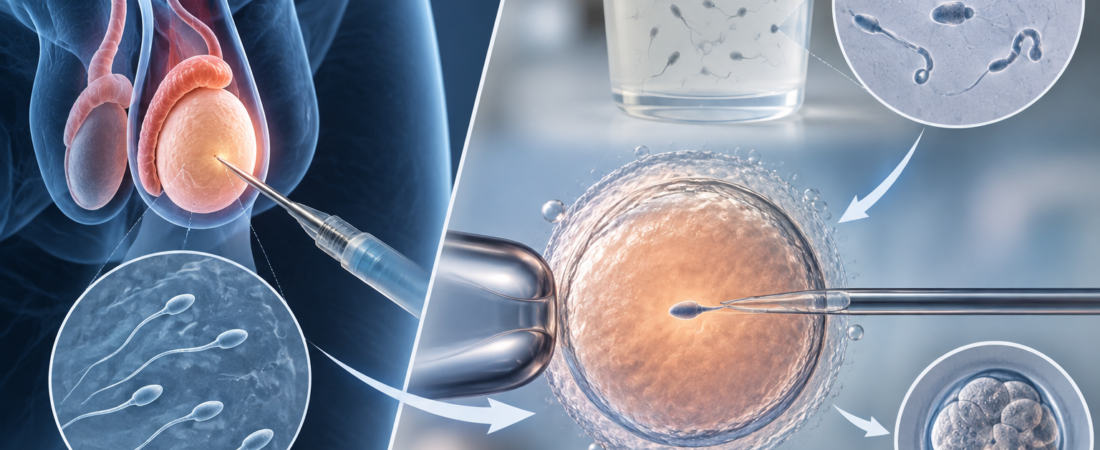
Testicular sperm for MMAF was associated with a higher ICSI fertilization rate in a study of 196 men with severe sperm-tail abnormalities. The difference was about 5.6 percentage points, but the research did not establish a benefit for pregnancy or live birth.
Some men produce sperm that barely move. The problem is not necessarily a shortage of sperm; it may be a serious abnormality in the tail that sperm need to swim.
This condition is called multiple morphological abnormalities of the sperm flagella (MMAF).
The sperm tail is more than an appendage. It acts as a motor, generating the propulsion needed to travel toward an egg. With MMAF, tails may be unusually short, bent, absent or irregularly formed. Sperm can therefore be present yet unable to move forward properly.
That raises a practical question: if ejaculated sperm hardly move, could sperm retrieved directly from the testis be a better choice for injection into the egg?
A study in the September 2026 issue of the Asian Journal of Andrology examined that question.
Why retrieve sperm from the testis when sperm are present in the ejaculate?
Intracytoplasmic sperm injection (ICSI) is an IVF technique in which an embryologist selects a single sperm and injects it directly into an egg.
The sperm therefore does not need to swim to the egg on its own. Even when motility is extremely low, identifying a living sperm and placing it inside the egg can create an opportunity for fertilization.
In MMAF, however, the severe structural abnormalities of the sperm tail raise a further question about the source of the sperm used.
Sperm produced in the testis normally pass through the epididymis and vas deferens before ejaculation. For men with severe flagellar abnormalities, could retrieving sperm before that journey produce different ICSI results from using sperm already present in the ejaculate?
Researchers retrospectively analyzed 196 men with MMAF who underwent ICSI between 2019 and 2024. Of these, 65 used sperm obtained through testicular sperm aspiration, while 131 did not undergo that procedure.
Testicular sperm aspiration (TESA) involves placing a thin needle into the testis, aspirating tissue containing sperm and then looking for sperm that can be used.
The study was restricted to couples without female-factor infertility and included fresh embryo transfer cycles. These details matter when considering how widely its findings might apply.
Fertilization was about 5.6 percentage points higher
After adjustment for several other factors, the fertilization rate in the TESA group was approximately 5.63 percentage points higher than in the group without TESA. A different statistical analysis found a difference of approximately 5.9 percentage points.
In the subgroup whose female partners were 30–35 years old, the difference was larger, at approximately 9.5 percentage points.
These numbers do not mean that using testicular sperm made fertilization several times more likely. They describe an absolute difference of roughly 5–6 percentage points in the proportion of eggs fertilized in the two groups.
There were also some positive signals in the early cleavage stage, when fertilized eggs begin dividing. Those findings were modest and depended on the statistical method used.
The important qualification is that better fertilization did not establish that more good embryos, pregnancies or births followed. The researchers found no clear differences in on-time day-3 embryo development or pregnancy outcomes, and the study had limited power for those later endpoints.
It would therefore be inaccurate to conclude that testicular sperm are generally “better sperm” than ejaculated sperm. This was evidence of a possible advantage at the fertilization stage in a specific form of male infertility involving severe structural abnormalities of the sperm tail.
Is this the same as retrieving sperm after a vasectomy?
Vasectomy offers a useful comparison, but it is a different clinical situation.
Most men continue producing sperm in the testes after a vasectomy. The issue is that the vas deferens—the passage carrying sperm out—is blocked. This is a form of obstructive azoospermia.
If a man wants to conceive after a vasectomy, options may include reversing the vasectomy or retrieving sperm from the epididymis or testis for use with ICSI. The choices are discussed further in our article on vas deferens repair versus surgical sperm retrieval.
The main reason for retrieving sperm in this setting is not that sperm inside the body are inherently superior. Sperm are being produced, but the blocked passage prevents them from appearing in the ejaculate. Retrieval provides access to them.
The men with MMAF in this study, by contrast, could have sperm available in the ejaculate. The research asked whether choosing sperm obtained directly from the testis instead was associated with a different fertilization rate.
For more background on the laboratory technique, see why surgically retrieved testicular sperm are generally used with ICSI.
From asking whether sperm exist to deciding which sperm to use
Evaluation of male infertility commonly centers on sperm count, movement and shape. Yet very poor movement does not mean that every patient has the same underlying problem.
The amount of sperm produced may be low. There may be abnormalities in the genes or structures responsible for building the tail. In other cases, sperm are made but cannot pass through an obstructed reproductive tract.
One motility figure cannot determine the appropriate treatment for all of these situations.
This is what makes the MMAF study noteworthy. It goes beyond whether sperm are present in the ejaculate and considers whether, for selected men with severe structural defects, the location from which sperm are obtained could become part of an ICSI strategy.
What remains uncertain about TESA for MMAF?
TESA is an invasive procedure: a needle is inserted directly into the testis. The decision to use it must be weighed against that burden, not based on a fertilization percentage alone.
This was also a retrospective cohort study, not a randomized clinical trial. Although statistical adjustment was used, the comparison cannot establish that TESA itself caused the difference.
Most importantly, improved fertilization was not shown to translate into higher pregnancy or live birth rates. A lack of a statistically clear difference in the later outcomes also does not prove that the two approaches are equivalent; further research is needed.
The practical message is not that every man with poorly moving sperm should use testicular sperm. It is that the reason for the poor movement needs to be understood first. If the cause is a severe flagellar abnormality such as MMAF, testicular sperm for ICSI may be an option worth evaluating in an individual clinical assessment.
Male infertility treatment is increasingly asking not only how many sperm are present, but why they do not move and where suitable sperm might be obtained for use.
Research source
This article is based on “Testicular sperm aspiration enhances fertilization rates in MMAF patients undergoing ICSI: a retrospective cohort study”, by researchers from West China Second University Hospital, Sichuan University, and the National Research Institute for Family Planning in China.
The study appeared in the September 2026 issue of the Asian Journal of Andrology; the publisher records online publication on May 15, 2026. It included 196 men with MMAF. DOI: 10.4103/aja2025113. PMID: 42139554.
This retrospective observational study did not establish that testicular sperm increase pregnancy or live birth rates.
Image disclosure: The image used in this article was created using generative artificial intelligence (ChatGPT, OpenAI). Any people depicted are fictional, not real individuals.
Copyright © 2026 Fertility Information TokTok · Fertility News | THE FERTILITY NOTES. All rights reserved. Unauthorized republication, reproduction, redistribution, scraping, AI training, and data use of any content, including articles, photographs, and images, are strictly prohibited. Violations may result in legal liability.