
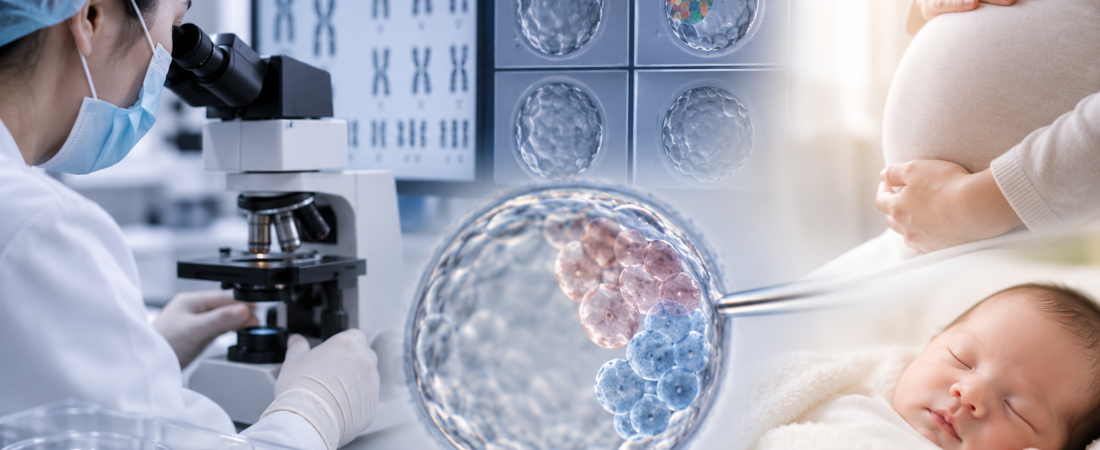
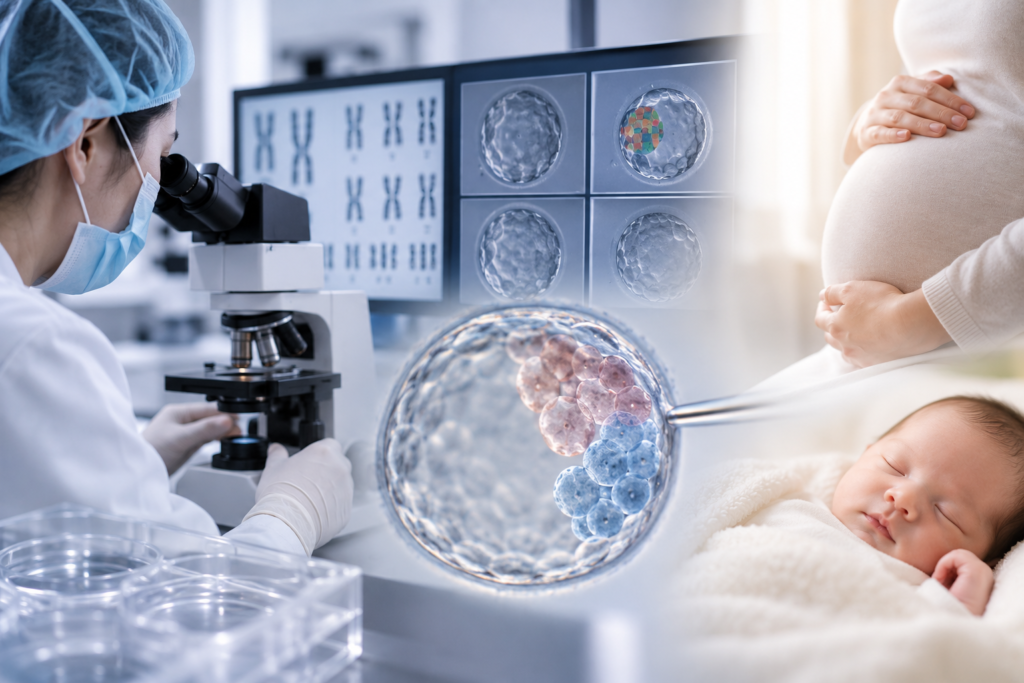
What does a mosaic PGT-A result mean for embryo transfer? A retrospective study of 2,898 single frozen blastocyst transfers compared pregnancy outcomes across mosaic subtypes. Whole-chromosome high-level mosaic embryos had poorer ongoing pregnancy outcomes in this cohort. The conference-abstract findings do not establish an individual embryo’s prognosis or guarantee safety.
- CHA Medical Center researchers analyze 2,898 single blastocyst transfers at ESHRE 2026
- Whole-chromosome high-level mosaic ongoing pregnancy rate was just 11.1% vs. 51.0% for euploid embryos
- Segmental and low-level mosaic embryos showed no statistically significant differences in clinical and ongoing pregnancy rates compared to euploids
- Discard decisions cannot be made based on the word ‘mosaic’ alone… Reported subtype, mosaic range and laboratory limitations require review
For patients undergoing preimplantation genetic testing for aneuploidy (PGT-A) during In Vitro Fertilization (IVF), one of the most perplexing and frustrating lab results is a “mosaic embryo.” It is not diagnosed as chromosomally normal, yet it is not classified as fully aneuploid either. The result suggests mosaicism from the DNA signal in the biopsy; it does not directly establish the chromosome count of each sampled cell.
For years, couples receiving a mosaic diagnosis have wrestled with fraught dilemmas: “Is it safe to transfer?”, “How high is the risk of miscarriage or congenital birth defects?”, or “Should we simply discard it and start another retrieval cycle?”
A large-scale analysis recently presented by a South Korean research team reveals that not all mosaic embryos share the same reproductive fate.
Researchers from the CHA Fertility Center Seoul Station at CHA University presented a study at the 2026 Annual Meeting of the European Society of Human Reproduction and Embryology (ESHRE) comparing pregnancy outcomes after transferring single euploid versus single mosaic blastocysts. The findings were featured in the July 2026 ESHRE special abstract issue of Human Reproduction.
The investigative team analyzed 2,898 single frozen blastocyst transfers conducted between August 2020 and June 2025. This cohort comprised 2,569 euploid embryo transfers and 329 mosaic embryo transfers.
The mosaic embryos were categorized into four distinct subtypes based on structural extent and the reported mosaic level:
- Segmental Low-Level Mosaic: Partial chromosome deletion or duplication with a low reported mosaic level (154 cycles)
- Segmental High-Level Mosaic: Partial chromosome anomaly with a high reported mosaic level (30 cycles)
- Whole-Chromosome Low-Level Mosaic: An entire extra or missing chromosome with a low reported mosaic level (118 cycles)
- Whole-Chromosome High-Level Mosaic: An entire extra or missing chromosome with a high reported mosaic level (27 cycles)
Whole-chromosome high-level mosaicism and pregnancy outcomes
The clinical divide was stark.
For embryos carrying high-level mosaicism involving an entire chromosome, the clinical pregnancy rate reached only 29.6%—halving the 59.6% seen in the euploid control group.
The disparity was also present for the study’s ongoing pregnancy outcome. While the ongoing pregnancy rate was 51.0% for euploid embryos, it dropped to a mere 11.1% for whole-chromosome high-level mosaic embryos.
The abstract reported miscarriage rates of 14.4% for euploid and 62.5% for whole-chromosome high-level mosaic cases. It did not define the miscarriage denominator, so these figures should not be interpreted as losses per embryo transfer.
After adjustment for maternal age, paternal age, body mass index (BMI), anti-Mullerian hormone (AMH) levels, and endometrial thickness, whole-chromosome high-level mosaic embryos were associated with significantly lower odds of clinical and ongoing pregnancy than euploid embryos.
Conversely, embryos categorized as segmental low-level, segmental high-level, or whole-chromosome low-level mosaic showed no statistically significant differences in clinical pregnancy or ongoing pregnancy rates compared to fully euploid embryos.
These findings concern clinical and ongoing pregnancy; they do not establish equivalent outcomes, live birth rates or child health across mosaic subtypes.
Mosaic PGT-A percentages and the limits of embryo biopsy
If a PGT-A lab report indicates a result like “partial deletion of chromosome 9, 20% mosaic,” patients should not immediately assume the embryo is unviable.
Clinicians must evaluate whether the abnormality involves an entire chromosome or only a regional segmental fragment, review the reported mosaic range and the laboratory’s thresholds, and check whether other fully euploid embryos are available in the cohort.
A reported low-range segmental finding and a high-range whole-chromosome finding are different laboratory categories; the percentage alone does not determine an embryo’s prognosis. However, because different genetic reference laboratories use varying baseline thresholds to define mosaicism and categorize “low” versus “high” levels, patients cannot automatically assume that a 20% reading is completely without risk.
Furthermore, PGT-A does not test every cell in the embryo.
The biopsy removes only 5 to 10 cells from the outer trophectoderm layer, which eventually forms the placenta, leaving the inner cell mass that develops into the fetus untouched. Consequently, a trophectoderm biopsy provides a limited sample that may not represent the chromosome status of the entire embryo.
ESHRE good practice recommendations call for counseling about test limitations and the centre’s mosaic-embryo policies, with further counseling before transfer when needed. They specify thorough genetic counseling before any high-range mosaic transfer because evidence is insufficient for a general transfer recommendation.
Mosaic embryo transfer decisions: evidence limits and counseling
The core message of this study is straightforward: embryos bearing the “mosaic” label should not all be treated as equal.
Euploid embryos may be prioritized after counseling, taking patient preferences and embryo morphology into account. However, for poor responders or patients who have exhausted their euploid options and hold only mosaic embryos, examining the fine print of the mosaic classification can reveal viable opportunities for pregnancy.
At the same time, this study was a retrospective observational cohort rather than a randomized controlled trial, and the data were presented in conference abstract format at ESHRE 2026. The authors identified possible residual confounding from the retrospective design and clinician-driven embryo selection.
Receiving a mosaic PGT-A result should not lead to an immediate discard order, nor should it lead to an unconsidered transfer. The safest path forward is a structured discussion with a reproductive endocrinologist and genetic counselor to review whether the anomaly is partial or complete, review the laboratory-reported mosaic range and its limitations, identify the specific chromosome involved, and weigh the clinical options based on the patient’s entire reproductive journey.
For separate questions about embryo classification and testing outcomes, read 1PN embryos and live birth after genetic assessment and PGT-A and cumulative live birth outcomes.
※ This article was synthesized based on the research abstract presented by researchers from CHA Fertility Center Seoul Station, CHA University School of Medicine, at the 2026 Annual Meeting of the European Society of Human Reproduction and Embryology (ESHRE) and published in the July 2026 conference special issue of Human Reproduction. Source: E.A. Park et al., abstract L26/P-663, doi:10.1093/humrep/deag083.993. Guidance: ESHRE 2022 and ASRM 2023. It does not replace individualized clinical diagnosis or medical care, and specific treatment decisions should always be made in consultation with a qualified reproductive specialist or clinical geneticist.
※ Image: AI generated (ChatGPT, OpenAI) / For illustrative reference only.