
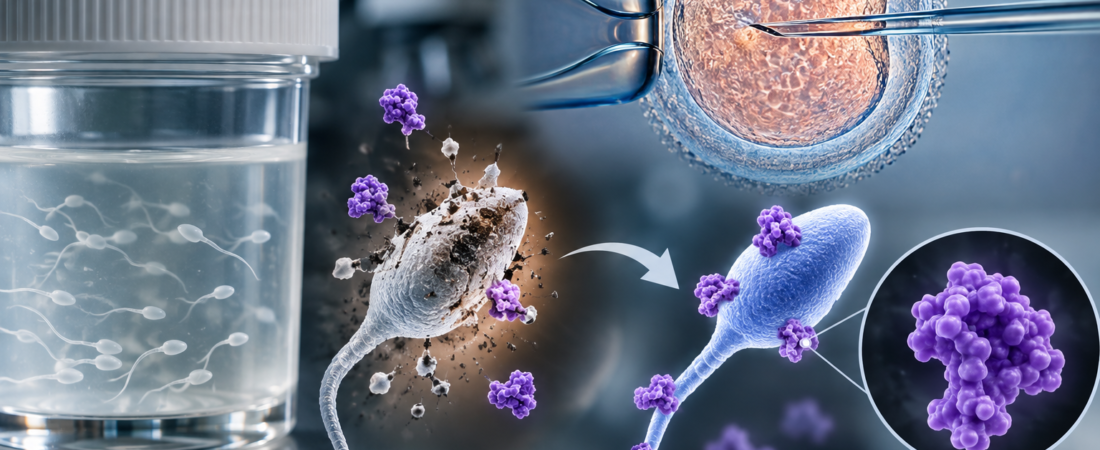
Seminal ubiquitin may offer a window into sperm damage that routine semen analysis misses. A study of 132 men linked this protein in the fluid surrounding sperm with DNA damage and ICSI outcomes, but the findings still need larger, prospective validation.
Semen analysis is the starting point for investigating male infertility. It tells us how many sperm are present, how well they move and what proportion have a normal shape.
Yet even when those results are not particularly poor, some couples experience low fertilization or difficulty obtaining good embryos during IVF. Why might that happen?
Researchers are looking beyond sperm numbers and movement to oxidative stress, DNA damage and the mechanisms that maintain protein quality. One small protein receiving attention is ubiquitin.
What is ubiquitin’s role in sperm quality control?
Its name may be unfamiliar, but its general role is easier to understand. Cells constantly make and break down proteins. Damaged proteins, or those that are no longer needed, must be identified and processed.
Ubiquitin is a small tagging protein that can be attached to proteins marked for disposal—rather like a label in a cell’s waste-handling system.
Ubiquitin-related quality control also operates during sperm production and maturation. It is involved in systems that recognize and help remove abnormal sperm.
There is an essential distinction in this study: the researchers did not measure how much ubiquitin was attached to each individual sperm cell. They measured its concentration in seminal plasma, the fluid in which sperm are suspended.
It is therefore more accurate to think of the measurement as a possible signal of sperm damage and the quality-control response to that damage. It does not mean that the protein measured in the sample directly “cleans” sperm or restores damaged sperm to health.
Higher seminal ubiquitin was associated with more sperm DNA damage
The research team in Türkiye investigated the relationship between sperm characteristics and seminal ubiquitin in 132 men. The men were divided into four groups: those with normal semen findings, those with abnormal sperm morphology, those with high sperm DNA damage, and those with both morphological and DNA abnormalities.
The researchers measured markers of oxidative stress, oxidative damage to DNA, cellular stress responses and ubiquitin together.
These markers increased progressively across groups with poorer sperm characteristics. Among them, ubiquitin had the strongest association with the DNA fragmentation index (DFI).
DFI describes the extent of breaks and damage in the DNA carried by sperm. Routine semen analysis mainly examines count, movement and shape; DNA fragmentation assessment looks further inside, at damage to genetic material.
The correlation between ubiquitin and DFI was r = 0.71. Higher ubiquitin concentrations clearly tended to accompany greater DNA damage. In contrast, the proportion of normally shaped sperm and progressive motility tended to be lower when ubiquitin was higher.
When several damage markers were included together in the statistical analysis, ubiquitin remained independently associated with DFI.
For context on this separate aspect of sperm quality, see sperm DNA fragmentation and differences between IVF and ICSI outcomes.
The association remained when a single sperm was selected for ICSI
The findings involving actual intracytoplasmic sperm injection (ICSI) outcomes are particularly relevant. In ICSI, an embryologist selects one sperm and injects it directly into an egg. The technique is widely used for male infertility involving low sperm counts, poor motility or too few normally shaped sperm.
The researchers analyzed the first ICSI treatment of 110 couples.
Higher seminal ubiquitin concentrations were associated with lower fertilization rates, with a correlation of r = −0.61. Higher concentrations were also linked to poorer blastocyst development and a lower likelihood of clinical pregnancy.
Even after factors including female age and sperm DNA fragmentation were considered, ubiquitin retained an independent association with clinical pregnancy. The reported adjusted odds ratio was 0.74.
An odds ratio of 0.74 must not be read as “the pregnancy rate fell by exactly 26%.” An odds ratio compares the relative odds of an outcome under the conditions represented by the statistical model. It is not the same as a relative reduction in probability, and this observational result does not show that ubiquitin caused the poorer outcome.
A possible link between oxidative stress, DNA damage and protein quality control
The study is interesting because it directs attention further beneath the surface of sperm quality.
Semen analysis assesses count, motility and normal morphology. DNA fragmentation tests can add information about damage to the genetic material. These findings suggest that oxidative stress, DNA damage, cellular stress and the quality-control processes responding to damaged sperm may be interconnected.
The researchers described a redox–genomic damage–proteostasis axis. In simpler terms, sperm may experience oxidative stress and damage to their DNA and proteins while the systems that respond to that damage are also active.
Ubiquitin could be an integrative signal reflecting several parts of that process at once. The study supports investigating that possibility; it does not establish a complete causal sequence or show that raising or lowering ubiquitin would improve fertility.
The distinction between sperm measurements and meaningful treatment outcomes also matters in other areas of research. Our article on antioxidants for male infertility and the uncertain evidence for live birth examines that issue.
Is a seminal ubiquitin test ready for routine use?
These results do not mean that patients should immediately seek a ubiquitin test.
The study involved 132 men, and its ICSI outcome analysis was limited to 110 couples. It used a single-center observational analysis of archived samples and existing clinical information, rather than a trial of a treatment.
Larger prospective studies and repeated validation are needed before seminal ubiquitin could be used as a clinical test to predict male infertility or ICSI success.
Still, the research returns to a longstanding question: if there are enough sperm, they move well and their shape appears acceptable, does that necessarily mean they are functionally healthy?
The assessment of sperm quality is gradually extending beyond “how many?” and “how well do they move?” toward DNA damage, oxidative stress and the internal systems that maintain cellular quality.
Research source
This article is based on “Seminal ubiquitin as an independent predictor of severe sperm damage and ICSI outcomes: evidence for a redox–proteostasis axis in male infertility”, by researchers from Malatya Turgut Özal University, Istanbul Medipol University and Istanbul Okan University Hospital in Türkiye.
The study appeared in Biology of Reproduction, volume 115, issue 3, September 2026. It was first published online on May 26, 2026; PubMed records the issue publication date as September 14, 2026. DOI: 10.1093/biolre/ioag112. PMID: 42189963.
Image disclosure: The image used in this article was created using generative artificial intelligence (ChatGPT, OpenAI). Any people depicted are fictional, not real individuals.
Copyright © 2026 Fertility Information TokTok · Fertility News | THE FERTILITY NOTES. All rights reserved. Unauthorized republication, reproduction, redistribution, scraping, AI training, and data use of any content, including articles, photographs, and images, are strictly prohibited. Violations may result in legal liability.