
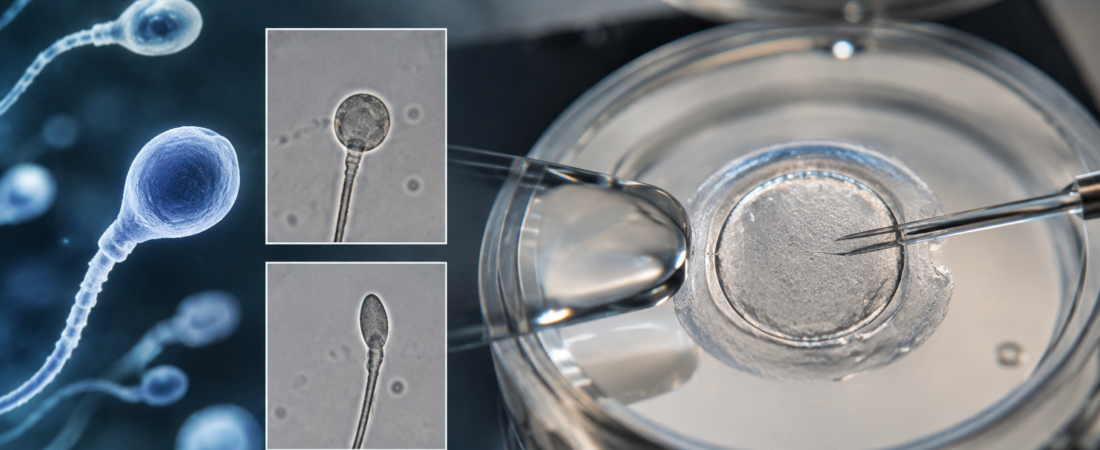
Higher proportions of round-headed sperm were associated with more DNA damage and impaired fertilizing function.
ICSI live-birth rates were 50.98% versus 32.86%, highlighting the need to consider both sperm shape and function.

Sperm head shape may be closely associated with IVF outcomes. A study found that men with higher proportions of round-headed sperm had more marked sperm DNA damage and functional impairment, alongside lower pregnancy and live-birth rates after intracytoplasmic sperm injection (ICSI).
The findings suggest that the extent of head-shape abnormalities, as well as sperm number and motility, may be relevant to fertility assessment.
In research published in Andrology in October 2026, the ICSI live-birth rate was about 18 percentage points lower among couples in whom round-headed sperm exceeded 7.2% than among those at or below that threshold. The authors suggested that sperm morphology might help predict fertilizing ability, embryo development and pregnancy outcomes.
Why might a round sperm head matter?
A typical sperm head is broadly oval. At its front lies the acrosome, which contains enzymes needed to pass through the egg’s outer layers. Some sperm have abnormally round heads and inadequately formed acrosomes, an abnormality known as globozoospermia.
The complete form, in which all sperm are round-headed, is rare; partial forms also occur. The concern is not simply a difference in appearance. Abnormal acrosome formation may accompany problems with nuclear-protein maturation or DNA stability inside the sperm.
To investigate how these abnormalities relate to sperm function and assisted reproduction, the researchers compared sperm characteristics in 1,456 men.
More DNA damage in a matched analysis of 1,456 men
The retrospective case–control study compared men with at least 5% round-headed sperm against controls. After propensity-score matching to balance baseline characteristics, each group contained 728 men.
A machine-learning-based automated morphology system measured sperm head shape and the proportion of round-headed sperm. The team also assessed DNA integrity, acrosome function, nuclear-protein maturation, motility and other functional measures.
The round-headed sperm group had lower proportions of normally shaped sperm and lower movement-related measures. Nuclear-protein maturity, acrosome integrity and activity of the acrosomal enzyme acrosin were also significantly reduced.
By contrast, the sperm DNA fragmentation index (DFI) and high DNA stainability (HDS) measure were significantly higher than in controls. These differences were statistically significant (P<0.001).
The findings indicate that a higher proportion of round-headed sperm may accompany not only abnormal appearance but also DNA damage and reduced function needed for fertilization.
Fertilization and embryo quality above a 7.2% threshold
The researchers also examined outcomes in 166 couples who underwent conventional IVF or ICSI. Statistical analysis using clinical pregnancy outcomes identified 7.2% round-headed sperm as a threshold for comparing groups.
Treatment outcomes differed when couples were grouped at or below 7.2% versus above 7.2%.
In conventional IVF, fertilization and high-quality embryo rates were significantly lower in the higher-proportion group. A similar pattern appeared in ICSI.
After ICSI, the high-quality embryo rate was 48.48% in the group at or below 7.2%, compared with 40.33% above that threshold.
Clinical pregnancy rates were 58.82% and 41.43%, respectively. Live-birth rates were 50.98% and 32.86%, a difference of approximately 18.12 percentage points.
The differences in high-quality embryos, clinical pregnancy and live birth were statistically significant. However, the 7.2% threshold was derived from this particular dataset; it is not an established clinical cutoff that can be applied uniformly to all fertility patients.
ICSI cannot resolve every problem inside sperm
A notable finding is that pregnancy and birth outcomes differed even after ICSI, which places a sperm directly inside an egg.
Conventional IVF allows sperm to approach and fertilize the egg themselves. With ICSI, an embryologist selects one sperm and injects it into the egg’s cytoplasm. This can be useful when sperm motility is low or the usual fertilization process is difficult.
Direct injection does not necessarily correct every functional problem inside a sperm. DNA damage or abnormal nuclear-protein maturation may still influence embryo development after fertilization.
The lower high-quality embryo, clinical pregnancy and live-birth rates in the higher-proportion group suggest that abnormal appearance and internal dysfunction may both be relevant to assisted reproduction outcomes.
Round-headed sperm cannot, however, be declared the direct cause of lower pregnancy rates. Female age, egg condition, embryo quality and culture conditions also influence results. As a retrospective observational study, this research cannot establish causation.
Looking beyond sperm count and motility
Standard semen analysis assesses sperm number, concentration, motility and the proportion of normal forms. This study raises the possibility of looking beyond the overall normal-morphology percentage to specific abnormalities and accompanying functional changes.
For men with higher proportions of round-headed sperm, additional assessment of acrosome function, sperm DNA or nuclear-protein maturation may potentially provide useful information.
That does not mean every man with infertility should routinely undergo sperm DNA fragmentation or acrosome-function testing. Nor can the round-headed sperm proportion alone determine whether conventional IVF or ICSI is preferable.
The authors considered this proportion a potential marker of sperm function and treatment outcomes before assisted reproduction. Larger prospective studies are needed to validate its predictive value before clinical application.
The study suggests that sperm head shape may reflect more than appearance: it may be associated with fertilizing ability, embryo development and birth outcomes. Considering morphology alongside internal function could offer clues in some cases that sperm count and motility alone do not explain.
Source: This article is based on “Different Proportions of Round-Headed Spermatozoa: Impacts on Sperm Function and IVF/ICSI Outcomes,” by S. Long, F. Yang, L. Yu and colleagues, published in Andrology in October 2026. The study compared 728 men per matched group, 1,456 in total, and analyzed treatment outcomes in 166 couples. DOI: 10.1111/andr.70421.
Image disclosure: The image was created using generative AI (ChatGPT, OpenAI); any people depicted are fictional, not real individuals.
For background on ovarian reserve, semen analysis and when additional investigations may be considered, see our guide to the first fertility clinic visit.
Copyright © 2026 Fertility Information TokTok Fertility News | THE FERTILITY NOTES. All rights reserved. Unauthorized reproduction, copying, redistribution, scraping, AI training, and other data use of any articles, photographs, images, or other content are strictly prohibited. Violations may result in legal liability.