
By Seungjoo Lee
Fertility testing at a first clinic visit usually examines ovarian reserve, ovulation, the fallopian tubes, the uterus and semen. AMH, ultrasound, hormone tests and semen analysis answer different questions; a low AMH result does not automatically mean poor egg quality. Both partners should be considered from the beginning.
After a year or more of trying without contraception, many people ask: why has pregnancy not happened? Infertility can have more than one cause. Clinicians may need to assess how many eggs remain, whether ovulation occurs, whether the tubes allow egg and sperm to meet, whether the uterus can support implantation and whether sperm count and motility are satisfactory.
Not every test is performed at once. Age, menstrual patterns, duration of trying, previous pregnancies or miscarriages, surgery and medical history guide the sequence. In Korean fertility clinics, a first visit is often arranged on cycle day two or three to coordinate early-cycle assessments; attending together can help both partners be evaluated. Scheduling and test requirements should be confirmed with the clinic.
1. Ovarian reserve: AMH and antral follicle count
Anti-Müllerian hormone (AMH) is measured in blood to estimate ovarian reserve indirectly. A common misunderstanding is that low AMH necessarily means poor-quality eggs. AMH primarily reflects quantity; female age is especially important to the probability of chromosomally normal eggs and embryos.
Antral follicle count (AFC), usually assessed with transvaginal ultrasound, counts the small follicles visible in both ovaries and is often used alongside AMH.
2. Ovulation: FSH, LH, estradiol and progesterone
Having menstrual bleeding does not establish that ovulation is normal in every cycle. Early-cycle blood tests may include follicle-stimulating hormone (FSH), luteinizing hormone (LH) and estradiol (E2). When necessary, ultrasound can follow follicular growth, or progesterone can be measured after expected ovulation.
Very irregular or absent periods may prompt assessment for ovulatory disorders such as polycystic ovary syndrome (PCOS). Thyroid-stimulating hormone (TSH) and prolactin may also be checked when indicated, because thyroid dysfunction and elevated prolactin can affect menstruation and ovulation.
3. Tubal patency: can sperm and egg meet?
Even when ovulation occurs, natural conception is difficult if sperm and egg cannot meet. Hysterosalpingography (HSG) introduces contrast into the uterus and uses imaging to assess whether the fallopian tubes are open.
The tubes are where sperm and egg usually meet. Significant blockage or other tubal disease can hinder both natural conception and intrauterine insemination; IVF may be needed to bypass that problem. Subsequent treatment depends on the location and severity of disease, age and ovarian reserve.
Checking the tubes may be particularly important after pelvic infection, ectopic pregnancy, or abdominal or pelvic surgery. Hydrosalpinx—fluid within a blocked tube—also requires consideration.
4. The uterus and the implantation environment
Ultrasound assesses conditions such as fibroids, adenomyosis and endometrial abnormalities, and can identify ovarian endometriomas or other cysts. Standard transvaginal ultrasound may not reveal every small lesion within the uterine cavity.
When indicated, saline infusion sonography (SIS) introduces saline into the cavity for ultrasound assessment, while hysteroscopy allows direct visualization. These can identify endometrial polyps, submucosal fibroids and intrauterine adhesions that may affect pregnancy.
Vaginal or cervical secretion testing may also be used to investigate inflammation or infection. Testing for sexually transmitted infections such as chlamydia or gonorrhea is performed when appropriate.
5. Semen analysis: evaluating the male partner from the start
Women often undergo several tests before the male partner is assessed, but infertility is not solely a female issue. Male evaluation should be considered early.
Semen analysis is the basic investigation. It examines volume, sperm concentration, total sperm count, motility and morphology. One result alone does not fully determine fertility. Abnormal findings may lead to repeat testing after an appropriate interval or assessment by a urologist.
Very low counts or azoospermia—no sperm found in the ejaculate—can warrant additional investigations. Depending on the case, these include examination, FSH, LH and testosterone measurements, scrotal ultrasound, a chromosomal karyotype or Y-chromosome microdeletion testing.
Sperm DNA fragmentation testing assesses DNA damage, but it is not a universal first-line test for every man with infertility. Its use should depend on the individual clinical situation.
A first visit does not require every specialized test
The many test names encountered online can make the first clinic visit confusing. Natural killer cell testing, other immune tests, thrombophilia investigations and endometrial receptivity tests should be distinguished from routine initial fertility assessment.
Clinicians decide whether additional investigations are relevant in situations such as recurrent pregnancy loss, particular diseases or repeated treatment failure. More testing does not guarantee that a cause will be found. Some couples have unexplained infertility despite a basic evaluation.
Five questions that organize the initial evaluation
The process starts with five practical questions: how many eggs may remain, whether ovulation occurs, whether the tubes are open, whether the uterus is suitable for pregnancy, and whether the sperm findings are satisfactory.
Treatment does not always have to wait until every investigation is complete. Depending on age, time spent trying, ovarian reserve and semen findings, patients and clinicians can discuss continued attempts at natural conception, ovulation induction, IUI or IVF while evaluation proceeds.
Older age, irregular menstruation, suspected ovarian or tubal disease, endometriosis, or testicular or sexual-function concerns can justify earlier consultation rather than waiting a full year.
How to use this overview
This article describes basic investigations commonly used in Korean fertility clinics. The tests and their timing vary with age, menstrual cycle, medical and surgical history, previous pregnancy or miscarriage, and duration of trying to conceive.
AMH and gynecological ultrasound in women, and semen analysis in men, are among commonly used fertility assessments. No single investigation establishes every cause of infertility: ovarian reserve, ovulation, uterine and tubal findings, and semen results must be considered together.
Additional DNA-fragmentation, immune, thrombophilia or genetic investigations are not a standard checklist for everyone. Their relevance depends on history and initial findings.
The tests described here are examples of what an evaluation may include, not a list of procedures every patient must undergo. A fertility specialist should interpret individual results and advise on treatment.
Further professional guidance: ASRM, Fertility evaluation of infertile women: a committee opinion (2021). It supports an individualized, systematic evaluation and earlier assessment when age or known risk factors warrant it.
Related reading
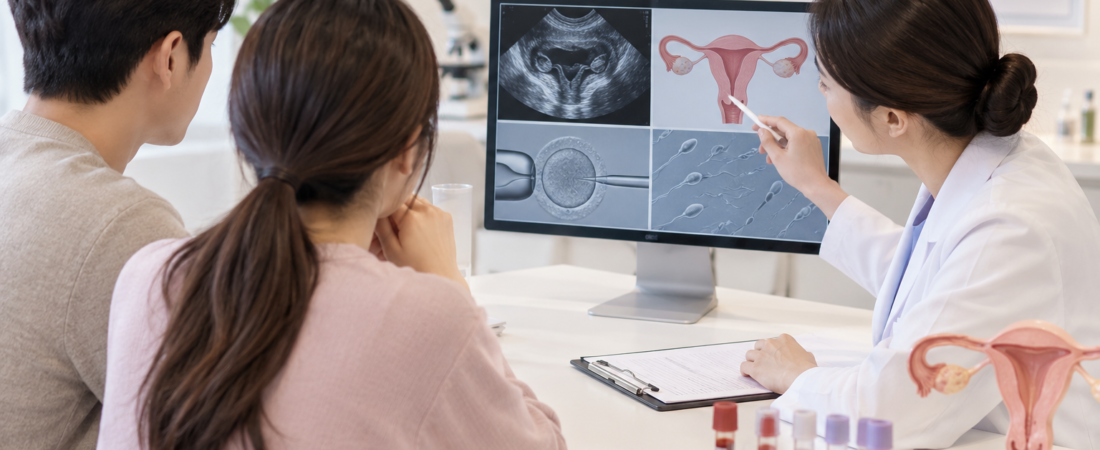
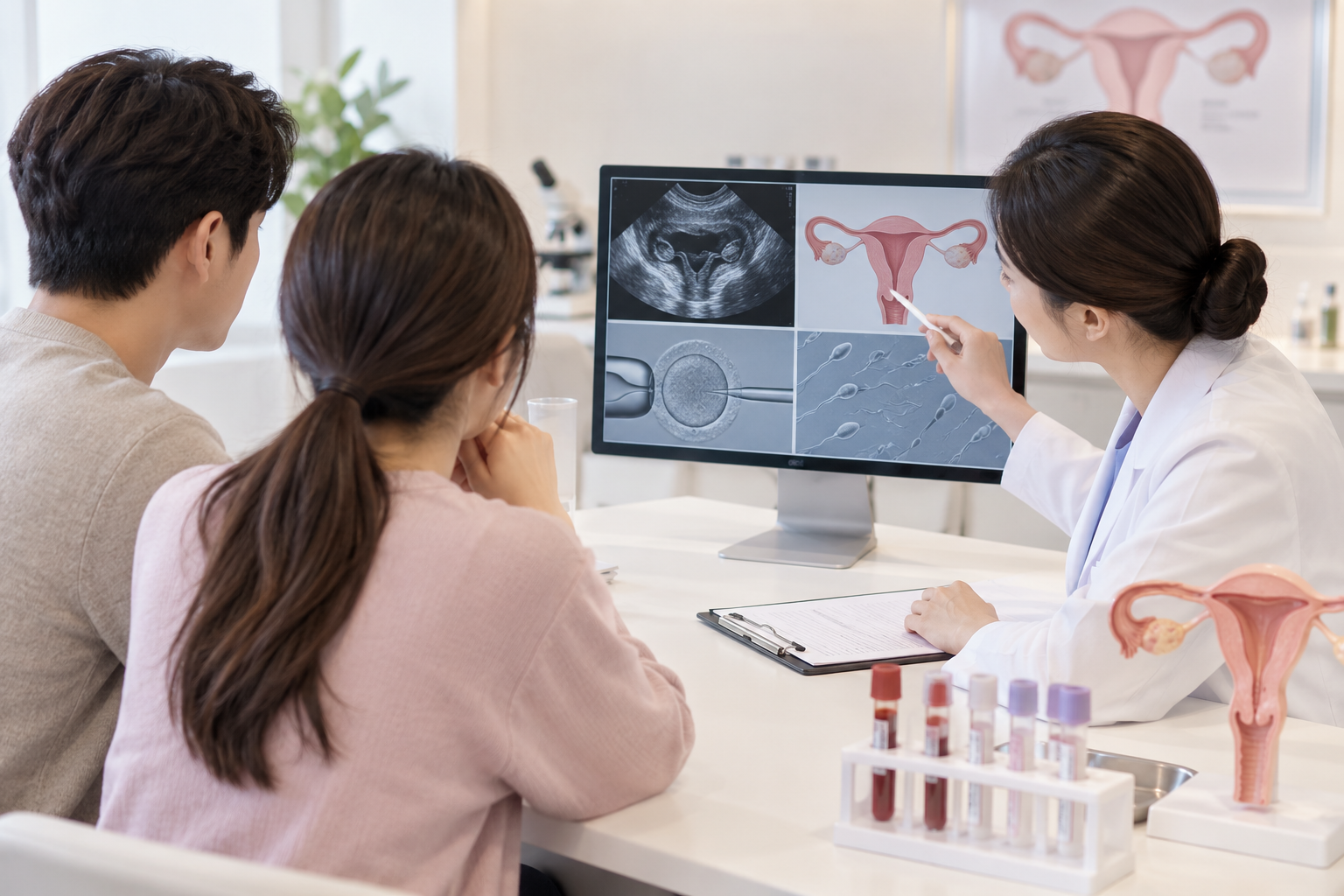
Images were created using generative AI (ChatGPT, OpenAI) for illustration and do not depict actual patients.
Copyright © 2026 Fertility Information TokTok | THE FERTILITY NOTES. All rights reserved. Unauthorized republication, reproduction, redistribution, scraping, AI training and data use of articles, photographs, images and all other content are strictly prohibited. Violations may result in legal liability.