
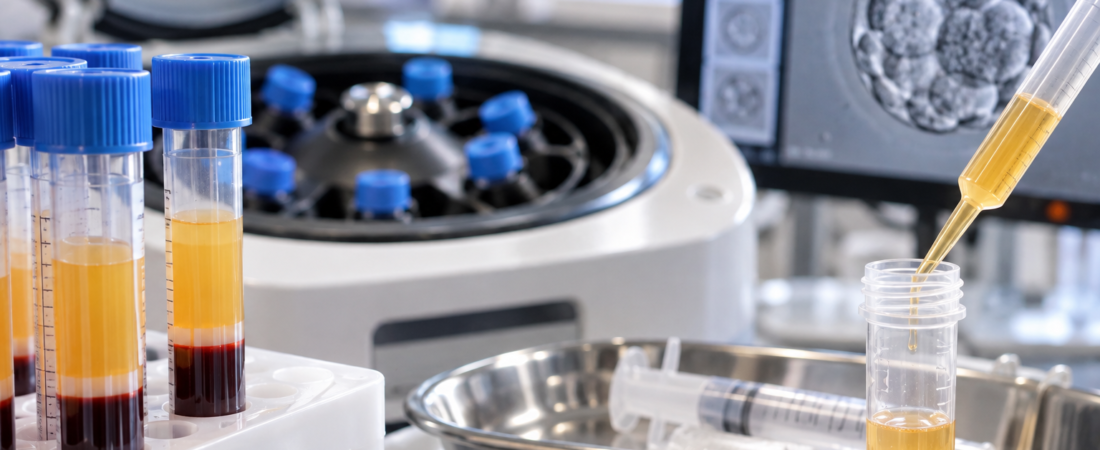
PRP for recurrent implantation failure is being studied even when the uterine lining is not thin. In a prospective observational study of 230 women with at least two failed euploid embryo transfers, live birth occurred in 45.5% of women who chose intrauterine platelet-rich plasma, compared with 30.0% of controls. All had an endometrial thickness above 7 mm. These IVF findings suggest an association, not proof that PRP improves live birth; treatment was chosen by patients rather than assigned randomly.
For women preparing for IVF, endometrial thickness is an important number. Before embryo transfer, ultrasound appointments often revolve around the question “How many millimeters?” A lining that is too thin may make implantation more difficult.
But what if the lining appears adequately thick and embryos with a normal chromosome count repeatedly fail to implant? The new research raises the possibility that the lining’s function—its readiness to accept an embryo—deserves attention alongside its thickness.
Published on September 25, 2026, in Frontiers in Endocrinology, the study found that pregnancy and live birth were observed more often in women with recurrent implantation failure and normal endometrial thickness who received intrauterine autologous PRP than in women who did not receive it.
Who was included: 230 women after failed euploid embryo transfers
The patient population is a distinctive feature of this study. Previous research on PRP has often focused on women with a “thin endometrium,” whose uterine lining does not grow adequately.
This study included only women whose endometrial thickness was greater than 7 mm, reducing the likelihood that a thin lining alone explained their implantation failures.
The 230 participants had experienced recurrent implantation failure. All had previously undergone at least two unsuccessful transfers of euploid blastocysts—embryos with a normal number of chromosomes.
This matters because chromosome abnormalities in the embryo are an important cause of failed implantation. By analyzing women receiving euploid embryos, the investigators sought to focus more closely on the endometrial environment, rather than on embryo chromosome status.
Of the 230 women, 110 received one intrauterine PRP infusion 36–72 hours before euploid embryo transfer. The remaining 120 did not receive PRP.
What is PRP, and how might it affect endometrial receptivity?
Platelet-rich plasma is prepared from a patient’s own blood. The blood is processed, for example by centrifugation, to separate plasma with a high concentration of platelets.
Platelets contain growth factors involved in wound healing, tissue repair and the formation of new blood vessels. This has led to the hypothesis that placing autologous PRP inside the uterus could help improve the endometrial environment.
The researchers were interested in more than simply making the lining thicker.
For implantation, the endometrium must do more than reach a particular thickness. It must exchange signals with the embryo at the right time, and its blood vessels and tissues must be in a state suited to implantation. This readiness is called endometrial receptivity.
If thickness is the size of a house, receptivity is closer to its condition inside: how ready it is to welcome the embryo.
PRP and live birth: 45.5% versus 30.0% in this cohort
The observed differences were substantial.
Clinical pregnancy occurred in 71.8% of women who received PRP, compared with 40.8% of women who did not. That is a difference of approximately 31 percentage points in reaching the stage when a gestational sac can be seen on ultrasound.
Ongoing pregnancy beyond 12 weeks was also more frequent: 50.9% in the PRP group, versus 33.3% among controls.
The most important outcome, live birth, differed as well. A baby was born to 45.5% of women in the PRP group, compared with 30.0% in the control group.
Expressed simply per 100 women undergoing embryo transfer, that corresponds to approximately 46 live births in the PRP group and 30 among controls.
The association remained after statistical adjustment for measured factors including age, BMI, AMH as a marker of ovarian reserve, and the number of previous failed euploid embryo transfers. The adjusted risk ratio for live birth in the PRP group was 1.61.
For the women in this study, this means the adjusted likelihood of live birth was observed to be about 61% higher in the PRP group than in controls. It does not mean that PRP will necessarily increase every patient’s chance of live birth by 61%.
Average lining thickness exceeded 9 mm in both groups
The actual endometrial measurements add another dimension to the findings.
During the embryo-transfer cycle, average thickness was 9.57 mm in the PRP group and 9.36 mm in controls. Both averages exceeded 9 mm, a setting quite different from the usual concern about a thin lining.
Despite this, these women had previously failed to achieve implantation after at least two transfers of euploid embryos.
The number of millimeters therefore cannot explain everything about the endometrium. Even an adequately thick lining may have differences in embryo–endometrial signaling, blood-vessel formation, inflammation or the immune environment that ultrasound measurement alone cannot reveal.
If the findings are confirmed in randomized trials, it will be worth investigating whether PRP affects the functional endometrial environment, rather than viewing it solely as a treatment to thicken a thin lining.
Why these results do not prove that PRP improves live birth
It is too early to conclude from these findings alone that PRP is an effective treatment for recurrent implantation failure.
The main reason is the study design: this was a prospective observational study, not a randomized controlled trial.
The investigators did not randomly allocate 230 women to receive or not receive PRP. The patients chose whether to have the treatment.
Women who chose PRP may therefore have differed from those who did not in ways the researchers could not measure. Statistical adjustment for age, AMH and other variables cannot completely remove those differences.
Another finding also deserves attention. Among women who achieved a clinical pregnancy, the proportion who subsequently had a live birth was 63.3% in the PRP group and 73.5% among controls.
Early pregnancies were therefore observed much more often in the PRP group, but PRP did not prevent all subsequent pregnancy losses. More research is needed to understand any effect on early implantation separately from the maintenance of pregnancy after implantation.
Normal endometrial thickness does not establish readiness for implantation
The importance of this study is not that PRP has become a new answer to recurrent implantation failure.
Rather, an adequately thick lining does not necessarily establish that every aspect of the endometrium is functioning normally.
When euploid embryo transfers repeatedly fail, how to evaluate the functional endometrial environment becomes an important question alongside assessment of the embryo.
Larger randomized controlled trials are needed to determine whether PRP actually improves that environment and increases live birth. Whether the difference observed here—45.5% versus 30.0%—can be reproduced in a randomized trial will be an important test of its clinical value.
Study source and limits
This article is based on a study by researchers affiliated with Sapienza University of Rome, the Centre for Reproductive Medicine at Villa Mafalda and other Italian institutions, published on September 25, 2026. It was a prospective observational cohort study: it identified associations between PRP use and reproductive outcomes, rather than establishing a treatment effect in a randomized controlled trial.
Costanzi F, Greco E, Varricchio MT, et al. Beyond endometrial thickness: platelet-rich plasma and reproductive outcomes in recurrent implantation failure following euploid embryo transfer. Frontiers in Endocrinology. 2026;17:1962479. DOI: 10.3389/fendo.2026.1962479.
Related reading
- ERA after failed IVF: what a study of 1,312 women found
- STAT3 and implantation failure: why the uterine lining matters
The image used in this article was created using generative AI (ChatGPT, OpenAI). Any people depicted are fictional, not real individuals.
Copyright © 2026 Fertility Information TokTok Fertility News | THE FERTILITY NOTES. All rights reserved. Unauthorized republication, reproduction, redistribution, scraping, AI training, or use of any content, including articles, photographs, and images, as data is strictly prohibited. Violations may result in legal liability.