


By Seungjoo Lee
Pregnancy and biological aging have a complex relationship. Studies of DNA methylation and epigenetic clocks suggest that some aging-related measures increase during pregnancy, then decline after birth. Postpartum recovery, the number of pregnancies and broader health circumstances all matter; looking youthful is a separate question.
People often say that having a baby makes a woman age overnight. Weight and hormone levels change substantially during pregnancy, the heart pumps more blood, and the postpartum period brings sleep loss and childcare demands. Does pregnancy really make the body age faster?
Recent aging research approaches this question through biological age recorded in DNA and blood, rather than wrinkles or skin elasticity.
Chronological age and biological age are different
Chronological age measures time since birth. Biological age estimates aging-related changes in the body.
One widely studied method is the epigenetic clock. It examines patterns of chemical marks called methyl groups attached at sites across DNA, rather than changes in the DNA sequence itself. Because some methylation patterns change with age, researchers can use them to estimate biological aging.
Other measures include phenotypic age based on blood biomarkers and clocks such as GrimAge designed around mortality-related biological signals. Different clocks measure different aspects of age or health risk.
A one-year increase in estimated biological age does not mean a person’s face suddenly looks a year older. It describes a shift in particular cellular or molecular aging-related measurements.
Pregnancy as a physiological stress test
Pregnancy involves dramatic changes in blood volume, cardiac output, insulin sensitivity, lipid metabolism and immune regulation. A new organ—the placenta—develops, and substantial energy and nutrients are directed to the fetus.
Researchers are interested in whether this intense physiological demand shifts aging-related measurements. A 2024 study in PNAS associated pregnancy experience and number of pregnancies with several epigenetic aging measures in young women. More pregnancies were associated with faster aging on some clocks.
Longitudinal studies following the same women from early to late pregnancy also observed increases in biological age estimates as pregnancy progressed. Considered alone, this might appear to support a simple “pregnancy equals aging” explanation. Findings after delivery complicate that interpretation.
Some aging-clock measures moved backward after birth
A 2024 study in Cell Metabolism attracted attention for postpartum changes. Several biological-age measures that had increased during pregnancy declined by approximately three months after delivery. On some clocks, postpartum measurements were lower than those recorded in early pregnancy.
A forward movement of a biological clock during pregnancy therefore need not be permanent. Some epigenetic aging measures may rise during physiological stress and decline as the body recovers.
This does not mean pregnancy damages an irreversible clock. It may represent a major physiological event that temporarily accelerates some measurable aging-related signals.
Does having more children mean aging more?
If one pregnancy increases an aging marker, repeated pregnancies might appear likely to produce cumulative effects. Some studies do report associations in that direction. The research summarized in the original article includes a systematic review and meta-analysis covering more than 550,000 women, in which higher parity was associated with increases in some epigenetic aging measures.
The wider picture is not linear. An analysis of 4,418 women in the United States found a U-shaped relationship between parity and biological aging among postmenopausal women. The lowest measurements were observed in those with three or four births, rather than those who had never given birth; values were higher at both extremes.
UK Biobank research examining frailty, blood-based biological age and brain age estimated from imaging has also reported nonlinear patterns, with several measures relatively lower among women with two or three children.
These observations cannot be converted into a formula assigning a fixed number of aging years to each birth. They also do not establish an ideal number of children for an individual’s health.
Recovery may be as important as pregnancy itself
Studies following women postpartum have measured telomeres—the protective structures at chromosome ends—and epigenetic age. Some observed stabilization or reductions in aging-related measures early after birth. Women who became pregnant again during follow-up sometimes showed shorter telomeres or less favorable changes in certain aging measures.
One possible interpretation is that another substantial physiological demand occurred before recovery from the previous pregnancy was complete. This remains a hypothesis rather than a universal rule.
Age and health at pregnancy, spacing between pregnancies, nutrition, sleep, weight, metabolic disease, socioeconomic circumstances and postpartum recovery all need consideration. A simple division into “pregnant” and “not pregnant” misses much of that context.
The placenta as a model for studying cellular aging
A 2026 Aging Cell study explored human placental trophoblast maturation as a model of rapid cellular aging. As these cells matured, they showed features including cell-cycle arrest, reduced DNA-repair capacity, genomic instability, epigenetic changes and secretion of inflammatory substances.
This suggests that placental development may offer a useful system for investigating aging biology. It does not mean that the entire mother ages at the same rate as placental cells.
Pregnancy involves major metabolic, immune and hormonal changes, followed by a substantial process of recovery. That biology is more complex than the claim that pregnancy simply makes a person old.
Not having children has not been shown to guarantee younger biological age
Current evidence cannot establish that a woman who has never given birth is biologically younger than a woman of the same chronological age who has. Some studies associate greater parity with higher aging measures, while others show the lowest measurements at intermediate parity. Pregnancy-related increases may also decline postpartum.
Most parity studies are observational. The number of children a person has is intertwined with income, education, relationship circumstances, smoking, alcohol use, body weight, exercise, existing disease, infertility, age at pregnancy and access to healthcare. These factors complicate causal interpretation.
Youthful appearance is also not synonymous with biological age. A younger epigenetic-clock estimate does not guarantee fewer wrinkles, and a youthful face does not establish a younger DNA methylation profile. Sun exposure, skin aging, facial structure, body fat, exercise, sleep, smoking, alcohol, skincare and cosmetic procedures can all affect appearance.
Explaining the youthful appearance of middle-aged celebrities simply by whether they have had children therefore goes beyond the medical evidence.
Pregnancy can leave measurable biological traces and may temporarily accelerate some aging-clock signals. The body also appears capable of substantial recovery. A central question for future research is how far those changes can reverse, how long recovery lasts and why it differs between individuals.
Research sources and interpretation
This feature draws on Pregnancy is linked to faster epigenetic aging in young women (PNAS, 2024), the longitudinal pregnancy and postpartum study The effects of pregnancy, its progression, and its cessation on human (maternal) biological aging (Cell Metabolism, 2024; DOI: 10.1016/j.cmet.2024.02.016), and A Novel Human Cellular System for Studying Normal Aging and for Anti-Aging Discovery (Aging Cell, 2026; DOI: 10.1111/acel.70352). The placental study included investigators at the University of Hong Kong and collaborating institutions.
The human cohort findings are associations involving specific aging measures; the placental study is cellular research. Neither can determine an individual’s future health or recommend reproductive choices. The original Korean feature also discusses broader parity and postpartum studies without supplying full bibliographic details for every report.
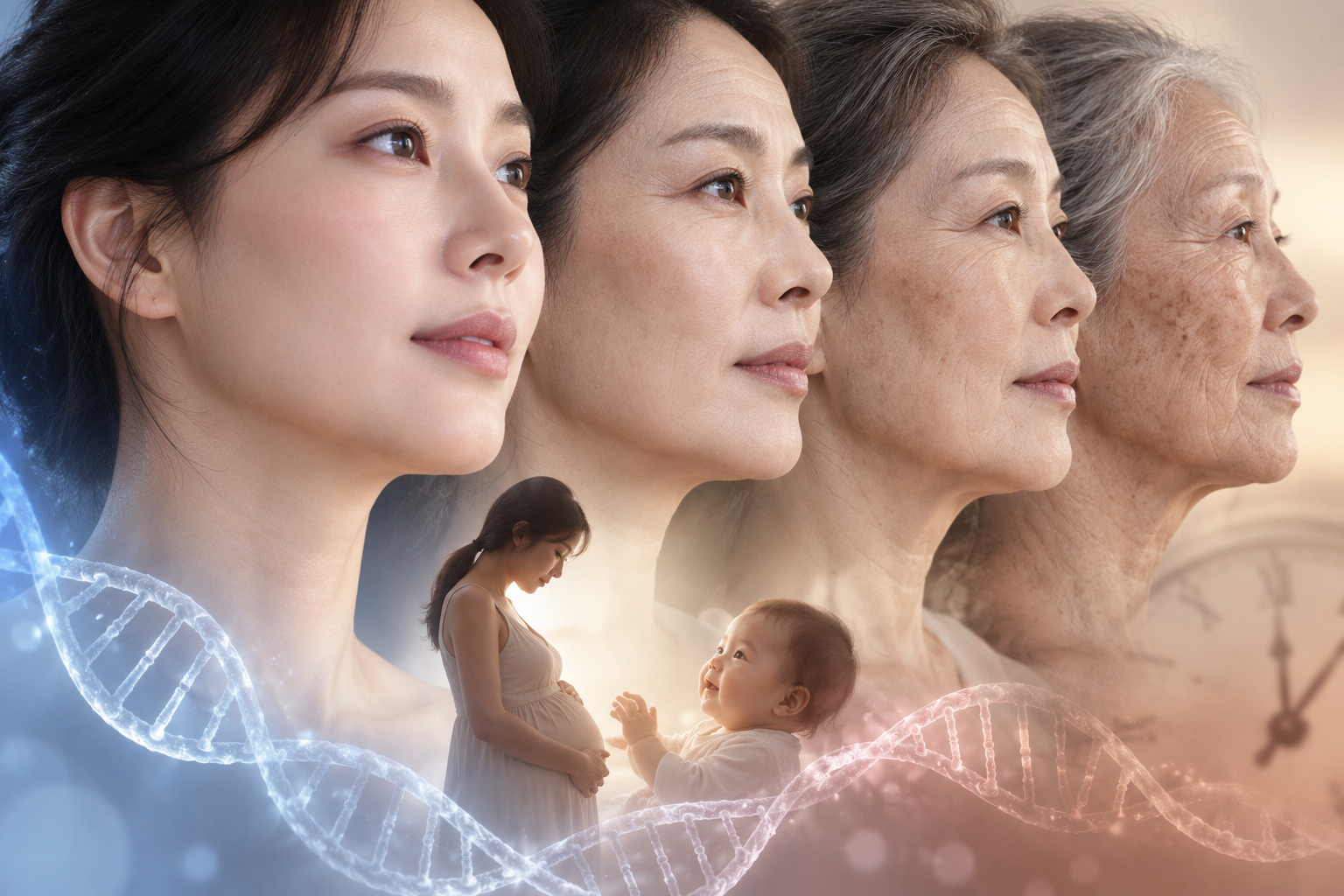
Image disclosure: the original publisher states that the images were made with generative AI (ChatGPT, OpenAI), including a composite representing unmarried women active in Korean entertainment. The images illustrate the discussion and provide no evidence about the depicted individuals’ fertility, reproductive history or biological age.
Related reading
Copyright © 2026 Fertility Information TokTok | THE FERTILITY NOTES. All rights reserved. Unauthorized republication, reproduction, redistribution, scraping, AI training and data use of articles, photographs, images and all other content are strictly prohibited. Violations may result in legal liability.