
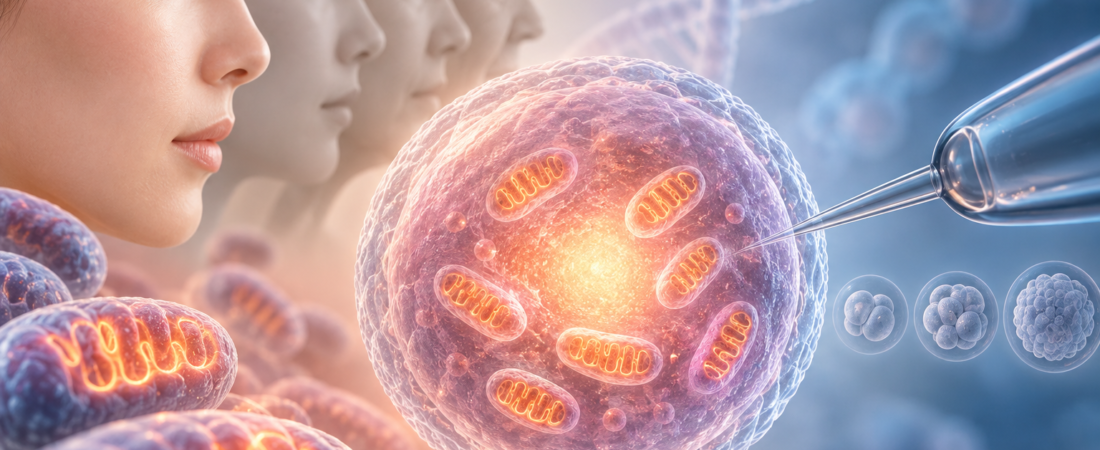
Mitochondria and egg aging: why scientists are studying the cell’s energy supply as egg function declines with age.
These cellular “powerhouses” supply energy for egg maturation, fertilization, and early embryo development.
Research ranges from CoQ10 and NMN to mitochondrial replacement, but it is too early to claim that these approaches improve IVF success.
It is well known that the number of eggs declines as women grow older. Fertility treatment faces another challenge alongside that decline in quantity: the eggs that remain may no longer function as well as they once did.
Why does this happen?
One place scientists are looking for answers is the mitochondria inside the egg.
Mitochondria are often called the powerhouses of the cell because they use nutrients from food to produce the energy cells need to function. Eggs contain far more mitochondria than many other cells. In effect, these structures help provide the energy required for cell division.
This raises an intriguing question.
If mitochondrial function in eggs declines with age, could improving mitochondrial health help restore egg function?
A “Directions” article in the September 2026 issue of Human Reproduction examined this question. Researchers at Yale School of Medicine in the United States reviewed how far mitochondria-targeted treatment strategies have progressed in assisted reproduction.
Why do eggs need so much energy?
An egg may look like a largely inactive cell. That changes as it matures, is fertilized by a sperm, and begins developing into an embryo.
A fertilized egg must keep dividing from one cell into two, four, eight, and beyond. Considerable energy is needed for this process to proceed smoothly, and mitochondria are central to supplying it.
Their role does not end there.
Mitochondria also participate in oxidative stress, cellular aging, and the process through which damaged cells undergo programmed cell death. When mitochondrial function is disrupted, the consequences can extend beyond a simple shortage of energy.
As women age, eggs may undergo changes including reduced mitochondrial function, DNA damage, and increased oxidative stress. Researchers continue to investigate how these changes may affect egg maturation, fertilization, and early embryo development.
Egg aging, then, is not just a matter of an egg becoming older. It also involves changes in the systems that generate energy and maintain the cell’s condition.
Why are CoQ10 and NMN being studied?
This is where some names familiar to fertility patients enter the discussion.
They include coenzyme Q10, or CoQ10; NAD+ precursors such as NMN; and resveratrol. Because these compounds are connected with mitochondrial energy production, oxidative stress, or cellular aging, they have attracted interest in egg-aging research. Mitoquinone, or MitoQ, an antioxidant that directly targets mitochondria, is also being investigated.
Animal and cell studies have suggested that some of these compounds may improve mitochondrial function or have favorable effects on egg condition and embryo development.
However, an essential distinction must be made.
“The eggs looked better” does not mean the same thing as “the chance of having a baby through IVF increased.”
Some human studies have also reported favorable findings related to ovarian response, eggs, or embryos. Evidence remains insufficient, however, to establish whether these findings translate into more pregnancies and live births. Study populations, doses, and treatment durations differ, and the results are inconsistent.
The current evidence therefore does not justify saying that taking a mitochondrial supplement improves egg quality and raises IVF success rates.
In particular, the phrase “egg-rejuvenation supplement,” often seen online, goes well beyond what the scientific evidence currently establishes.
Mitochondrial replacement goes much further than supplements
Scientists are not looking only at drugs and nutritional compounds.
Mitochondrial replacement approaches, intended to substitute healthy mitochondria for those that function poorly, are also being studied.
One example is maternal spindle transfer. In simplified terms, the structure containing the egg’s nuclear genetic material is moved into another egg containing healthy mitochondria. Another approach, pronuclear transfer, moves the pronuclei after fertilization has taken place.
These techniques are fundamentally different from taking CoQ10 or NMN in an attempt to support mitochondrial function.
They involve directly manipulating eggs or fertilized eggs. Researchers must assess not only safety but also the implications for mitochondrial DNA and future generations. Substantial scientific and clinical challenges remain before these techniques could be widely applied to infertility treatment.
Why “making eggs younger” remains an unproven claim
Even so, the reasons for reproductive medicine’s interest in mitochondria are clear.
Female age has long been treated as an essentially irreversible factor in fertility treatment. Current medicine cannot halt the age-related decline in egg number or the increasing likelihood of chromosome abnormalities.
If some aspects of egg aging are linked to changes in mitochondrial function, identifying a point at which those processes can be safely influenced could open a different possibility.
For now, it remains a possibility.
It is not yet clear which compounds should be used, at what dose, or when during egg development an intervention should take place. Most importantly, the ultimate question is whether an approach leads to pregnancies and the birth of healthy children—not simply whether eggs look a little better in the laboratory.
It is therefore too early to describe mitochondrial research as a technology for rejuvenating eggs.
Instead, researchers’ questions are becoming more precise.
Why does egg function decline with age? How important are mitochondria in that process? And if their function can be protected safely, how much of egg aging might be open to intervention?
Those questions explain why reproductive scientists are focusing on the tiny powerhouses inside the egg.
For related reporting, see mitochondrial clearance and ovarian aging and what the evidence says about NMN and egg aging.
Research source
This article is based on “Mitochondria-targeted therapeutic strategies in assisted reproduction: challenges and potential solutions,” a review by researchers at Yale School of Medicine, United States, published in the September 2026 issue of Human Reproduction and first published online on August 3, 2026. DOI: 10.1093/humrep/deag118.
The image used in this article was created using generative artificial intelligence (ChatGPT, OpenAI). Any people depicted are fictional, not real individuals.
Copyright © 2026 Fertility Information TokTok Fertility News | THE FERTILITY NOTES. All rights reserved. Unauthorized republication, reproduction, redistribution, scraping, AI training, and data use of any content, including articles, photographs, and images, are strictly prohibited. Violations may result in legal liability.