
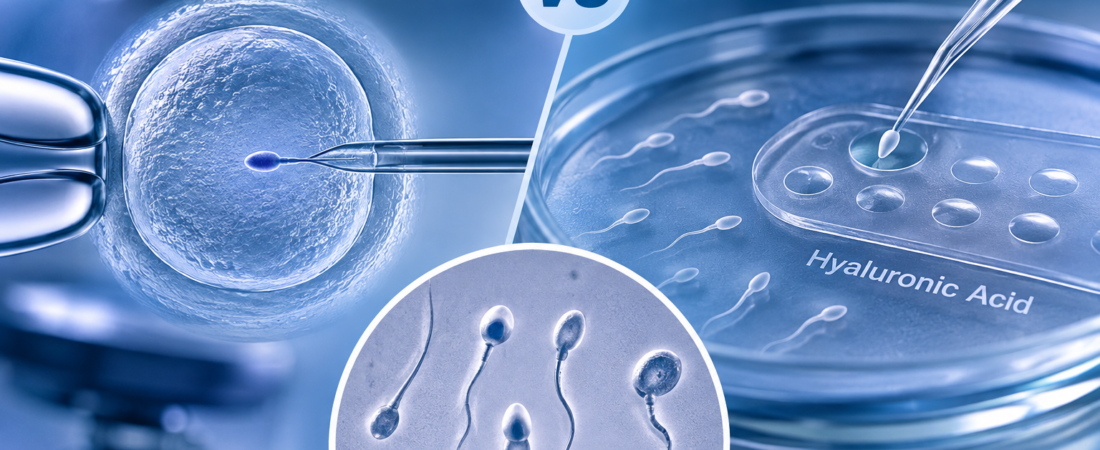

A comparison in 246 couples found no clear difference in fertilization or embryo development.
Selecting sperm by hyaluronic-acid binding did not establish better pregnancy or live birth outcomes.
Does PICSI improve IVF outcomes when fewer than 4% of sperm have normal morphology? A study comparing conventional ICSI with physiological ICSI found no clear difference in fertilization, embryo development, pregnancy or live birth in couples affected by abnormal sperm shape.
Researchers at Hanoi Medical University in Vietnam reported the analysis of 246 couples in Clinical and Experimental Reproductive Medicine on October 2, 2026.
The findings suggest that low normal morphology alone does not establish that an additional sperm-selection step will improve the chance of a baby.
What does morphology below 4% mean?
Morphology assessment is part of basic semen analysis. A microscope is used to examine sperm heads, midpieces and tails and estimate the proportion with a normal structure.
The 2021 WHO semen reference framework includes 4% normal morphology as an important reference value. A result below this may be described as teratozoospermia.
A low percentage does not mean every sperm is abnormal or that natural conception is impossible. Sperm numbers and movement, female age and ovarian function also matter.
With ICSI, an embryologist selects a sperm and injects it directly into an egg. It is widely used in men with abnormal morphology.
Some additional selection techniques consider maturation and functional characteristics alongside appearance. PICSI is one example.
How PICSI adds to conventional sperm selection
In conventional ICSI, an embryologist examines sperm shape and movement before selecting one sperm for injection.
PICSI uses the ability of sperm to bind hyaluronic acid.
Hyaluronic acid is also present around the cells surrounding an egg. Mature sperm can bind it, offering a potential way to enrich selection for more mature cells.
In PICSI, sperm binding to hyaluronic acid are selected before injection, adding another selection step to ICSI.
The theoretical expectation is that selecting mature sperm could aid fertilization and embryo development. Whether it improves pregnancy or birth needs separate clinical evidence.
No clear difference in fertilization or blastocyst formation
The researchers reviewed 246 couples treated at Hanoi Medical University Hospital between January 2022 and January 2024. All male partners had normal morphology below 4%.
They compared conventional ICSI with PICSI while accounting for female age, anti-Müllerian hormone and antral follicle count to make the groups as comparable as possible.
There were no statistically significant differences in the number of mature eggs, fertilization rate, day-5 blastocyst formation or good-quality blastocyst formation.
A blastocyst is the developmental stage usually reached around days 5–6 after fertilization and commonly used for embryo transfer or freezing.
The study did not establish that selecting sperm by hyaluronic-acid binding produced better fertilization or more high-quality embryos.
Pregnancy and live birth outcomes were also similar
Clinical outcomes were assessed as well as laboratory development.
The analysis used the first frozen embryo transfer with a day-5 blastocyst.
Positive pregnancy tests, ultrasound-confirmed clinical pregnancy, implantation, ongoing pregnancy and live birth did not differ significantly between groups.
Analyses stratified by female and male age also did not establish an advantage for PICSI.
Adding the technique for low sperm morphology therefore did not necessarily increase the chance of pregnancy or birth in this population.
However, absence of a statistically significant difference does not prove the methods are exactly equivalent. Small differences may have gone undetected because of sample size or participant characteristics.
Sperm shape and DNA integrity are different questions
The study also highlights the limits of judging fertilizing ability or embryo-development potential from appearance alone.
Morphology and DNA integrity can be related, but they do not always agree.
Sperm that look normal may have DNA damage, while abnormal shape does not mean every sperm has damaged genetic material.
DNA fragmentation refers to breaks or damage within sperm DNA. It is important in male infertility research because of possible effects on embryo development and pregnancy outcomes.
The authors suggested that future work should incorporate DNA fragmentation results to investigate which men might benefit from PICSI.
They also proposed sibling-oocyte studies, splitting eggs from the same retrieval between ICSI and PICSI. This could reduce variation in egg quality when comparing the selection methods.
Low morphology does not automatically require PICSI
This was a retrospective observational analysis of clinical records, not a randomized trial, limiting definitive conclusions about comparative effectiveness.
It involved one hospital and assessed pregnancy and birth chiefly after the first frozen transfer. The findings cannot be applied uniformly to couples with repeated fertilization or implantation failure.
Men with low counts, poor motility or DNA damage in addition to abnormal morphology may need a separate assessment.
Nevertheless, the findings provide useful evidence when considering treatment add-ons.
A low normal-morphology percentage alone does not establish a need for more elaborate selection than conventional ICSI.
Sperm count and motility, previous fertilization, embryo development, female age and ovarian function all belong in the decision.
The authors favored selecting the injection approach according to patient characteristics, rather than applying PICSI uniformly to all couples with abnormal sperm morphology.
The relevant question is whether a technique improves pregnancy and birth for a particular group, rather than whether it is technically more sophisticated.
Study source
Hoan Phuc Nguyen, Dung Ngoc Le, Hoa Thanh Nguyen and colleagues at Hanoi Medical University: “Comparative effectiveness of physiological intracytoplasmic sperm injection and intracytoplasmic sperm injection in couples affected by abnormal sperm morphology.” Clinical and Experimental Reproductive Medicine, October 2, 2026. DOI: 10.5653/cerm.2026.09579. PMID: 42823190.
The illustration was generated using ChatGPT (OpenAI). ICSI injects one selected sperm into an egg; PICSI adds hyaluronic-acid-binding selection. PICSI does not directly test sperm DNA or select only chromosomally normal sperm.
Related reading
High sperm DNA fragmentation: what laboratory sperm preparation can change
Copyright © 2026 THE FERTILITY NOTES. All rights reserved. Unauthorized reproduction, copying, redistribution, scraping, AI training, or data use of any content, including articles, photographs, and images, is strictly prohibited. Violations may result in legal liability.