
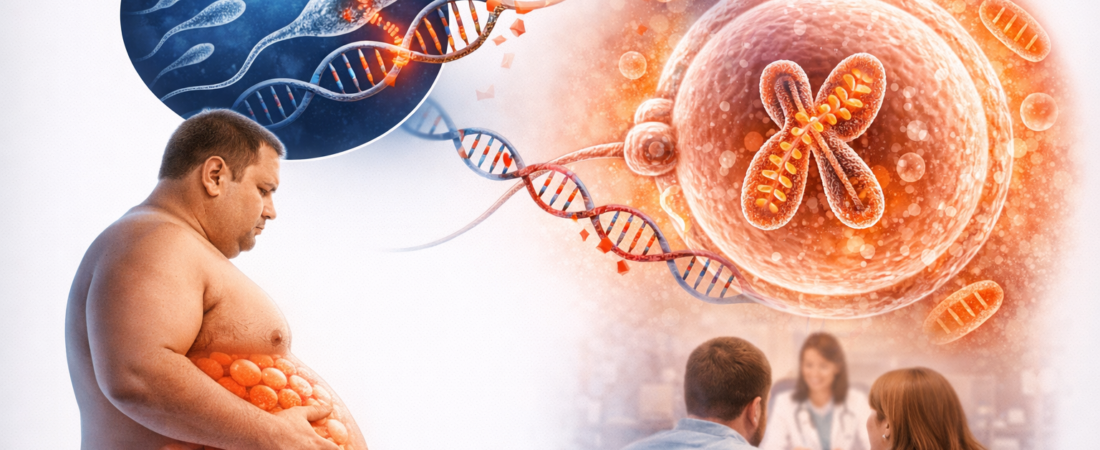
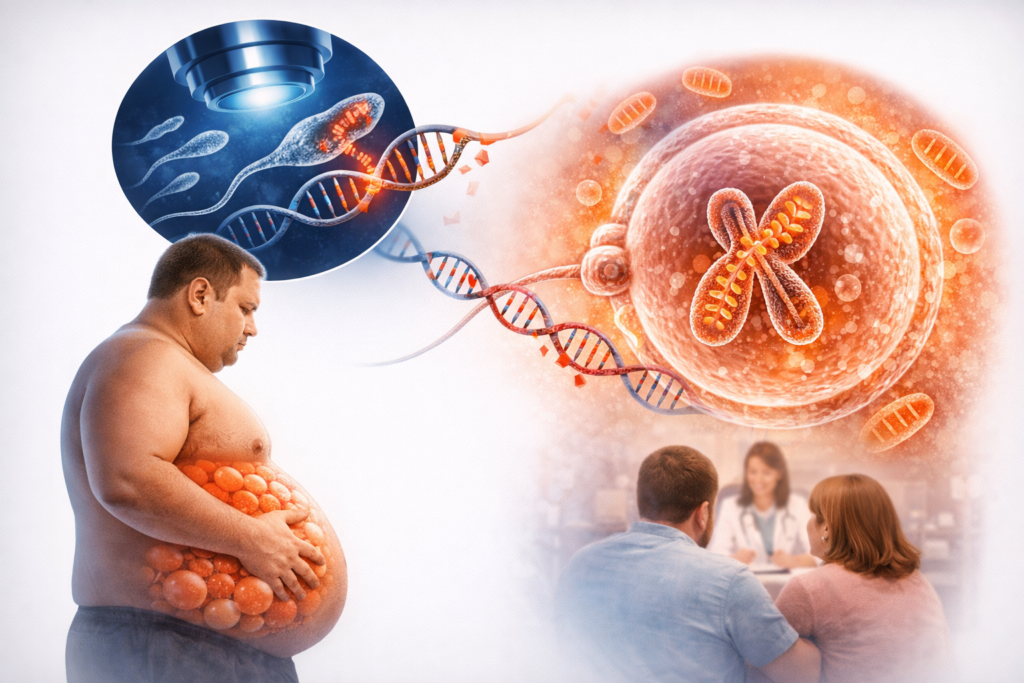
For too long, obesity has been misinterpreted through a lens of judgment—framed as a result of poor lifestyle choices, a lack of willpower, or a failure in self-management. This traditional narrative, however, is being dismantled by modern reproductive science. Current research suggests that gaining weight is not merely a change in body size; it is a clinical indicator that the most fundamental units of life—sperm and eggs—are beginning to malfunction.
The Male Perspective: Beyond Sperm Count Historically, male fertility was gauged by sperm count. Today, we know the real metric is quality. Obesity triggers systemic inflammation that directly attacks sperm DNA. Even sperm that appear morphologically normal under a microscope can harbor internal genetic damage. This damage doesn’t just affect fertilization; it propagates into the embryonic stage. Where we once saw a problem of “insufficient sperm,” we now recognize a problem of “damaged sperm.”
The Female Perspective: A Metabolic Energy Crisis In women, the impact is even more complex. Obesity transcends the simple disruption of ovulation; it induces insulin resistance and destabilizes the egg’s internal energy systems. Critically, mitochondrial dysfunction becomes a deciding factor. An egg may appear healthy on the outside, but it lacks the internal energy required for proper development. Some studies suggest that these eggs are more prone to chromosomal abnormalities—essentially, the egg ages prematurely. This is the physiological toll of obesity: the biological clock is accelerated by the body’s internal metabolic environment.
The Paradigm Shift: Metabolic Restoration The landscape is shifting with the advent of advanced obesity treatments. GLP-1 receptor agonists are changing the game by doing more than just reducing body mass; they modulate insulin levels and dampen systemic inflammation, fundamentally re-engineering the body’s metabolic environment. This means we are no longer just fighting weight; we are reconstructing the reproductive landscape. Clinical observations confirm that after metabolic correction, ovulation often resumes and sperm quality shows measurable improvement.
The Trap of Simplification However, there is a dangerous misconception that “losing weight is the only goal.” Weight loss without metabolic health is a hollow victory. Rapid weight loss that leads to muscle wasting and nutritional deficiencies can destabilize the hormonal system even further. Extreme dieting does not restore reproductive function; it merely dismantles it in a different way.
Conclusion: Reproductive Power is Cellular, Not Numerical The medical community’s view of obesity is evolving. It is no longer about the “flesh”; it is about a complex metabolic axis spanning inflammation, insulin signaling, cellular energy, and DNA stability. Conception is no longer just the meeting of egg and sperm; it is the final act of a long narrative written by the body’s entire physiological status.
When we counsel patients struggling with weight, we must shift our questioning. It should not be “How much weight have you lost?” but “How have you transformed your biological environment?” Fertility is determined at the cellular level, not by the numbers on a scale.
Sources: Zini A & Sigman M, Human Reproduction; du Plessis SS et al., Asian Journal of Andrology; Rando OJ & Simmons RA, Nature Reviews Genetics; Fertility and Sterility; World Health Organization (WHO) GLP-1 Guidelines.
Disclaimer: This content is provided for informational purposes, based on reporting on infertility and various public data. Medical judgments and treatment decisions must always be made in consultation with professional medical personnel. Image: AI-generated (ChatGPT, OpenAI) / Visual reference for illustrative purposes only.