
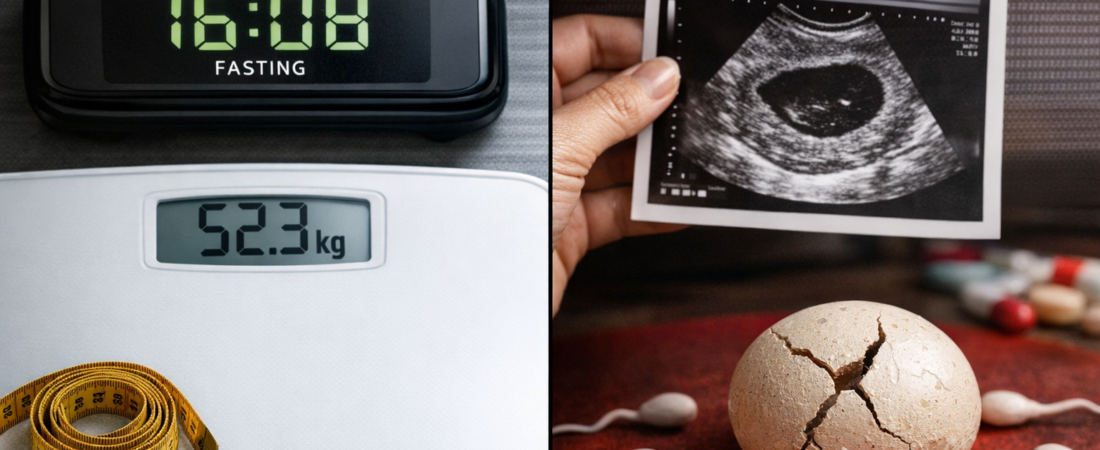
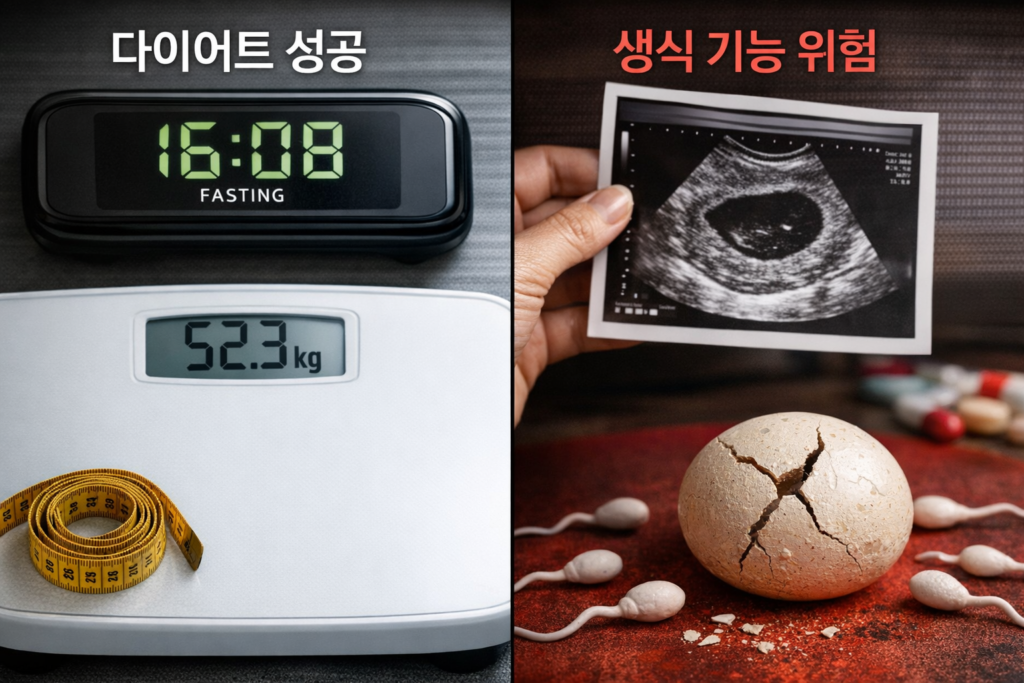
Intermittent fasting has surged from a trendy diet to a lifestyle movement, and its influence is now crossing the boundaries into hormone regulation and fertility. Among patients struggling with infertility, a growing belief holds that “fasting improves the odds of pregnancy.” But according to the latest research, intermittent fasting is not a universal fertility booster; rather, it is a “metabolic corrective tool” that functions only under specific conditions. Once that boundary is crossed, the body initiates a completely different survival response.
A 2025 metabolic and endocrine review repeatedly reports that intermittent fasting can improve insulin resistance and restore ovulation in women with Polycystic Ovary Syndrome (PCOS). In some cohorts, menstrual cycle recovery rates exceeded 60%. Based on this data, one might be tempted to conclude, “Fasting leads to pregnancy.” However, this overlooks a critical prerequisite: these benefits occur exclusively when the body is in a pathological state—the goal is to return a “dysfunctional system” to a baseline state of normalcy.
When intermittent fasting is applied to women with a healthy body mass index, the outcome often reverses. The body interprets such dietary restriction not as a “healthy choice,” but as a state of “energy deficiency.” In the hierarchy of physiological functions, reproduction is the first to be down-regulated when the body senses an energy crisis.
Consequently, intermittent fasting can trigger a suppression of the hypothalamic-pituitary-gonadal axis. GnRH secretion decreases, followed by a drop in LH and FSH, eventually stalling ovulation. In men, the result is a reduction in testosterone and a deceleration of spermatogenesis. This is not a pathology; it is a normal, adaptive decision by the body to prioritize survival over reproduction.
Recent nutritional reviews clearly define this phenomenon: intermittent fasting is a “double-edged sword” in female reproduction. It is beneficial for metabolic repair, but if the conditions are not met, it leads directly to reproductive inhibition. This risk is exacerbated in those who are already at a healthy weight or those facing chronic stress. While some studies suggest minimal hormonal shifts, these results only highlight that the physiological response depends heavily on the intensity and duration of the fast. The boundary between “metabolic repair” and “reproductive shutdown” is far thinner than many assume.
Many patients fall into the trap of believing that “more restriction equals better results.” In reproductive biology, however, this is a fallacy. This system does not function on a “maximum restriction strategy”—it operates on a “sufficient maintenance strategy.” Ovulation, fertilization, and implantation proceed only when the body perceives that its energy reserves are safe. The moment it detects an energy deficit, reproduction is deprioritized.
The message from modern reproductive medicine is clear: intermittent fasting is not a direct path to pregnancy. It is, at best, a process to correct obesity and metabolic dysfunction. The moment this context is ignored in favor of “eating less,” the body reacts with brutal honesty. It chooses survival first, and puts reproduction on hold.
Source: Velissariou M, Athanasiadou CR, Diamanti A, et al., “The impact of intermittent fasting on female reproductive function and PCOS: A systematic review,” PMC / PubMed (2025).
Disclaimer: This content is provided for informational purposes, based on reporting on infertility and various public data. Medical judgments and treatment decisions must always be made in consultation with professional medical personnel. Image: AI-generated (ChatGPT, OpenAI) / Visual reference for illustrative purposes only.