

Metformin may help selected women with PCOS by improving insulin resistance and ovulation, and can reduce OHSS risk in some IVF protocols.
It does not improve pregnancy success for every patient, and guidelines emphasize selective use.
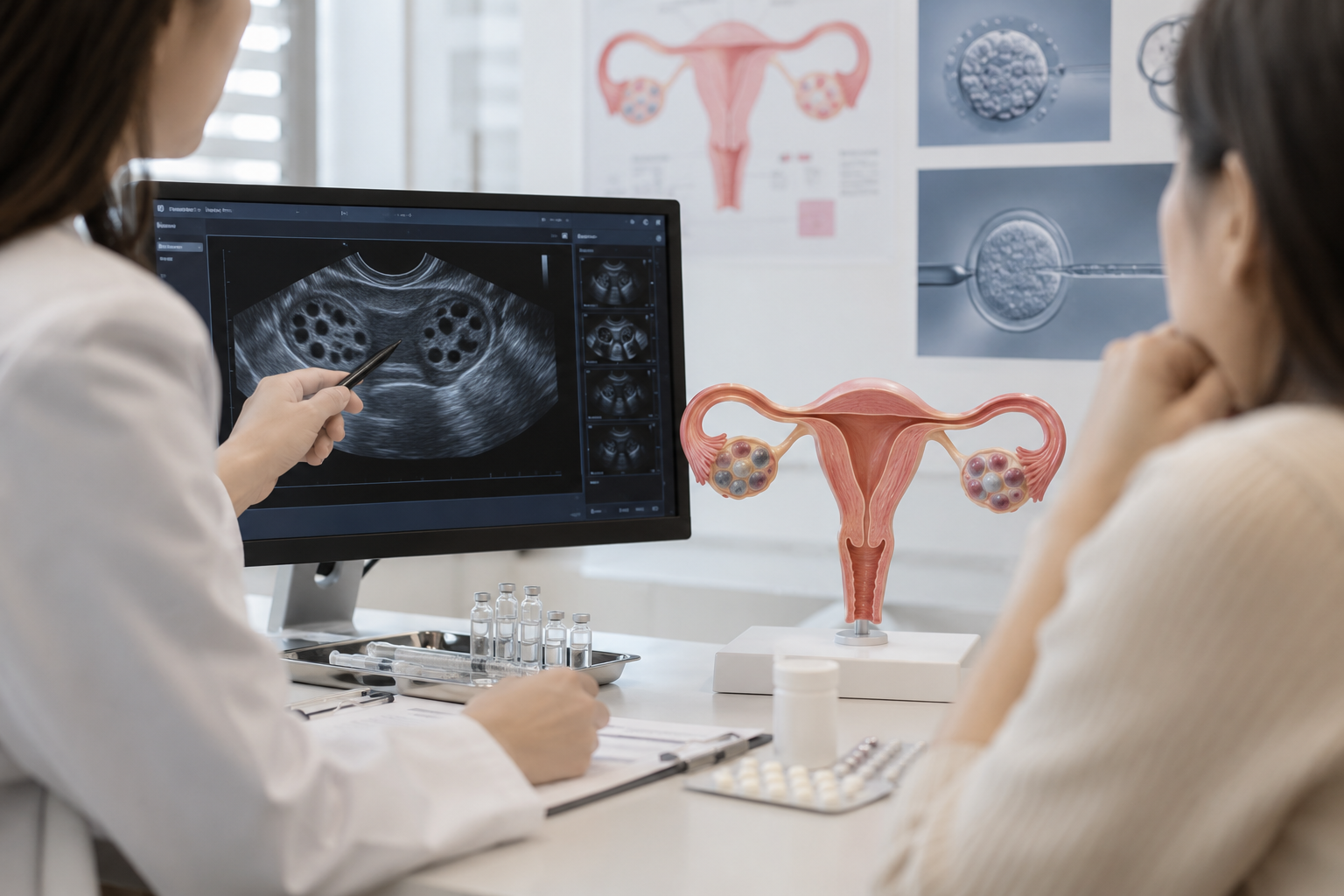
Women receiving fertility treatment for polycystic ovary syndrome (PCOS) may be prescribed a diabetes medicine despite not having diabetes. Being offered metformin before IVF can be puzzling: why take it when blood glucose is normal?
PCOS is not simply a condition involving many small ovarian follicles. Insulin resistance and hormonal imbalance can interact in this endocrine disorder.
Metformin may improve insulin resistance and help restore ovulation in some patients. In certain IVF protocols, it is also used to reduce the risk of ovarian hyperstimulation syndrome (OHSS).
International guidance does not support prescribing it uniformly to everyone with PCOS.
PCOS involves more than the ovaries
PCOS is a common hormonal disorder in reproductive-age women, often involving irregular periods, ovulatory dysfunction and elevated androgens. Irregular ovulation can make conception difficult.
Insulin resistance is an important part of the picture.
Insulin helps glucose enter cells for use as energy. When cells respond inadequately, the pancreas produces more insulin to compensate.
Higher insulin levels can stimulate ovarian androgen production, potentially disturbing follicle growth and ovulation and contributing to irregular cycles and infertility.
Insulin resistance can occur in PCOS even at a normal body weight. Absence of obesity or diabetes does not rule out metabolic disturbance.
Why metformin may help ovulation
Metformin reduces excessive glucose production by the liver and improves insulin sensitivity.
In some patients, reduced insulin resistance may lessen excess androgen production and improve cycles and ovulation.
That explains its use without diabetes: the purpose may be to improve the metabolic conditions interfering with ovulation rather than simply lower blood glucose.
It does not restore ovulation in everyone. Letrozole is generally recommended as first-line ovulation induction for anovulatory infertility in PCOS, while metformin’s role depends on metabolic circumstances and treatment goals.
A possible role in reducing OHSS risk
Another reason for prescribing metformin during IVF relates to OHSS.
Women with PCOS often have many small follicles and may respond strongly to stimulation, allowing an excessive number to grow.
OHSS can involve enlarged ovaries, abdominal distension, pain and fluid accumulation; severe cases may require hospitalization.
Some clinical studies have reported lower OHSS risk with metformin in women with PCOS.
However, this benefit does not apply equally to every IVF protocol.
Guidelines distinguish between stimulation protocols
The 2025 ESHRE ovarian-stimulation guideline update takes a selective approach.
Evidence suggests possible OHSS risk reduction in some protocols, but routine addition solely for prevention is not recommended in commonly used GnRH antagonist cycles.
Metformin may be considered as an adjunct to reduce OHSS risk in PCOS when using a long GnRH agonist protocol.
Other approaches include individualizing stimulation doses, triggering final maturation with a GnRH agonist where appropriate, and freezing all embryos when indicated.
Prescribing should therefore consider both metabolic status and the stimulation method, rather than the PCOS diagnosis alone.
Does it improve egg quality or pregnancy rates?
Patients understandably want to know whether metformin increases the chance of pregnancy.
It is tempting to assume that improved insulin resistance automatically improves the ovarian environment and egg quality, but clinical findings are more complex.
Some studies show improved ovulation or other clinical measurements. Evidence of consistently improved clinical pregnancy or live birth in IVF is insufficient.
Egg quality is influenced by age, ovarian function, chromosome abnormalities and metabolic circumstances. Improving insulin resistance does not correct egg chromosome abnormalities or improve embryo development in every patient.
Metformin should therefore not be understood as a direct egg-quality treatment or a guarantee of implantation.
Should treatment continue after pregnancy is confirmed?
Patients who conceive while taking metformin may wonder whether to continue.
The original reason for prescribing it is important.
If used for PCOS-related ovulation problems or as an IVF adjunct, continuation can be reviewed after pregnancy confirmation. With diabetes or a need for glucose control, treatment may need continuing or changing according to the pregnancy management plan.
The 2023 international PCOS guideline explains that metformin in pregnancy has not been shown to prevent conditions such as gestational diabetes or pre-eclampsia. It may help some outcomes in selected circumstances, but long-term effects on children remain uncertain.
Nausea, diarrhea and abdominal discomfort can occur. Dose and continuation should be discussed with the treating team.
Treatment should match the individual indication
Prescribing a diabetes medicine in PCOS is not solely about lowering glucose. It may address insulin resistance and the hormonal environment affecting ovulation, or reduce complications with particular IVF methods.
Not everyone with PCOS needs it, and taking it does not necessarily improve pregnancy rates.
PCOS also does not automatically require IVF as the initial treatment. Ovulation induction may be considered first when tubal assessment and semen testing do not reveal other significant problems.
Age, weight, glucose and metabolic status, ovulation, ovarian reserve and other infertility factors should inform the plan.
If metformin is prescribed before IVF, it is useful to clarify whether the aim is metabolic treatment, OHSS prevention or another indication, rather than viewing it simply as a medicine that helps pregnancy.
The goal is to select appropriate treatment that supports safe pregnancy and birth, rather than maximize the number of medicines used.
This article draws on ESHRE’s “Ovarian stimulation for IVF/ICSI: an update in 2025,” published in Human Reproduction Open, the 2023 international evidence-based PCOS guideline, and ASRM’s 2024 OHSS-prevention guidance. Prescribing or stopping metformin depends on metabolic circumstances and treatment protocol and should be discussed with the treating clinician.
The accompanying image was created using generative AI (ChatGPT, OpenAI); any people depicted are fictional.
Related reading: Understanding the tests at a first fertility clinic visit
Copyright © 2026 Fertility Information TokTok Fertility News | THE FERTILITY NOTES. All rights reserved. Unauthorized reproduction, copying, redistribution, scraping, AI training, and other data use of any articles, photographs, images, or other content are strictly prohibited. Violations may result in legal liability.