

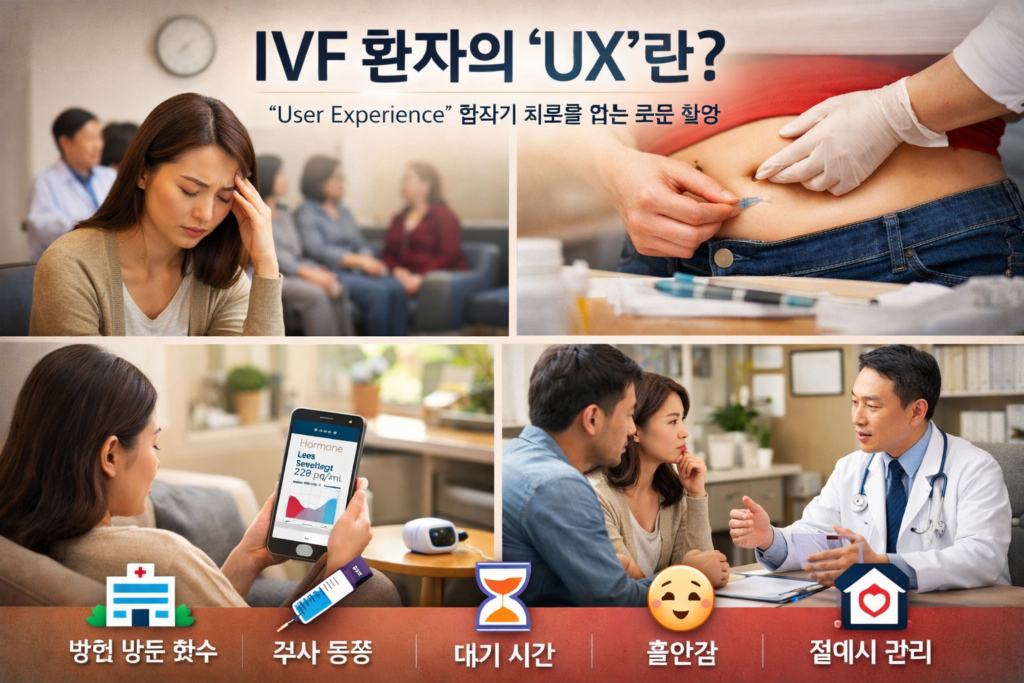
The narrative that IVF is transforming into a patient-centered, decentralized experience is gaining traction. While it is true that IVF is evolving, the moment we simplify this shift under the banner of “UX innovation,” we risk blurring the fundamental nature of the treatment itself.
Recently, wearable hormone tracking technologies have emerged, offering a seductive proposition: remote data collection without the need for repeated blood draws, promising fewer hospital visits. For patients, this is an undeniable allure. However, to interpret this trend as “IVF moving from the hospital to the home” is not just bold—it is potentially dangerous.
In IVF, repeat blood draws are not merely a clinical inconvenience; they are the cornerstone of essential data acquisition. Estradiol levels dictate the timing of ovulation induction, influence the “trigger shot” timing, and ultimately determine the quality and quantity of retrieved eggs. This process exists for precision, not convenience. For wearable technology to replace this, it must demonstrate not just parity, but exact reproducibility—a standard that remains an aspiration rather than a clinical reality today.
Furthermore, there is a fundamental misunderstanding about the nature of the treatment. IVF is not simply a matter of monitoring variables; it is a complex therapeutic process where follicular growth, endometrial receptivity, drug response, and highly individual patient variables interact in real-time. While data collection can be decentralized, the interpretation of that data and the adjustment of therapeutic strategy remain, and must remain, within the domain of medical expertise. IVF is not “migrating” to the home; it is expanding through a digital augmentation of the hospital-based core.
The current emphasis on “UX” (User Experience) also requires recalibration. While enhancing the patient experience and improving treatment adherence are noble and necessary goals, we must be careful not to conflate “convenience” with “clinical quality.” The ultimate goal of IVF is not merely a smooth process, but a healthy birth. Any discussion of UX that deviates from this clinical outcome risks losing its way.
We need a more precise definition of our current trajectory. IVF is not simply shifting from technology to experience; it is evolving into a “dual-structure” where high-precision biological intervention and patient-centric management systems advance in tandem. Wearables are likely to serve as complementary devices that bridge the gaps in data, not as replacements for rigorous diagnostic standards. And UX should be viewed as a strategic variable for improving treatment adherence, not as a surrogate for success rates.
Ultimately, we are left with a singular question: Do we want an IVF that is convenient, or one that is successful? The answer, of course, is both. However, the order of priority must be inviolable: success is the standard upon which the patient experience is built. The moment we invert this hierarchy, IVF ceases to evolve—it merely simplifies.
Disclaimer: This content is provided for informational purposes, based on reporting on infertility and various public data. Medical judgments and treatment decisions must always be made in consultation with professional medical personnel. Image: AI-generated (ChatGPT, OpenAI) / Visual reference for illustrative purposes only.