
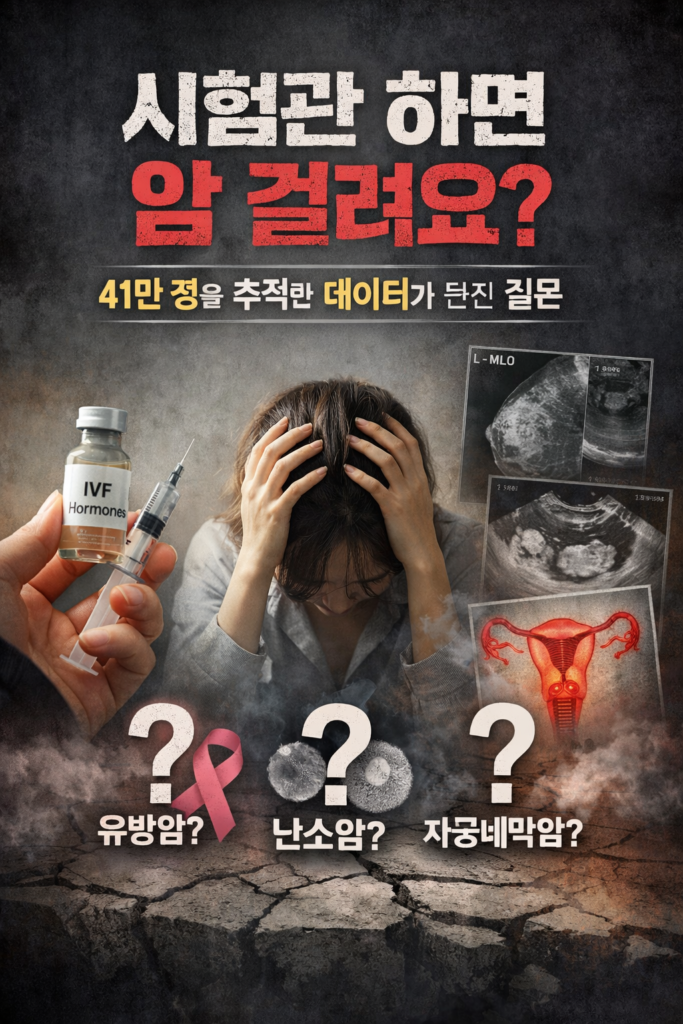
The moment a patient decides to pursue In Vitro Fertilization (IVF), a quiet but persistent fear almost always surfaces: “Will this treatment give me cancer?”
This question, often whispered in consultation rooms, carries the weight of decades of anecdotal anxiety. For years, the narrative has been fueled by the fear of hormonal stimulation: “Is it safe to use these drugs to produce so many eggs? Is it safe to repeatedly stimulate the ovaries?” From breast and ovarian cancer to more obscure fears regarding melanoma or thyroid cancer, the association between IVF and malignancy has grown into a widespread public concern.
The problem, however, has always been that this fear was rooted in “suspicion” rather than “verified risk.”
Finally, we have the numbers to address this—and the scale is profound. A landmark, population-based cohort study tracking over 400,000 women has provided a definitive answer. The result is sober and reassuring: the overall incidence of invasive cancer among women who underwent assisted reproductive technology (ART) was no different from that of the general population. The long-standing formula of “IVF equals cancer” has collapsed under the weight of the data.
Digging Deeper into the Data
While the overall conclusion is a resounding “no,” the data reveals a complex landscape. Some studies show a slight elevation in specific cancers, such as breast, ovarian, or endometrial cancer, while simultaneously noting a decrease in others, such as cervical and lung cancer.
This variability highlights a crucial clinical truth: it is impossible to isolate “IVF” as the sole cause. Infertility itself is a complex “environmental” state—intertwined with hormonal patterns, ovulation history, metabolic profiles, body mass index, and lifestyle factors. Furthermore, women undergoing ART are subjected to more frequent medical check-ups and diagnostic imaging, leading to higher rates of early detection—a phenomenon known as “detection bias.”
The Verdict: IVF is Not Guilty
The conclusion is clear: IVF is not a carcinogenic procedure. At least, the current body of large-scale data offers no evidence that it increases the overall risk of invasive cancer.
The standardized incidence ratio (SIR) of 1.00—representing no difference—is as powerful a statistic as one can find in epidemiology. Both IVF and IUI (intrauterine insemination) cohorts showed near-identical cancer risk profiles to the control group.
This does not mean we should discard caution. Areas of clinical interest, such as breast and ovarian health, remain under active surveillance. However, we have shifted from a phase of “fear-based speculation” to a phase of “data-driven observation.”
The era of debating whether to undergo IVF based on unfounded fears is over. We have entered a stage of upgrading the conversation: we are no longer asking if it is dangerous, but rather how to provide the safest, most effective care possible. The questions have changed, and so have the answers.
Source: JAMA Network Open. 2026; “Assisted Reproductive Technology and Risk of Invasive Cancer” (n=417,984, SIR 1.00).
Disclaimer: This content is provided for informational purposes, based on reporting on infertility and various public data. Medical judgments and treatment decisions must always be made in consultation with professional medical personnel. Image: AI-generated (ChatGPT, OpenAI) / Visual reference for illustrative purposes only.