
From a Disease of Menstrual Pain to a Systemic Condition
“Why did the IVF attempts repeatedly fail? The answer wasn’t in the uterus, but in the immune system.”
Just a decade ago, endometriosis was described as a relatively simple disease. The general perception was that it was a gynecological condition where endometrial tissue, which should be inside the uterus, settles in the ovaries, peritoneum, or fallopian tubes, causing inflammation and pain, and in severe cases, pelvic adhesions and infertility. Treatment focused primarily on surgery to remove lesions or medication to suppress female hormones.
The medical community has begun to redefine endometriosis as an entirely different disease. While the disease may begin in the uterus, the true culprits that nurture and exacerbate it are the immune system and chronic inflammation.
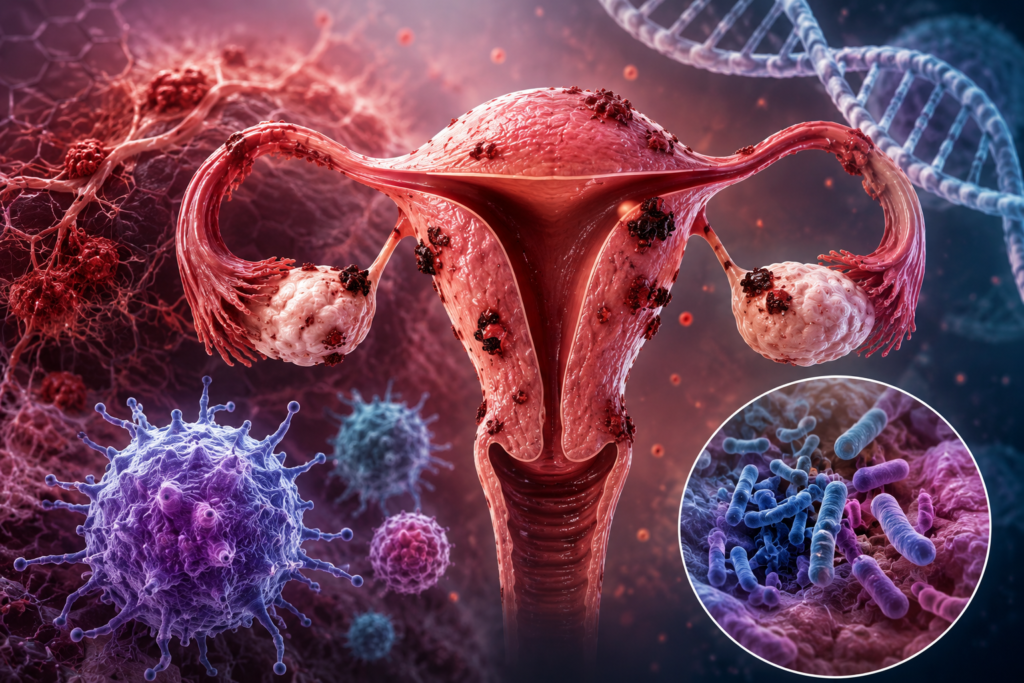
Recent research increasingly views endometriosis not as a simple gynecological disorder, but as a systemic disease where immune dysfunction and chronic inflammation interact in complex ways. Research attempting to connect gut microbiota, immune cells, angiogenesis, neurogenesis, and oxidative stress into a single disease process is rapidly increasing. This is why the recognition is spreading that treating only the uterus is insufficient to address the essence of the disease.
It Was Immunity, Not the Uterus, That Created the Disease
Endometriosis is a common condition occurring in about 10% of women. However, it does not occur in everyone. It is common for healthy women to experience some degree of menstrual blood reflux into the abdominal cavity through the fallopian tubes.
So why does endometriosis develop in some women and not others? Recent studies are finding the answer in the immune system.
In a normal state, endometrial cells that enter the abdominal cavity are quickly removed by immune cells like macrophages and Natural Killer (NK) cells. However, in patients with endometriosis, these immune surveillance functions are impaired, allowing the cells to survive, attach to surrounding tissues, and grow into lesions. As inflammatory cytokines are continuously secreted, these lesions gradually enlarge, constructing their own survival foundation by creating new blood vessels and nerves.
Ultimately, the interpretation that endometriosis is not just a disease of misaligned tissue growth, but a disorder where the immune system creates an environment that permits the disease, is gaining strength.
Pain Is Only a Result… ‘Chronic Inflammation’ Continues Within the Body
Many patients think of endometriosis as merely “severe menstrual pain.” However, pain is only one part of the disease’s symptoms.
Lesions continuously secrete various inflammatory substances such as interleukins and Tumor Necrosis Factor (TNF). These substances promote blood vessel formation, cause nerve fibers to grow, and make pain sensitivity more acute.
This is why the size of the lesion and the intensity of pain are not necessarily proportional. Some patients suffer from pain so severe that daily life is difficult despite small lesions, while others experience no particular symptoms despite extensive lesions. Because of this, the focus of treatment is shifting from pain management itself to how to control the inflammatory and immune environment.
Even Gut Microbiota Have Become a Subject of Research
The field receiving the most attention in recent years is gut microbiota research.
The gut is the body’s largest immune organ. Gut microbes play a crucial role in regulating estrogen metabolism, immune cell activation, and inflammatory responses. In fact, recent studies consistently show that the gut microbial composition of endometriosis patients is distinctly different from that of healthy women.
While not yet established as a primary treatment method, the possibility of modulating gut microbiota to reduce chronic inflammation and slow disease progression is emerging as a new research frontier. Gut microbiota, once considered solely the domain of gastroenterology, are now expanding into a core research topic in reproductive medicine.
Rewriting the Causes of Infertility
This shift is significantly impacting infertility treatment.
In the past, the core cause of endometriosis-related infertility was explained as sperm and eggs failing to meet due to ‘chocolate cysts’ (endometriomas) or pelvic adhesions. Recently, however, an increasing number of studies suggest that ‘implantation’ is a more critical issue than fertilization itself.
Even if an embryo reaches the uterus, implantation can become difficult in a uterine environment altered by inflammation. In patients with endometriosis, the balance of immune cells in the uterus is disrupted, and inflammatory substances increase, leading to a potential decline in endometrial receptivity. In other words, obtaining high-quality embryos is not enough; creating an immune environment where the embryo can reside is becoming another essential condition for pregnancy success.
For this reason, infertility treatment for IVF is moving beyond the era of merely checking whether lesions were removed. Customized treatment strategies that consider inflammation control, hormonal environments, implantation timing, and immune status are gradually expanding.
The Era of Ending with Surgery Alone Is Passing
In the past, the goal of endometriosis treatment was simply to remove lesions. Recently, however, the treatment concept has shifted toward preventing recurrence and preserving long-term reproductive potential.
Researchers worldwide are proposing Precision Medicine—customized treatment by analyzing individual immune characteristics, gene expression, inflammatory responses, and gut microbial composition—as the new goal. It suggests that hormone therapy may be effective for some patients, while others may require combined modulation of immunity and inflammation for better outcomes.
Although clinical application will take time, endometriosis treatment is already transitioning from an era of ‘lesion removal’ to an ‘era of understanding the biological nature of the disease.’
It Should No Longer Be Dismissed as a “Disease with Severe Menstrual Pain”
Experts point out that the biggest problem is late diagnosis caused by misunderstanding endometriosis as simple menstrual pain. On average, it often takes several years from the onset of symptoms to diagnosis. During this time, inflammation repeats, lesions grow, and ovarian function and reproductive capacity can be affected.
Medicine is currently relearning endometriosis.
Once explained as a problem occurring only in or around the uterus, it is now understood as a complex disease linked to immunity, inflammation, blood vessels, nerves, and even gut microbiota. The shift in perspective on endometriosis is not merely an academic debate. It means the direction of medicine itself is changing—from treatments that reduce pain to those that protect reproductive potential, and from treatments that remove lesions to those that restore the body’s entire immune environment.
Fertility specialists explain, “Endometriosis is no longer a disease confined to the uterus; it is a systemic disease where the immune system and chronic inflammation lead to the onset and progression of the condition.” As this new perspective spreads, infertility treatment is rapidly shifting from a ‘surgery-centered’ approach to an ‘era of managing immunity and inflammation together.’
※ This article was written based on the latest endometriosis and reproductive medicine research published in international academic journals such as Frontiers in Endocrinology, Frontiers in Microbiology, Human Reproduction, and Human Reproduction Update. It does not replace specific individual diagnosis or treatment, and actual medical judgment must be made through consultation with a specialist.
※ The images used in this article were created using generative AI (ChatGPT, OpenAI) and depict fictional individuals, not real people.