
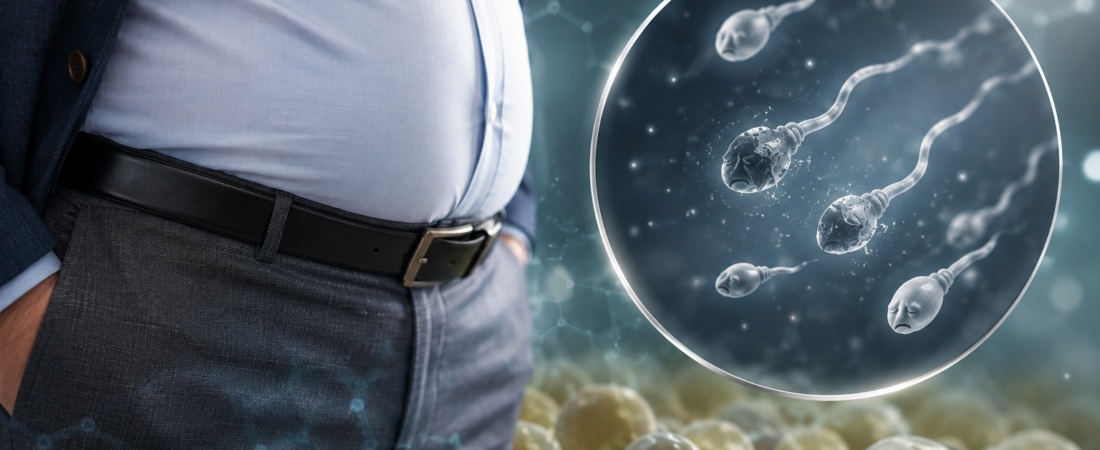
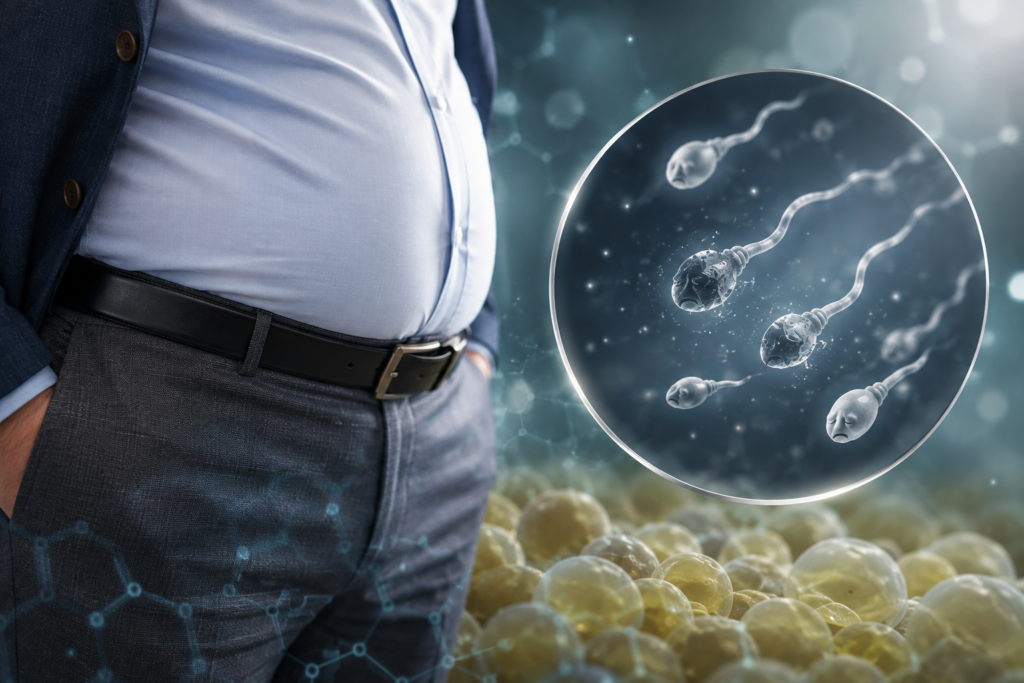
“It Was ‘Obesity Itself’ That Reduced Sperm Count… When Combined with Hyperglycemia, Sperm DNA Was Also Compromised”
- Analysis of 1,048 Men: Oligozoospermia prevalence reached 9.89% in the obese group vs. 5.75% in the non-obese group
- Adjusting for Age, Glucose, Insulin, and Lipids: Odds of oligozoospermia remained 2.37-fold higher in obese men (aOR 2.369, P = 0.004)
- Synergistic Deterioration with Hyperglycemia: When obesity co-existed with elevated blood glucose, asthenozoospermia rose to 20.93% and high DNA fragmentation (DFI >= 30%) reached 18.60%
- Male Infertility Workup: Evaluation must expand beyond routine semen parameters to incorporate metabolic health, including weight, fasting glucose, and insulin resistance
When men undergo a fertility evaluation, the first numbers they typically look at are sperm count and motility. The focus almost always centers on how many sperm there are, how well they move, and what percentage have normal morphology.
However, recent studies in male reproductive medicine increasingly indicate that clinicians and patients must look beyond the basic semen analysis report.
Evidence is growing that metabolic health—including waist circumference, body weight, fasting blood glucose, and insulin resistance—directly impacts testicular function and the functional competence of spermatozoa.
A study published on July 23, 2026, in the international journal Andrology adds substantial evidence to this shifting paradigm.
Analyzing 1,048 men, researchers from Zhejiang University School of Medicine in China demonstrated that oligozoospermia (low sperm count) was significantly more common in obese men. Even after adjusting for multiple metabolic covariates, obesity remained an independent risk factor for reduced sperm count.
Weight Alone Created a Significant Difference
The research team analyzed men who underwent both semen analysis and comprehensive biochemical blood testing between July 2022 and November 2025 at an affiliated hospital of Zhejiang University School of Medicine. The final analysis included 1,048 men: 765 in the non-obese group and 283 in the obese group.
In accordance with Chinese clinical diagnostic criteria, obesity was defined as a Body Mass Index (BMI) >= 28 kg/m2. Therefore, this threshold should be interpreted within its regional demographic context rather than directly equated with Western BMI benchmarks (where obesity is typically defined as BMI >= 30 kg/m2).
Semen analysis was conducted according to the World Health Organization (WHO) 5th Edition manual. Oligozoospermia was defined as a sperm concentration < 15 million/mL or a total sperm count per ejaculate < 39 million.
The initial findings revealed a clear disparity:
- Non-Obese Cohort: Oligozoospermia was identified in 44 out of 765 men (5.75%).
- Obese Cohort: Oligozoospermia was identified in 28 out of 283 men (9.89%).
In raw proportions, oligozoospermia was approximately 1.7 times more prevalent in the obese group.
However, this raw difference raises an obvious question: “Because obese individuals often have higher blood sugar and dyslipidemia, is the issue truly obesity itself, or is it driven by other co-existing metabolic disorders?”
To answer this, the researchers performed a multi-variable regression analysis.
Controlling for Other Variables: “Obesity” Remained an Independent Factor
The researchers statistically adjusted for numerous clinical variables, including age, systolic and diastolic blood pressure, fasting blood glucose, fasting insulin, total cholesterol, LDL-C, HDL-C, liver enzymes (ALT, AST), and serum uric acid.
Even after controlling for all of these parameters, the odds of oligozoospermia in obese men remained 2.369 times higher than in non-obese men (Adjusted Odds Ratio [aOR]: 2.369, 95% CI: 1.313–4.272, P = 0.004). This is why the authors designated obesity as an “independent risk factor” for low sperm count.
It is important to understand what “independent risk factor” means in this context: it does not prove direct biological causation on its own, but rather confirms that the statistical association persists after ruling out measured confounding metabolic variables.
Interestingly, obesity alone did not indiscriminately impair every semen parameter:
- Asthenozoospermia (Low Motility): 8.76% in the non-obese group vs. 10.60% in the obese group (no statistically significant difference).
- Teratozoospermia (Abnormal Morphology): 38.30% vs. 37.10% (no statistically significant difference).
- Baseline Sperm DNA Fragmentation Index (DFI): No statistically significant difference based on obesity status alone.
In this study, isolated obesity manifested primarily as a deficit in sperm quantity rather than functional sperm quality.
The Turning Point: When Hyperglycemia Coincided
The clinical picture changed dramatically when elevated blood glucose was introduced.
The researchers defined hyperglycemia as a fasting blood glucose >= 6.1 mmol/L (approximately 110 mg/dL). Sperm DNA fragmentation was evaluated using the Sperm Chromatin Structure Assay (SCSA), with a DFI >= 30% categorized as the high DNA fragmentation group.
Across the total cohort of 1,048 men, hyperglycemic individuals exhibited higher rates of asthenozoospermia (16.30% vs. 8.58% in normoglycemic men) and high DFI (15.22% vs. 7.22%).
However, the divergence was most pronounced when examining obese men specifically:
| Clinical Group | Asthenozoospermia Rate | High Sperm DFI (>= 30%) Rate |
| Obese + Normal Blood Glucose (n = 240) | 8.75% | 5.00% |
| Obese + High Blood Glucose (n = 43) | 20.93% | 18.60% |
| Comparative Difference | ~2.4-fold increase | ~3.7-fold increase |
- Among obese men who maintained normal fasting glucose, the high DFI rate was only 5.00%.
- In obese men with concurrent hyperglycemia, the high DFI rate surged to 18.60%—a 3.7-fold increase.
Obesity Affects “Quantity,” Hyperglycemia Impairs “Function”
These findings carry important pathophysiological implications.
While obesity alone was predominantly associated with oligozoospermia, the addition of hyperglycemia expanded the damage to include impaired motility and loss of genomic DNA integrity.
The authors outlined several biological pathways through which obesity impairs male reproductive function:
- Endocrine Disruptions: Increased adipose tissue volume upregulates aromatase enzyme activity, accelerating the peripheral conversion of testosterone into estradiol. This altered steroid ratio suppresses the hypothalamic-pituitary-gonadal (HPG) axis, blunting LH and FSH release and reducing intratesticular testosterone necessary for spermatogenesis.
- Systemic Metabolic & Oxidative Stress: Insulin resistance, chronic low-grade systemic inflammation, and elevated reactive oxygen species (ROS) associated with obesity impair developing spermatogenic cells and compromise mitochondrial bioenergetics.
- Scrotal Hyperthermia: Excess suprapubic and medial thigh adiposity impairs the testicular counter-current heat exchange mechanism, elevating scrotal temperatures.
Existing literature from the American Society for Reproductive Medicine (ASRM) similarly notes that endocrine shifts, diabetes, and elevated scrotal temperatures interact to impair male reproductive potential.
When sustained hyperglycemia is superimposed on obesity, oxidative stress and microvascular metabolic imbalances intensify, aligning with the observed spikes in motility loss and DNA strand breaks.
Semen Analysis Alone Is Insufficient
For couples navigating subfertility, this study offers actionable clinical insight.
When semen analysis reveals low sperm count, the immediate response should not merely be searching for empirical sperm supplements.
Clinicians and patients should evaluate systemic metabolic markers:
- Current body weight and waist-to-hip ratio
- Recent fasting blood glucose and HbA1c
- Blood pressure, triglyceride, and lipid panels
- Endocrine profiles (Total and Free Testosterone, Estradiol, LH, FSH)
Clinical guidelines on male infertility from the European Association of Urology (EAU) include lifestyle and metabolic modification as core management pillars, noting that weight reduction can help reverse obesity-induced secondary hypogonadism.
However, clinical caution is warranted: available evidence does not claim that weight loss will automatically normalize sperm counts or guarantee pregnancy in every individual.
The appropriate takeaway is not that “losing weight will magically fix all sperm problems,” but that obesity and metabolic dysregulation must be systematically evaluated as treatable, modifiable risk factors in male subfertility.
A 3-Month Perspective on Treatment
Sperm do not change overnight based on yesterday’s diet or today’s workout. The complete cycle of human spermatogenesis and epididymal maturation takes approximately 70 to 75 days.
Consequently, metabolic and lifestyle interventions require a medium-to-long-term approach, with follow-up semen testing scheduled at least 3 months after initiating changes.
Furthermore, a single semen analysis should never be treated as an immutable lifelong report card. Sperm concentration and motility exhibit wide physiological fluctuation between ejaculates. Guidelines from both the American Urological Association (AUA) and ASRM stress that an abnormal semen analysis must always be confirmed with at least one repeat test before establishing a definitive diagnosis.
Study Limitations and Conclusions
Several methodological boundaries apply:
- The study was a retrospective, single-center cohort.
- Azoospermic men were excluded from the primary analysis.
- Obesity was categorized using the Chinese BMI threshold of >= 28 kg/m2.
- Large-scale prospective interventional trials are needed to confirm the exact reversibility of these parameters following targeted metabolic interventions.
Nevertheless, the core message of this study is clear:
Isolated obesity first showed up as a reduction in sperm count. When hyperglycemia was added to the equation, the damage escalated to include impaired motility and structural sperm DNA fragmentation.
In modern reproductive medicine, fertility assessments must evaluate the whole patient who produces the sperm. A scale and a metabolic blood panel are just as essential to a male fertility workup as the semen analysis report itself.
Medical Source & Study Information
- Journal: Andrology (Official Journal of the American Andrology Society and the European Academy of Andrology), Published online July 23, 2026.
- Study Title: Obesity Is an Independent Risk Factor for Oligozoospermia, With Co-Existing Hyperglycemia Exacerbating Risks of Asthenozoospermia and Elevated Sperm DNA Fragmentation
- Lead Institutions: Reproductive Medicine Center, The Fourth Affiliated Hospital, Zhejiang University School of Medicine, Yiwu, Zhejiang, China
- DOI: 10.1111/andr.70324
※ This article was synthesized based on the clinical study published in Andrology (July 2026) alongside male infertility practice guidelines from the AUA, ASRM, and EAU. It does not replace individualized clinical diagnosis or medical care, and specific medical decisions should always be made in consultation with a qualified urologist, andrologist, or reproductive endocrinologist.
※ The images associated with this article were generated using generative AI (ChatGPT, OpenAI) as illustrative visual references and do not depict real individuals.