
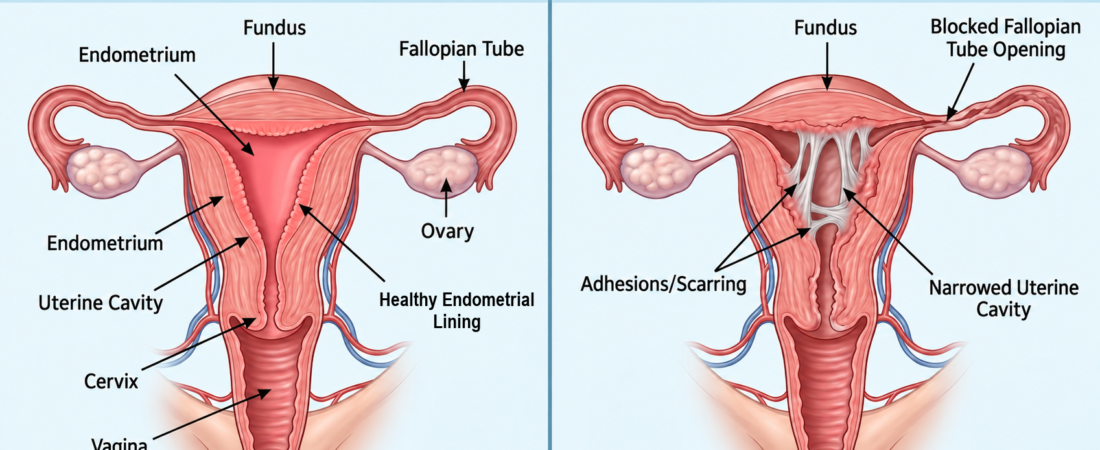
Intrauterine adhesions form when scar tissue makes opposing walls of the uterus stick together, narrowing the uterine cavity. They may cause lighter periods, infertility or recurrent miscarriage. Whether hysteroscopic adhesiolysis is appropriate depends on symptoms, the extent of scarring and pregnancy plans. Severe adhesions require particular surgical experience because treatment must preserve the remaining endometrium and anticipate recurrent scarring from the first operation.

The inside of the uterus normally forms a cavity. When its front and back walls start adhering to each other, that space changes. At first, only a small area may be joined by a thin band. In more severe cases, multiple areas adhere and the normal cavity may become narrow or almost disappear.
This is an intrauterine adhesion.
The degree of adhesion varies enormously. Some are thin and filmy; others are thick, firm bands of scar tissue crossing the cavity. Severe scarring can distort the normal anatomy to the point that the openings of the fallopian tubes can no longer be seen.
The same diagnosis can therefore involve very different levels of treatment difficulty.
Mild adhesions may separate relatively easily during hysteroscopy. Severe adhesions, however, require more than simply pulling apart two surfaces that have stuck together.
The surgeon must find where the normal cavity should be while preserving as much of the remaining endometrium as possible. Dissecting too deeply can injure the uterine muscle or cause a perforation. Separating too little may leave the cavity inadequately restored.
Even after difficult surgery, the walls may adhere again.
Severe adhesions therefore call for an integrated treatment plan covering the extent of surgery, preservation of normal endometrium, prevention of recurrence and reassessment of the cavity after surgery.
What causes intrauterine adhesions?
Adhesions develop when tissue inside the uterus is injured, scar tissue forms during healing, and opposing walls become attached.
Pregnancy-related uterine surgery and curettage are well-recognized causes. Adhesions can also occur after removal of retained placental tissue, repeated procedures inside the uterus or hysteroscopic removal of fibroids. Less commonly, infection within the uterus may contribute.
The depth and extent of injury are especially important. If the deep layer of the endometrium is damaged, it may heal with scar tissue instead of regenerating as normal lining. If opposing uterine surfaces are both injured, they may adhere while healing.
This is why the same procedure does not cause adhesions in every woman. The location and extent of injury, repeated operations and the way the uterus recovers can all make a difference.
How can uterine adhesions affect periods and pregnancy?
One of the first changes may be lighter periods, because less normally functioning endometrium remains to produce menstrual bleeding. With severe adhesions, periods may become almost absent or stop altogether.
Women preparing for pregnancy face an additional concern.
Adhesions can reduce the area of normal lining available for embryo implantation and change the shape of the cavity. Depending on their location, they may create an unfavorable environment for an embryo and are associated with infertility or recurrent miscarriage.
Adhesions accompanied by menstrual disturbance, infertility or related symptoms are commonly termed Asherman’s syndrome; severe cases can involve marked disruption of the cavity.
Does every intrauterine adhesion need surgery?
No. The decision should take into account the location and extent of adhesions, lighter or absent periods, pain, infertility or recurrent miscarriage, and whether the patient hopes to become pregnant.
Mild adhesions that cause no symptoms and do not affect pregnancy plans do not automatically require surgery. Hysteroscopic adhesiolysis may be considered for moderate or severe adhesions that substantially narrow the cavity, cause menstrual abnormalities or may interfere with pregnancy.
In hysteroscopic adhesiolysis, a small camera is introduced into the uterus so that the clinician can identify the adhesions directly and separate the adherent tissue.
Why does experience matter in severe hysteroscopic adhesiolysis?
Surgery for mild and severe adhesions differs greatly in difficulty.
With severe scarring, the normal boundaries of the cavity may be difficult to recognize through the hysteroscope. It can also be hard to locate the openings of the two fallopian tubes.
The clinician must gradually reconstruct the cavity while distinguishing scar tissue from normal tissue.
Going too deeply may damage normal endometrium or uterine muscle and create a risk of perforation. Inadequate separation, on the other hand, may fail to restore a normal cavity.
The more severe the adhesions, the more important it becomes to remove tissue precisely while preserving normal structures, rather than simply to remove as much as possible.
The joint AAGL and European Society of Gynaecological Endoscopy (ESGE) practice guidelines recommend that extensive or dense adhesions be treated by a clinician with substantial expertise in hysteroscopic adhesiolysis. Read the AAGL/ESGE guideline.
For someone with severe adhesions, asking only whether a clinic performs hysteroscopy is therefore insufficient. Relevant questions include the clinician’s experience with severe adhesiolysis, how recurrent adhesions are managed, and whether a second-look hysteroscopy will be used to reassess the cavity when needed.
Preventing adhesions from coming back
Recurrence is an essential part of understanding treatment. Separating previously adherent uterine walls leaves injured surfaces, which can stick together again during healing.
The AAGL/ESGE guideline explains that adhesions may recur after surgery and that this risk is particularly high in severe cases.
Recent research therefore focuses as much on keeping the walls from adhering again as on separating them initially.
A 2026 systematic review and network meta-analysis in Archives of Gynecology and Obstetrics compared postoperative methods for preventing recurrence using data from 26 randomized controlled trials involving 3,040 women. The research team included investigators at the PLA Rocket Force Characteristic Medical Center and General Hospital of Chinese PLA in Beijing. Read the recurrence-prevention review.
Approaches under investigation include balloons or intrauterine devices that keep opposing walls apart, as well as platelet-rich plasma (PRP) and platelet-rich fibrin (PRF).
Some approaches showed potential to reduce recurrence. However, treatments and patient characteristics differed across studies, and the review emphasized substantial heterogeneity and limited evidence. It is not possible to conclude that one method is best for every patient.
Why the first operation matters in severe uterine adhesions
Treatment does not end with an operation that separates the adherent areas.
For severe adhesions, treatment includes finding and restoring the normal cavity, preserving the remaining healthy endometrium, preventing renewed adhesion and later confirming that the cavity has stayed open.
This matters especially for women preparing for pregnancy. The goal is not merely to enlarge the space inside the uterus, but to restore as much as possible the environment in which an embryo can implant and a pregnancy can continue.
If severe adhesions have led to a recommendation for surgery, one question deserves a clear answer when choosing a clinic: how much experience does the clinician have in treating severe intrauterine adhesions?
From the first adhesiolysis, the treatment strategy should aim to preserve normal tissue and address the possibility of recurrence.
Guideline and research sources
The AAGL/ESGE practice guideline was published in Gynecological Surgery in 2017; DOI: 10.1186/s10397-017-1007-3. The 2026 recurrence-prevention network meta-analysis by Song and colleagues was published online on August 29, 2026 in Archives of Gynecology and Obstetrics; DOI: 10.1007/s00404-026-08544-7.
Related reading
- Endometrial polyps and the decision to operate before IVF
- Uterine fibroids, myomectomy and implantation signaling
Whether and how to treat intrauterine adhesions depends on their extent and severity, symptoms, the condition of the endometrium and pregnancy plans.
The image accompanying this article was created using generative AI (ChatGPT, OpenAI).
Copyright © 2026 Fertility Information TokTok Fertility News | THE FERTILITY NOTES. All rights reserved. Unauthorized republication, reproduction, redistribution, scraping, AI training, and other use of any content, including articles, photographs, and images, are strictly prohibited. Violations may result in legal liability.