
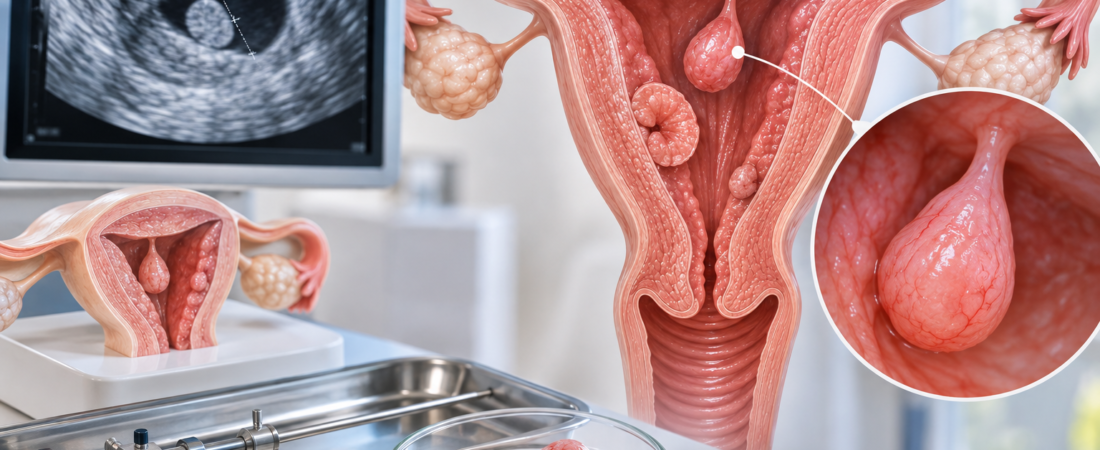
An endometrial polyp can raise concern before IVF: if an embryo needs to attach inside the uterus, could the growth prevent implantation? The answer depends on more than whether a polyp is present. Evidence differs for natural conception, intrauterine insemination (IUI) and IVF, and removal of small polyps has not been clearly shown to improve IVF live birth.
A randomized trial found that removing polyps before planned IUI increased the chance of pregnancy about 2.1-fold. The 2026 British Fertility Society (BFS) guidance, however, allows fresh embryo transfer as one option when a polyp smaller than 20 mm is discovered during IVF stimulation. It favors removal in women with recurrent implantation failure or recurrent miscarriage.
Many women first learn they have a uterine polyp during an infertility ultrasound. This can be especially worrying just before IVF. Polyps may interfere with conception, but it is too simple to say that their presence prevents implantation or that every polyp must be removed before IVF.
Size, location, number, previous implantation failures and miscarriage history all matter, alongside the type of fertility treatment being planned.
A polyp is more than a small lump
An endometrial polyp is a localized overgrowth of the lining of the uterus that projects into the uterine cavity. Most are benign, and many women have no symptoms.
The concern is that the growth occupies the space where an embryo needs to implant. A polyp may distort the cavity or affect the available implantation surface, and the surrounding endometrial environment may also change.
In its 2026 committee opinion on recurrent implantation failure, the American Society for Reproductive Medicine (ASRM) describes moderate evidence that endometrial polyps adversely affect endometrial receptivity and implantation in women trying to conceive. Research has also found reduced expression of some implantation-related genes.
But evidence that a polyp can interfere with implantation is different from evidence that removing it improves live birth after IVF.
Pregnancy was about 2.1 times more likely after removal before IUI
An important randomized trial was published in Human Reproduction in 2005. It included 215 women with infertility and ultrasound-diagnosed endometrial polyps who were planning IUI.
The trial compared hysteroscopic polyp removal with a control group that underwent diagnostic hysteroscopy and polyp biopsy without complete removal.
Over follow-up covering up to four IUI cycles, there were 93 pregnancies: 64 in the removal group and 29 in the control group. The relative chance of pregnancy after removal was approximately 2.1 times that of the control group.
Another finding was striking: 65% of the pregnancies in the removal group occurred before the first IUI. These women conceived naturally during the waiting period after polypectomy.
The investigators concluded that removing polyps by hysteroscopy before planned IUI could be an effective way to improve the likelihood of pregnancy.
Evidence for IVF is different
These results might suggest that removing every polyp before IVF is beneficial, but the IVF evidence does not show the same clear pattern.
A systematic review published in the Journal of Minimally Invasive Gynecology in 2019 analyzed eight studies involving 2,267 patients.
For polyps with a mean size below 2 cm, hysteroscopic removal was associated with a higher clinical pregnancy rate in women undergoing IUI.
Among women undergoing IVF or intracytoplasmic sperm injection (ICSI), however, the review found no clear improvement in clinical pregnancy, implantation or live birth after removal. It also found no clear miscarriage benefit.
The conclusion that polyp removal improves pregnancy therefore cannot be applied unchanged to every form of fertility treatment.
Does a small polyp discovered during IVF mean cancelling transfer?
A polyp found after ovarian stimulation has begun creates a particularly difficult decision. A patient may already have reached egg retrieval and then be asked whether to postpone embryo transfer and remove the polyp first.
Studies have repeatedly suggested that small polyps below 20 mm do not necessarily reduce IVF success.
In research on polyps smaller than 20 mm newly identified during stimulation, clinical pregnancy and live-birth rates were not significantly different from those in women without polyps. Biochemical pregnancies were more frequent in the polyp group.
A 1999 study compared 83 IVF patients with polyps smaller than 20 mm. It compared proceeding with embryo transfer against removing the polyp after egg retrieval and undertaking frozen embryo transfer later; the BFS guideline reports no significant difference in clinical pregnancy or live birth between these approaches. A 2025 study involving polyps smaller than 15 mm reported a similar pattern.
Why the 2026 guidance discusses 20 mm
The British Fertility Society's 2026 policy and practice guideline provides a more specific framework.
When a polyp larger than 20 mm is identified during ovarian stimulation, it advises considering elective freezing of all embryos, polyp removal and a later frozen embryo transfer.
For polyps smaller than 20 mm, there are two options. If there are no risk factors for endometrial pathology, proceeding with fresh embryo transfer while leaving the polyp in place is considered reasonable. If there are relevant endometrial risk factors or poor previous reproductive outcomes, freezing embryos and removing the polyp can instead be considered.
This does not make 20 mm an absolute threshold for every patient. The guidance also notes that the literature does not establish one universally accepted size cutoff for removal. Small polyps below 10 mm may sometimes regress spontaneously.
Previous implantation failure or miscarriage changes the decision
A patient's reproductive history is as important as size.
The 2026 BFS guidance states that polypectomy is preferred when an endometrial polyp is found in a woman with recurrent implantation failure or recurrent miscarriage.
Decisions should consider the polyp's size, location and number, the cause of infertility, the number of good-quality embryos available, and previous reproductive outcomes.
ASRM likewise considers it reasonable to offer hysteroscopy to evaluate the cavity and remove identified endometrial polyps in patients with recurrent implantation failure. It also emphasizes that evidence is insufficient to establish that removing polyps before IVF improves implantation or live birth.
The presence or absence of a polyp alone is therefore not enough to decide what to do.
A randomized trial before planned IUI supports a pregnancy benefit from removal, and many pregnancies in that trial occurred naturally before IUI began. For IVF, clear evidence that removing small polyps improves implantation or live birth is still lacking.
In particular, discovering a polyp smaller than 2 cm does not by itself provide a strong evidence-based reason to cancel an IVF cycle already in progress.
Seeing one uterine polyp need not mean assuming that the next embryo cannot implant. What matters is its size, location, number, effect on the uterine cavity and the patient's history of implantation failure or miscarriage.
This article draws on the 2026 British Fertility Society polyp-management guideline, ASRM's 2026 committee opinion on recurrent implantation failure, the 2005 randomized IUI trial and the 2019 systematic review listed below.
Whether a polyp should be treated depends on its size and location, symptoms, age, the cause of infertility, previous implantation failure or miscarriage, and the current stage of treatment. Decisions should be made with the treating clinical team.
Research references
Management of endometrial polyps in fertility: British Fertility Society policy and practice guideline. Human Fertility, 2026;29(1):2633925. Published online February 25, 2026. DOI: 10.1080/14647273.2026.2633925.
Recurrent implantation failure: a committee opinion. American Society for Reproductive Medicine, 2026.
Endometrial polyps and their implication in the pregnancy rates of patients undergoing intrauterine insemination: a prospective, randomized study. Human Reproduction 2005;20(6):1632–1635. PMID15760959. DOI: 10.1093/humrep/deh822.
Hysteroscopic Resection of Endometrial Polyps and Assisted Reproductive Technology Pregnancy Outcomes Compared with No Treatment: A Systematic Review. Journal of Minimally Invasive Gynecology 2019;26(4):618–627. DOI: 10.1016/j.jmig.2018.10.024.
Related reading
- What hysteroscopy can reveal inside the uterus
- Evidence for investigations after repeated failed transfers
The images used in this article were created using generative AI (ChatGPT, OpenAI). Any people depicted are fictional, not real individuals.
Copyright © 2026 Fertility Information TokTok Fertility News | THE FERTILITY NOTES. All rights reserved. Unauthorized republication, reproduction, redistribution, scraping, AI training, or use of any content, including articles, photographs, and images, as data is strictly prohibited. Violations may result in legal liability.