

Embryos and the endometrium exchange signals as implantation begins; researchers identified SDC1/MMP7-expressing cells and CSF3 signaling.
A Nature Cell Biology study opens a new direction for studying implantation failure, without establishing a treatment.
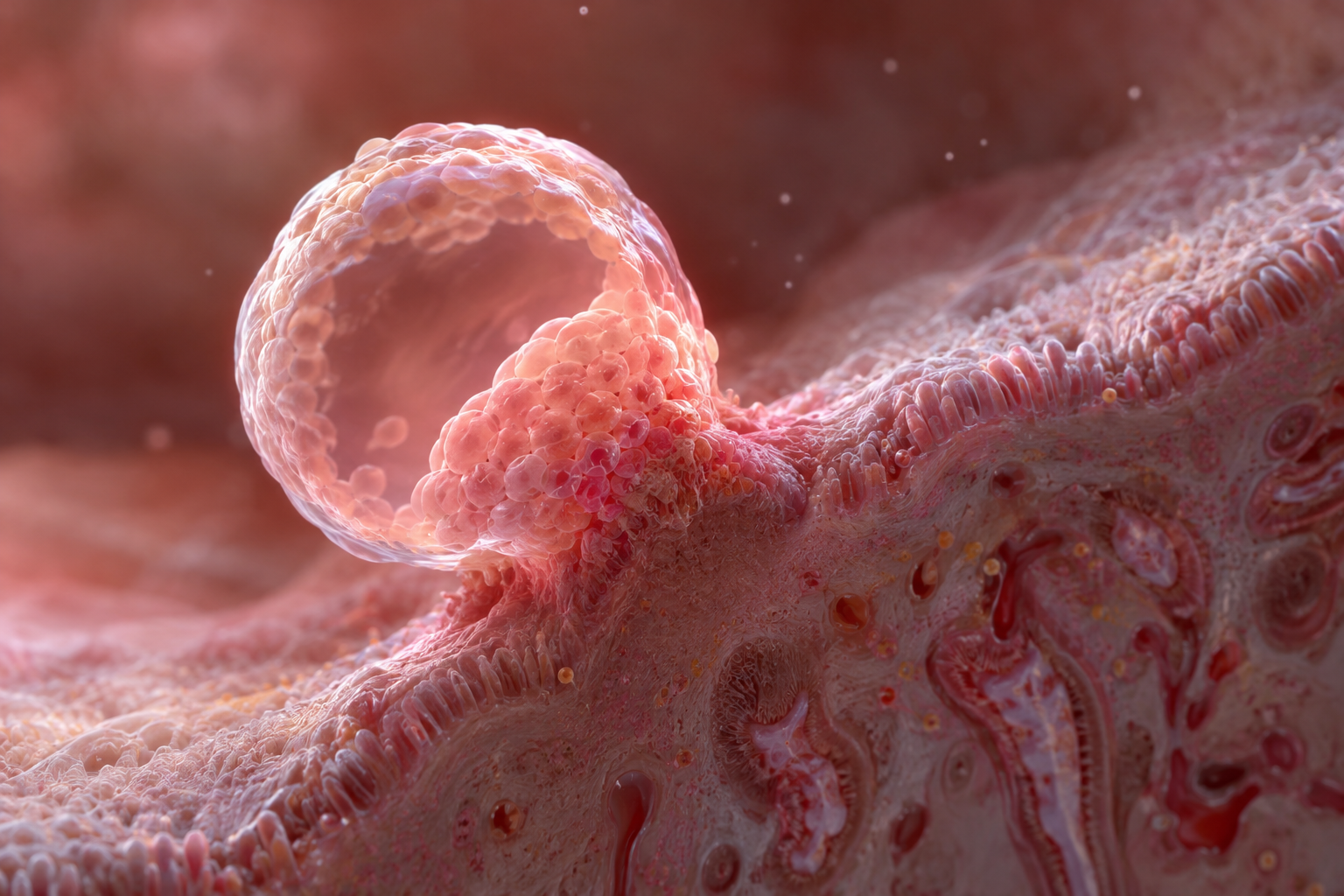
One of the most difficult moments in IVF is transferring a good-quality embryo without achieving pregnancy. Why might implantation fail when embryo development appears satisfactory and the uterine lining is appropriately thick?
Chromosomal abnormalities in the embryo and endometrial receptivity have long been considered important explanations. Yet much remains unknown about what happens when the embryo first encounters the endometrium.
Researchers have now cultured human embryos together with endometrial tissue in the laboratory to observe cellular changes at the beginning of implantation. Their findings suggest that an embryo does more than simply attach: cells on both sides exchange signals and adapt toward a state suited to implantation.
Published in Nature Cell Biology, the study recreated embryo–endometrial interactions in a three-dimensional co-culture model and identified a particular trophoblast population and signaling pathways involved in this early process.
Is implantation simply a matter of an embryo attaching?
The beginning of pregnancy is more complex than it may appear. After a fertilized egg divides repeatedly and develops into a blastocyst, the trophoblast cells forming its outer layer contact the endometrium. Attachment and entry into the tissue then follow.
These events are difficult to observe directly because they take place inside the body. Ultrasound can measure endometrial thickness and blood tests can assess hormones, but neither reveals the signals exchanged by individual embryonic and endometrial cells.
To address this, the researchers co-cultured human blastocyst-like models, called blastoids, and actual human blastocysts with a three-dimensional endometrial culture model.
Blastoids are stem-cell-derived research models that reproduce some features of an early embryo. The endometrial model recreates aspects of the lining's cellular and tissue environment in the laboratory.
By combining these models, the team brought embryo and endometrium into contact and examined which genes became active in each cell over time.
Single-cell transcriptomic analysis, which measures gene expression in individual cells, allowed them to track cellular changes and signaling during implantation-like events in detail.
A distinctive trophoblast population at implantation onset
A central finding was a trophoblast population expressing the molecular markers SDC1 and MMP7.
Trophoblast cells lie on the outside of the embryo, interact directly with the endometrium and later contribute to placental formation. The researchers identified this SDC1/MMP7-expressing population when embryos and endometrium were cultured together.
These cells showed gene-expression features associated with migration and remodeling of the extracellular matrix. This matrix surrounds cells and supports tissue structure; changes to it are needed as an embryo interacts with and enters endometrial tissue.
The population was particularly evident in an environment containing decidualized endometrial stromal cells. Decidualization is the functional transformation of these cells under hormonal influence as the lining prepares for pregnancy.
This suggests that implantation-related changes depend not only on the embryo's own capabilities but also on the cellular environment of the endometrium.
Endometrial CSF3 signaling and the embryo's response
The team also investigated the signals exchanged between the two tissues. CSF3 and its receptor, CSF3R, emerged as important candidates.
CSF3 is generally known for its involvement in the production and function of immune cells. Here, signaling originating from endometrial stromal cells was associated with changes in trophoblast state.
Alongside cell-to-cell signaling analysis, the researchers performed functional experiments that altered particular signaling pathways. They obtained evidence that CSF3–CSF3R signaling contributes to trophoblast adaptation and blastoid expansion in an implantation-like environment.
The findings indicate that molecular signals from the endometrium can influence early embryonic behavior.
They do not mean that giving CSF3 to patients improves implantation rates. These are cellular findings from a laboratory culture model, distinct from a clinical trial testing treatment benefit.
The endometrium adapts too
Changes occurred in the endometrium as well as in the embryo.
Endometrium co-cultured with embryos showed gene-expression changes consistent with enhanced decidualization and greater glandular secretory activity.
Endometrial glands help create an environment supporting implantation and early development. Changes in their secretory function therefore offer clues to the conditions of early pregnancy.
The results challenge a one-way account in which an embryo simply invades the lining. The embryo changes in response to the endometrium, while the endometrium also adapts through interaction with the embryo.
Implantation is, in this sense, a biological process of reciprocal response.
A new avenue for understanding repeated implantation failure
The work is of interest to fertility research because it offers another way to investigate repeated implantation failure.
IVF transfer timing takes account of embryo development, chromosomal status, endometrial thickness and the hormonal environment. Pregnancy may still not occur despite careful consideration of these factors.
This study focuses on cellular signals between embryo and endometrium that have been difficult to examine directly in clinical practice.
If future work confirms that the same SDC1/MMP7-related trophoblast changes and CSF3 signaling operate during implantation in humans, it could help explain some biological causes of failure.
However, this was not a study of patients with repeated implantation failure, and it did not establish that abnormalities in these cells or signals cause failed implantation. Their usefulness as predictive biomarkers also requires further validation.
A research platform, with clinical application still unproven
The three-dimensional model may become a useful experimental tool for implantation research.
Co-culturing embryo and endometrium allows researchers to observe changes, compare the roles of different molecules and examine responses when signals are inhibited or altered.
An implantation-like process in the laboratory does not reproduce everything that happens in the uterus. Complex interactions involving immune cells, blood vessels and hormonal changes are difficult to recreate fully.
These results therefore do not justify recommending a new implantation-promoting treatment or changing existing fertility care.
They do raise an important question: when a good embryo meets an apparently well-prepared lining but pregnancy does not follow, might some of the necessary cellular dialogue be missing?
That question remains unanswered. Nevertheless, establishing an experimental basis for studying implantation as a reciprocal interaction represents a meaningful step toward understanding the biology of early pregnancy.
Source: This article is based on “A three-dimensional human co-culture system reveals reciprocal embryo–endometrial adaptation at implantation onset,” published in Nature Cell Biology in October 2026 by Yan Bi, Zhifen Tu, Xinbao Zhang, Jindian Hu, Che Chen and colleagues. The researchers used human blastoids, actual blastocysts and a three-dimensional endometrial culture model to examine cellular changes and signaling at implantation onset. DOI: 10.1038/s41556-026-02106-4.
Image disclosure: The illustration was created using generative AI (ChatGPT, OpenAI).
Related guide: Understanding the tests at a first fertility clinic visit.
Copyright © 2026 Fertility Information TokTok Fertility News | THE FERTILITY NOTES. All rights reserved. Unauthorized reproduction, copying, redistribution, scraping, AI training, and other data use of any articles, photographs, images, or other content are strictly prohibited. Violations may result in legal liability.