
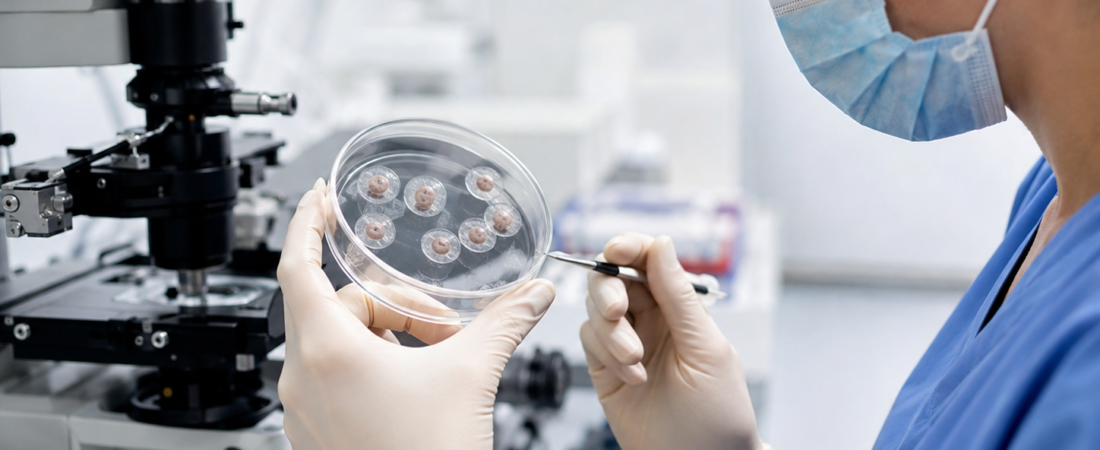

Rescue IVM after egg retrieval: eight years of clinical records covered 47 patients with few mature eggs and 266 immature oocytes.
After up to 24 additional hours in culture, around half matured; some patients gained additional chromosomally normal embryos.
The researchers describe a possible option for selected patients with few mature eggs, rather than an approach for everyone.
For someone undergoing fertility treatment, one of the most disappointing things to hear after egg retrieval is this:
“We retrieved five eggs, but only three were mature.”
If five eggs were retrieved, why can only three be used? Some of the remaining eggs are still immature. For patients with a poor prognosis, who may feel that every egg matters, an egg that was retrieved but cannot be used can be especially difficult to accept.
A recent study gave these immature eggs another 24 hours instead of giving up on them immediately. Around half reached a mature stage suitable for fertilization, and some patients ultimately obtained embryos with a normal chromosome count.
What is a GV oocyte?
An egg is not necessarily ready to be fertilized as soon as it is removed from the ovary. It must first complete the maturation process that prepares it for fertilization.
When an immature egg is examined under a microscope after retrieval, a clearly visible, intact nucleus identifies the early stage called the germinal vesicle, or GV, stage.
Put simply, a GV oocyte has been retrieved, but has not yet finished preparing for fertilization.
The study’s background describes GV oocytes as approximately 10% of retrieved eggs in general. That background estimate is different from the unusually high proportion of GV oocytes in this deliberately selected study population.
As maturation continues, the visible nuclear structure breaks down. The egg passes through further stages before becoming a mature oocyte ready for fertilization. In fertility treatment, these fully mature eggs are generally the ones used for fertilization.
When a retrieval includes GV oocytes, the number of eggs that can actually be used for fertilization may therefore be smaller than the number retrieved.
That raises a question: does an egg’s potential end simply because it was not yet mature at the moment of retrieval?
Giving 266 immature eggs another 24 hours
A study published in Human Reproduction began with precisely that question.
Researchers at IVI Valencia in Spain reviewed 47 women younger than 39 who underwent fertility treatment between 2017 and 2024 and had fewer mature eggs than expected. The abstract defines this selected population as having six or fewer mature oocytes, a maturity yield below 80% relative to follicles at least 14 mm at trigger, and at least four GV oocytes at retrieval. The full-text methods use “fewer than six”; this inconsistency in the publication should be kept in mind.
Instead of discarding the 266 GV oocytes collected from these patients, the team cultured them in a time-lapse incubation system for up to another 24 hours. This gave the eggs additional time to mature outside the body in the laboratory.
The results were noteworthy.
Of the 266 GV oocytes, 127 matured to the metaphase II (MII) stage within 24 hours, a pooled maturation rate of 47.7%. The mean maturation rate calculated separately for each patient was 53.7%. These figures use different denominators and should not be treated as interchangeable.
The average number of mature eggs available per patient increased from 4.4 to 7.1, adding around two to three mature eggs per patient. The paper reports a mean patient-level relative increase of 75%. This averages the change within each patient; it is not calculated simply by dividing the difference between the two group means by 4.4.
In other words, a substantial proportion of eggs classified as immature on retrieval day became candidates for fertilization the following day.
Can eggs that mature later be fertilized?
The next question is whether these late-maturing eggs can fertilize normally.
The overall fertilization rate for eggs matured through rescue culture was 66.1% (84 of 127), compared with 71.4% (147 of 206) for eggs that had already been mature at retrieval. The difference was not statistically significant (P=0.330).
This does not mean that waiting one day makes every immature egg equivalent to one that was already mature.
A difference appeared at the next stage. After fertilization, the rescued eggs were less likely than the initially mature eggs to reach the blastocyst stage, a stage commonly used for embryo transfer. Blastocyst formation was 20.2% (17 of 84 normally fertilized eggs) after rescue maturation, compared with 49.0% (72 of 147) among eggs mature at retrieval. This difference was statistically significant (P<0.001).
There was a possibility of rescuing immature eggs, but not every rescued egg became a good embryo. Nevertheless, additional chromosomally normal embryos were obtained from rescued eggs in a subset of patients.
Did the extra effort of culturing immature eggs therefore provide a practical benefit for patients?
This is where one of the study’s most notable findings emerged.
What did chromosome testing show?
Among rescued eggs that did produce blastocysts, embryo appearance and the overall proportion found to be chromosomally normal on preimplantation genetic testing for aneuploidy, or PGT-A, did not clearly differ from blastocysts produced by eggs that had been mature from the start.
PGT-A classified 13 embryos as euploid among 17 blastocysts from rescue-matured eggs (76.5%), compared with 37 among 72 blastocysts from eggs mature at retrieval (51.4%). The overall difference was not statistically significant (P=0.101). The result cannot establish that rescue-matured eggs have superior chromosome outcomes, but it shows that some can produce euploid embryos.
The statistical approach matters here. An unpaired comparison of mean patient-level euploidy rates was significant (P=0.040), while the paired comparison in patients with blastocysts from both sources was not (P=0.149). This small study does not support a simple claim that rescue maturation improves embryo chromosome quality.
The abstract reports that 11 of the 47 patients obtained at least one additional euploid embryo—an embryo classified as having the expected chromosome count by PGT-A—from rescued GV oocytes. However, the paper’s results, discussion and Table 3 report 13 patients. This internal inconsistency is unresolved; the number 11 should therefore be understood as the abstract’s reported count rather than a settled correction to the full text.
The paper separately reports 13 euploid blastocysts derived from rescued eggs. In four cycles, the only euploid embryos available came from those rescued eggs. Including them increased the number of patients with at least one euploid embryo from 26 to 30. Without the rescued embryos, these four patients would have had no euploid embryo available from that retrieval.
One additional egg may seem less consequential for someone who produces many eggs. For a patient with only a few retrieved eggs, the situation can be different. If an immature egg becomes a mature egg, then a fertilized egg, a blastocyst, and ultimately a euploid embryo, it can change the opportunities available from that retrieval.
Did the rescued eggs lead to live births?
Laboratory development was not the only outcome. Ten transfers of euploid embryos derived from rescue-matured eggs resulted in four live births. For comparison, embryos from eggs already mature at retrieval resulted in 16 live births after 31 transfers. The per-transfer difference, 40.0% versus 51.6%, was not statistically significant (P=0.719).
Across the study cohort, the number of women who had at least one live birth increased from 15 when only initially mature eggs were counted to 18 when births from rescued eggs were included. The authors describe this as a 20% relative contribution to cumulative live birth, not a 20 percentage point increase. It is an observed contribution within a small retrospective cohort, not a randomized estimate of how much treatment would improve another patient’s chance.
The methods define the paper’s live-birth endpoint as an ongoing pregnancy beyond 22 gestational weeks, although gestational age and birthweight are also reported for newborns. This endpoint wording should be considered when interpreting the reported outcomes.
The reported gestational ages and birthweights did not differ significantly between the two embryo sources. The very small number of births, particularly four from rescued eggs, is insufficient to establish long-term safety or guarantee a healthy child.
Should all immature eggs now be rescued?
It is too early to draw that conclusion.
This was not a randomized clinical trial. It was a retrospective review of eight years of treatment at one fertility center, involving only 47 patients. It also selected women younger than 39 with unexpectedly few mature eggs and at least four GV oocytes, so its findings cannot be applied directly to every IVF patient.
The researchers describe generally normal baseline ovarian-reserve measures in these selected patients, despite unexpectedly low maturation. The results should not be taken as proof that rescue IVM benefits every patient with diminished ovarian reserve or repeatedly low egg yield.
Most importantly, eggs that matured later had a lower capacity to develop into blastocysts than eggs that were mature at retrieval. The additional culture time and the laboratory’s technical capabilities also need to be considered.
Even so, the study raises a meaningful point: an egg classified as immature on retrieval day is not necessarily an egg that can never be used.
For patients who retrieve several eggs but have few mature eggs available for fertilization, giving immature eggs another day may provide an opportunity to obtain another embryo.
When every egg matters, “immature” may sometimes mean an egg worth waiting a little longer for, rather than one whose potential has ended.
However, an additional 24 hours does not automatically make an immature egg usable. The laboratory must maintain stable conditions that allow maturation to continue outside the body, and staff experience matters when assessing maturity and deciding when to attempt fertilization.
Rescue in-vitro maturation, or rescue IVM, of GV oocytes that were immature at retrieval is a different approach from routine culture of mature eggs. The same results therefore cannot be assumed to occur at every fertility center.
For related background, read about why well-grown follicles may still yield immature eggs and why egg yields differ despite similar ovarian stimulation.
Research source
This article is based on “Germinal vesicle oocytes’ rescue: a worthless treatment or a patient-centred approach? Eight years of clinical experience in poor prognosis patients,” published online in Human Reproduction on July 13, 2026, and in volume 41, issue 9, pages 1507–1521. The study included 47 women younger than 39 and 266 GV oocytes. DOI: 10.1093/humrep/deag115. PMID: 42442002.
The original publication contains inconsistent wording about the number of patients gaining euploid embryos and the mature-oocyte eligibility cutoff. Those differences are identified above rather than silently resolved. The 47.7% pooled maturation rate and 53.7% mean patient-level rate are also distinguished.
Whether rescue culture of immature eggs is appropriate depends on factors including the patient’s egg number, maturity profile, and laboratory conditions. Discuss its suitability with the treating clinical team.
The image used in this article was created using generative artificial intelligence (ChatGPT, OpenAI). Any people depicted are fictional, not real individuals.
Copyright © 2026 Fertility Information TokTok Fertility News | THE FERTILITY NOTES. All rights reserved. Unauthorized republication, reproduction, redistribution, scraping, AI training, and data use of any content, including articles, photographs, and images, are strictly prohibited. Violations may result in legal liability.