
Blood Analysis of 60 Men with Non-Obstructive Azoospermia: RNA Signals Linked to micro-TESE Success Identified
Focus on INPP1, GTSF1, and Regulatory RNAs… Select Biomarkers Reach an AUC of 0.97
Researchers: “Candidate Non-Invasive Biomarkers Predicting the Likelihood of Sperm Presence Prior to Surgery”… Not Yet at Clinical Application Stage
When men receive a diagnosis of ‘azoospermia’—where not a single sperm is detected in a semen analysis—the first question they often ask is:
“Does that mean there is no sperm in my body at all?”
Not necessarily. Even if no sperm appears in the ejaculate, minuscule amounts of sperm may still be produced within isolated pockets of the testes. The dilemma is that it is exceptionally difficult to determine accurately—prior to surgery—where and how much sperm remains.
Recently, research emerged seeking this answer from peripheral blood. The idea is to analyze circulating molecular signals in the bloodstream prior to surgically opening testicular tissue to predict the likelihood that sperm remains inside the testes.
In a study published in May 2026 in the international journal Scientific Reports, researchers confirmed that in the blood of men with non-obstructive azoospermia (NOA), the expression levels of the genes INPP1 and GTSF1, along with their regulatory RNAs, were associated with the actual success of surgical testicular sperm retrieval.
Finding Sperm in the Testes Despite a ‘Zero’ in the Ejaculate
Azoospermia is broadly categorized into two types: obstructive azoospermia (OA), where sperm is produced in the testes but cannot exit due to a blocked reproductive tract, and non-obstructive azoospermia (NOA), where the testicular capacity for spermatogenesis itself is severely impaired.
The clinical reality in non-obstructive azoospermia is far more complex. While spermatogenesis has ceased completely throughout the testes in some men, others exhibit focal spermatogenesis—where sperm production is preserved in only tiny, isolated areas while absent across most of the tissue.
The standard procedure performed in these cases is microsurgical testicular sperm extraction (micro-TESE). Under an operating microscope, surgeons meticulously examine the testicular tissue to identify seminiferous tubules that appear fuller and more likely to harbor active spermatogenesis, extract tissue, and search for viable sperm within.
If sperm is successfully recovered, it creates the opportunity to proceed with intracytoplasmic sperm injection (ICSI).
However, undergoing micro-TESE does not guarantee sperm retrieval in every patient. The researchers noted that sperm retrieval rates via micro-TESE in NOA are generally under 50%. From the patient’s standpoint, knowing “what are my chances that sperm actually remains” before consenting to surgery is an issue of critical importance.
Two Names Noted by Researchers: ‘INPP1 and GTSF1’
The research team first integrated 7 existing gene expression datasets to identify genes whose expression was consistently down-regulated in the testicular tissue of patients with non-obstructive azoospermia.
Among numerous candidates, they singled out INPP1 and GTSF1 as molecular clues reflecting whether spermatogenesis is actively occurring in the testes.
In particular, GTSF1 is highly expressed in the testes and is known to be involved in germ cell development. On the other hand, INPP1 is expressed across various tissues and encodes an enzyme involved in intracellular signaling pathways; its precise biological role in spermatogenesis remains to be fully elucidated.
The investigators took this a step further. Rather than examining INPP1 and GTSF1 in isolation, they concurrently analyzed microRNAs (miRNAs) and circular RNAs (circRNAs) that potentially regulate the activity of these genes.
Put simply, rather than testing an isolated gene, they examined the regulatory network—the circuit through which various molecules governing spermatogenesis interact.
Blood Drawn from 60 Men with NOA
The study included 60 men with non-obstructive azoospermia and 40 fertile male controls.
Based on testicular histopathology, the NOA patients were categorized into three histological patterns (20 patients each): Sertoli cell-only syndrome (SCOS), maturation arrest (MA), and hypospermatogenesis (HYPO).
They were then regrouped according to their actual micro-TESE outcomes.
Among the 60 men, sperm was successfully retrieved in 29, while retrieval failed in 31.
Comparing the peripheral blood between the two cohorts revealed distinct differences. Men in whom testicular sperm was retrieved exhibited significantly higher activity of both INPP1 and GTSF1. Certain regulatory RNA signals associated with these two genes were also expressed at higher levels in men with successful sperm retrieval.
Conversely, RNA signals presumed to suppress the activity of these target genes were more prevalent in men where no sperm could be retrieved.
In essence, distinct molecular signatures were captured in the blood of men actively producing sperm in their testes compared to those who were not. The researchers proposed that exploiting these differences could one day enable clinicians to gauge the likelihood of residual sperm inside the testes via a simple pre-operative blood test.
Diagnostic Accuracy: Some RNAs Reached an AUC of 0.97
The researchers analyzed how effectively these blood-based molecular signatures could differentiate between patients where sperm could be retrieved versus those where it could not.
The findings were pronounced. Specifically, certain RNA markers demonstrated an Area Under the Curve (AUC) value of 0.96 to 0.97 in discriminating between the two groups. An AUC closer to 1 indicates superior discriminatory accuracy.
Put simply, distinct molecular signatures were identified in the blood of men with successful sperm retrieval versus those with failed retrieval.
However, because the patient cohort in this study was relatively small, these metrics alone do not mean that surgical success can be definitively predicted in routine clinical practice today. Further validation across larger patient cohorts is necessary to replicate these findings.
Ultimately, the question posed by this study is simple:
While undergoing micro-TESE is currently required to definitively determine the presence of sperm, could we one day draw blood before surgery, analyze circulating RNA patterns, and pre-screen individuals with a high probability of successful sperm retrieval?
This holds profound clinical significance for patients. Patients with an exceedingly low probability of sperm retrieval could avoid unnecessary invasive surgery, while those showing molecular signals indicative of active spermatogenesis could gain reassuring evidence to help shape their reproductive strategies.
Does Not Mean ‘Blood Tests Can Determine Surgical Success Immediately’
However, these findings should not be prematurely embraced as a ready-to-use clinical test.
Above all, this was a relatively small exploratory study encompassing only 60 NOA patients. Among patients with Sertoli cell-only syndrome, only 3 individuals had successful sperm retrieval, meaning subgroup findings must be interpreted with particular caution, as the authors noted.
In addition, further functional assays are required to delineate how INPP1, GTSF1, and their associated RNAs directly influence spermatogenesis. Future research must also confirm whether the same diagnostic performance can be replicated across diverse ethnic populations and larger international cohorts.
At present, fertility clinics cannot yet calculate a patient’s exact percentage chance of retrieving testicular sperm using a routine blood draw.
Nevertheless, the reason this study garners attention is clear: it demonstrates that circulating molecular biomarkers in the blood could provide a long-sought answer to an enduring clinical question in non-obstructive azoospermia: “Can we know whether sperm remains inside the testes before surgically opening them?”
Receiving a “zero sperm” result on a semen analysis does not immediately equate to “zero sperm in the testes.” The research frontier is now expanding beyond simply how to extract hidden sperm during surgery, toward uncovering the molecular traces of hidden sperm before entering the operating room.
※ Study Source: Based on research published on May 20, 2026, in the international journal Scientific Reports, conducted by researchers from Shahid Beheshti University of Medical Sciences, Shahid Sadoughi University of Medical Sciences, and Yazd Reproductive Sciences Institute in Iran. Title: “Uncovering hidden spermatogenesis: INPP1 and GTSF1 as non-invasive predictors of sperm retrieval in non-obstructive azoospermia.” The study included 60 men with non-obstructive azoospermia and 40 fertile controls. Scientific Reports 16, Article 23039 (2026), DOI: 10.1038/s41598-026-47513-7.
※ This article provides informational coverage of recent medical research and does not replace individualized clinical advice or treatment decisions. The etiology of azoospermia and the decision to perform testicular sperm retrieval must be evaluated based on chromosomal/genetic testing, endocrine profiles, testicular evaluation, and comprehensive clinical assessment by a medical team.
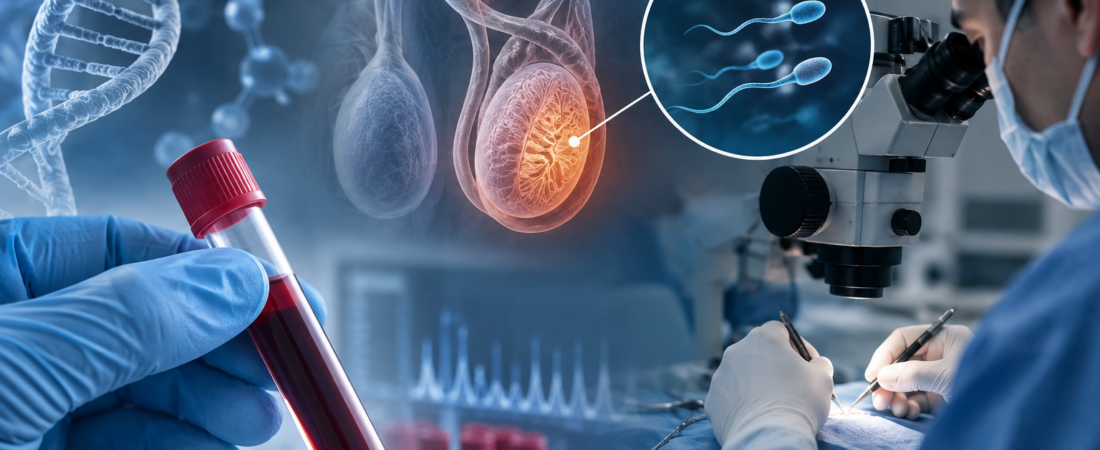
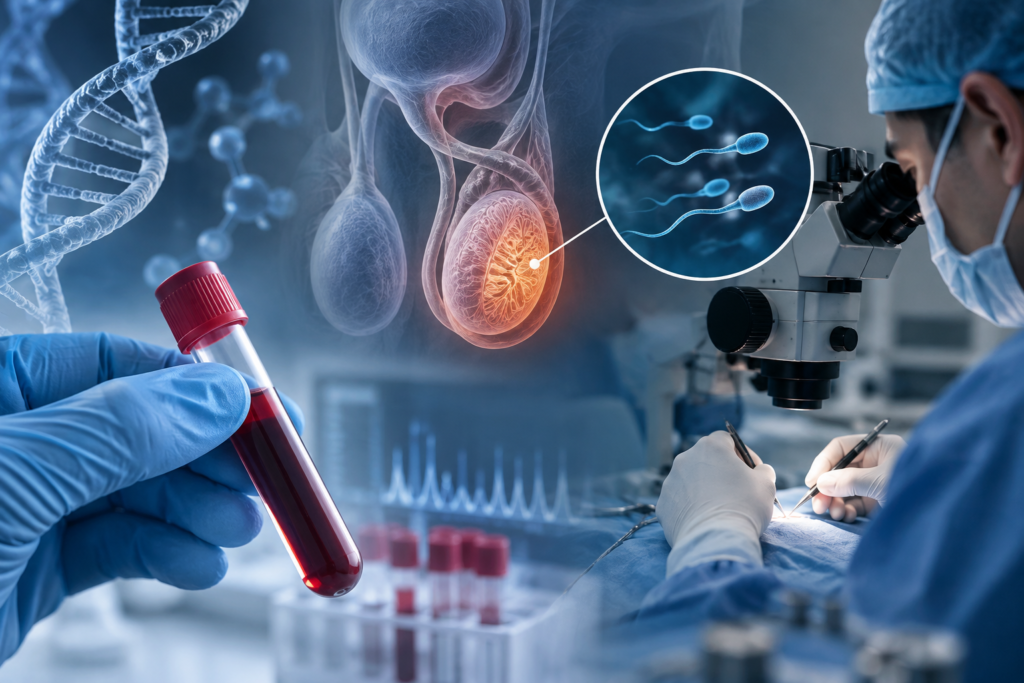
※ The images used in this article were generated using artificial intelligence (ChatGPT, OpenAI) as illustrative reference materials and do not depict real individuals.
※ Copyright © 2026 THE FERTILITY NOTES. All rights reserved. Unauthorized reproduction, duplication, distribution, scraping, AI training, or data utilization of all content, including articles, photos, and images, is strictly prohibited and subject to legal liability.