
No Menstruation but Normal Breasts… The Rare ‘MRKH Syndrome,’ Affecting 1 in 5,000 The Biggest Question from MRKH Patients: “Can I Have Children?”
“It was my first time, so I thought it was supposed to hurt.”
In her late 20s, Ms. A experienced excruciating pain every time she had intercourse after starting a relationship. Penetration failed repeatedly, and any forced attempt resulted in unbearable agony. She believed it would get better over time and blamed herself for being ‘too sensitive.’ She spent years without being able to easily talk to anyone about it.
Eventually, she mustered the courage to visit an obstetrician-gynecologist, and the diagnosis from the detailed examination was unexpected. Her vagina was formed very short, and her uterus had not developed normally. She had been living with MRKH (Mayer-Rokitansky-Küster-Hauser) syndrome since birth.
MRKH syndrome is a rare congenital anomaly occurring because the Müllerian ducts, which form the uterus and the upper part of the vagina during fetal development, fail to develop properly. It is known to affect approximately 1 in every 4,500 to 5,000 women.
In many cases, the vagina is absent or very short, and the uterus is either missing or underdeveloped, but ovarian function is usually normal. Because female hormones are secreted normally, secondary sexual characteristics such as breast development, body shape, and voice are almost identical to those of other women. The external genitalia also appear normal, so in most cases, neither parents nor the individual notice any abnormality during childhood.
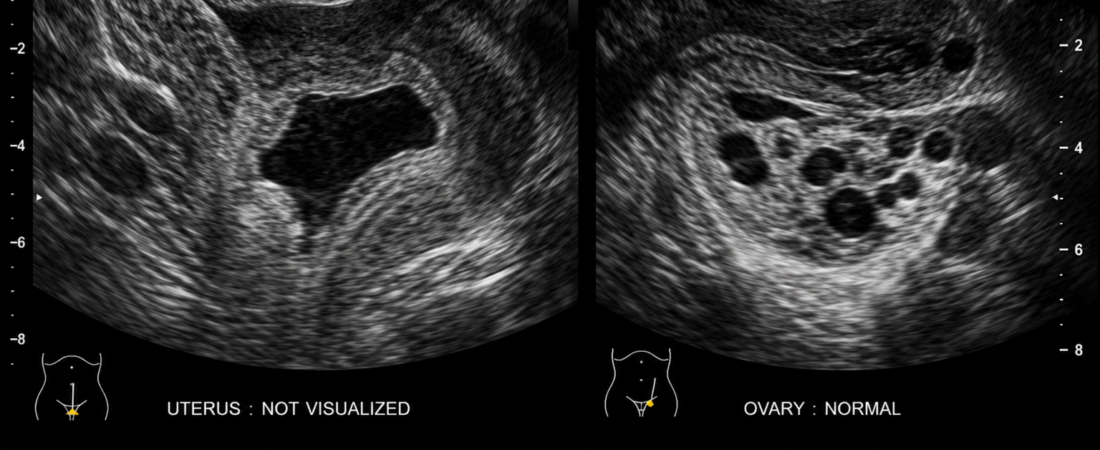
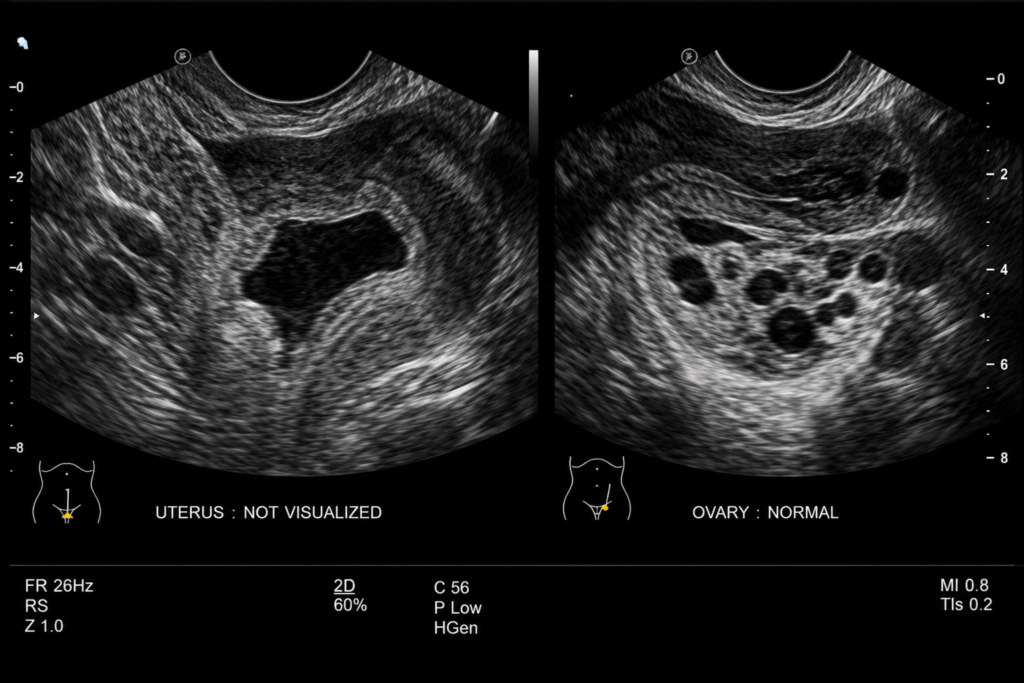
Therefore, the condition is most commonly discovered as ‘primary amenorrhea’—the failure to begin menstruation after passing puberty. Girls are often shocked when they visit a doctor because they haven’t started their period while all their friends have, only to be told during an ultrasound that their uterus is not visible.
Conversely, there are many cases where it remains completely unknown until adulthood, only to be diagnosed late after experiencing repeated difficulties or extreme pain during sexual intercourse after marriage or entering a relationship.
Fertility specialists offer this explanation.
Dr. Yang Gwang-moon of Suji Maria Clinic says, “Sexual intercourse can be somewhat uncomfortable at first, but if penetration is almost impossible despite multiple attempts or if the pain is severe enough to affect daily life, it should not be dismissed as a simple personal difference.” He adds, “Because there is a possibility of a rare congenital reproductive anomaly, an accurate medical examination is necessary.”
Of course, not all dyspareunia (painful intercourse) is caused by MRKH syndrome. Much more common causes include vaginal dryness, vaginitis, pelvic floor muscle tension, psychological anxiety, or endometriosis. However, experts point out that the culture of accepting repeated pain as something to ‘endure’ is one of the biggest reasons for delayed diagnosis.
Dr. Seo Dong-ho of Dongtan Cheil Eye Hope Clinic advises, “Many women feel ashamed of sexual pain or think it’s their own problem, so they don’t visit a hospital for years. Pain is an important signal from the body; if it repeats, you must identify the cause.”
In the past, MRKH syndrome was perceived as a condition that made a normal sexual life impossible forever, but treatment outcomes have greatly improved recently. International clinical guidelines prioritize non-surgical treatment using vaginal dilators, and many patients successfully achieve sufficient vaginal length through consistent treatment. If necessary, vaginal reconstruction surgery can also be performed, and many patients lead satisfying sexual lives after appropriate treatment and rehabilitation.
However, psychological recovery is as important as physical treatment.
MRKH patients often experience deep frustration immediately after diagnosis, facing questions like ‘Am I not a normal woman?’, ‘Will I be able to get married?’, or ‘Can I not have children?’. Therefore, accurate medical information, psychological counseling, and support from family and spouses are essential to enhance treatment effectiveness.
Dr. Cho Jung-hyun of Sarang-i Women’s Clinic says, “MRKH syndrome is a rare disease, but early diagnosis opens up a much wider range of treatment options. If menstruation does not start or penetration is repeatedly difficult during sexual intercourse, it is most important not to worry alone but to find an obstetrician-gynecologist and seek counseling.”
Fertility specialists agree that the ‘culture of endurance’ must change. While sexual intercourse may involve slight tension or discomfort for anyone, repeated extreme pain or a situation where penetration is impossible should never be accepted as normal.
The body sends signals through pain. Not ignoring those signals is the most important starting point for the early detection of various female health conditions, including rare diseases.
Can I Have a Baby?
I Have Ovaries, but I Don’t Have a ‘Uterus’
The first question MRKH syndrome patients ask is, “Can I have children too?” Fertility specialists explain that to understand this disease, you must first know the fact that ‘ovaries and the uterus are different.’
In most MRKH syndrome cases, ovarian function is normal. Female hormones are secreted normally, and follicles grow every month. In other words, in most cases, the ability to produce eggs is maintained.
The problem is that there is no uterus, or it is not normally developed, to sustain a pregnancy. Because there is no space for a fertilized egg to implant and grow into a baby, it is currently difficult in the domestic medical environment to carry a pregnancy and give birth oneself.
Dr. Cho Jung-hyun explains, “MRKH patients are not unable to produce eggs; in most cases, they have uterine-factor infertility. It is possible to retrieve eggs through IVF, but because there is no uterus, standard IVF treatment alone cannot lead to pregnancy.”
Reproductive medicine is still advancing rapidly. Globally, over 100 cases of successful pregnancy and childbirth through uterine transplantation have been reported, opening new therapeutic possibilities. Although this is high-level treatment performed limitedly at professional medical institutions in some countries, it is evaluated as a new turning point for uterine-factor infertility treatment, which was previously considered impossible.
Dr. Park Soo-hyun of Yonsei Eye-Bom Women’s Clinic says, “In the past, the only thing we could say was ‘you can never have a child,’ but now medicine is gradually creating new hope. However, because surrogacy is not permitted in Korea and uterine transplantation is not a standard treatment, customized consultation and long-term planning for each patient are more important than anything else.”
Fertility specialists emphasize that there is no need to accept MRKH syndrome as a ‘disease of despair.’ Sexual life can be sufficiently improved through appropriate treatment, and reproductive medicine is also developing at a rapid pace. The important thing is not to spend time worrying alone, but to get an accurate diagnosis and establish a realistic treatment plan with professional medical staff.
If you desire childbirth, you should meet a fertility specialist for diagnosis and consultation.
※ This article was written to help general readers understand the topic based on clinical experience in obstetrics/gynecology and reproductive medicine, as well as the latest research data. It does not replace a specific individual’s diagnosis or treatment, and actual medical judgment must be made through consultation with a specialist.
※ Images: Created using generative AI (ChatGPT, OpenAI); depict fictional individuals, not real people.