
An international team analyzing 13 families with male infertility identified loss-of-function variants in CFAP46, CFAP57, SEPTIN4 and SPEM2.
Mouse experiments showed reduced sperm count and motility and abnormal tail structure, offering clues to genetic causes of male infertility.

Why do some sperm fail to move properly? Even with adequate numbers, poor movement or abnormal heads and tails can make natural conception difficult.
Hormonal problems, reproductive disease and lifestyle factors can contribute, but research suggests that impaired gene function is important in some men.
A team including Sidra Medicine in Qatar, the University of Osaka and the University of Tokyo analyzed 13 families with male infertility and identified four genes involved in abnormal sperm movement and morphology. The findings appeared in Human Reproduction on October 21, 2026.
Genetic clues to impaired sperm movement and shape
The study focused on asthenoteratozoospermia, the combination of reduced movement and abnormal morphology.
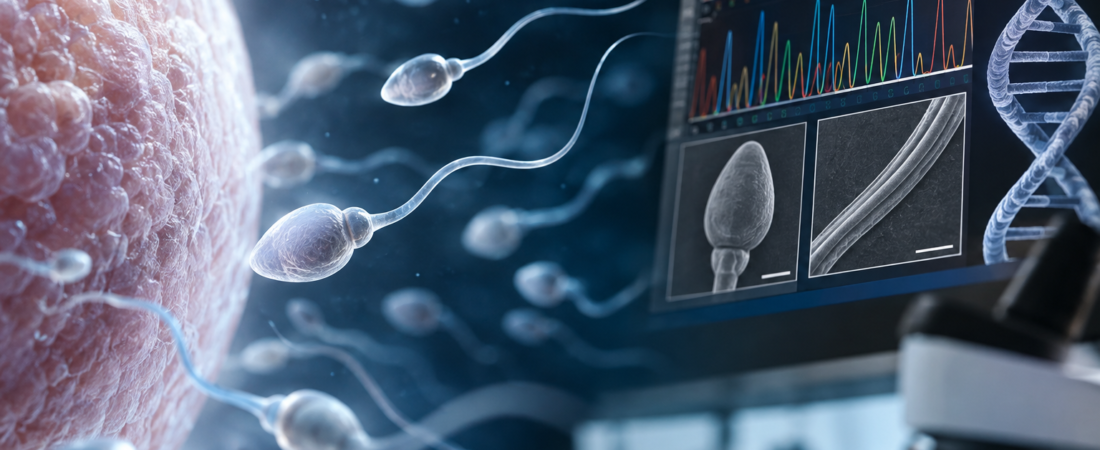
Sperm have a head, midpiece and tail. The head contains genetic material; the tail generates propulsion. Inside the tail, a microtubule structure called the axoneme enables movement. Abnormal formation can prevent normal motility.
The team performed whole-genome or whole-exome analysis in 13 consanguineous families with affected men. Related parents are more likely to share a recessive variant that can be inherited by a child.
Loss-of-function variants were identified in CFAP46, CFAP57, SEPTIN4 and SPEM2. These genes participate in sperm structure and function, and the variants were associated with the patients’ motility and morphology defects.
Removing CFAP46 impaired sperm production and movement in mice
A notable part of the work was experimental investigation of CFAP46.
Using CRISPR/Cas9, researchers created three mouse models with CFAP46 removed or altered. They assessed sperm count, movement and shape and used electron microscopy to examine internal structures.
Male mice lacking CFAP46 function had markedly reduced sperm count and motility, severe axonemal abnormalities and infertility.
CFAP46 also formed a complex with proteins including CFAP54, CFAP74 and CFAP221. This supports a role in normal tail formation and head development.
Could several genes contribute together?
The research also explored the possibility that some cases involve more than one gene.
For patients whose findings were not readily explained by a single variant, the team examined an additional 345 genes involved in sperm formation.
Some patients carried rare, potentially damaging variants across 4–16 genes. Their rare-variant burden was higher than in fertile controls.
This supports a hypothesis that combined disturbances in several genes may impair sperm formation. The contribution of individual variants and whether combinations cause infertility still require further study.
Does low motility always require genetic testing?
The findings may open diagnostic possibilities for some men with unexplained infertility.
Routine semen testing measures count, movement and shape without necessarily identifying their underlying causes. Genetic explanations may warrant consideration with severe tail defects or persistent, pronounced motility and morphology abnormalities.
Low motility alone does not mean that every man needs genetic testing. Infection, varicocele, hormonal abnormalities, medicines and lifestyle factors also need assessment.
The four genes have not been established as routine tests for all men with infertility. Testing decisions require specialist consideration of semen results, medical history and family history.
Implications for assisted reproduction remain to be established
Research into genetic causes may eventually help guide assisted reproduction.
ICSI, which injects a sperm directly into an egg, may be considered when movement is severely impaired. It cannot resolve every genetic cause of male infertility.
The nature of the genetic defect, fertilization capacity and potential embryo development matter alongside movement and appearance.
This was basic research on how gene defects affect sperm structure and function. It did not directly compare ICSI pregnancy or live-birth rates in carriers. It should not be presented as a new treatment or evidence of improved pregnancy success.
Understanding why sperm develop abnormally
Male infertility assessment has traditionally focused on sperm count, movement and morphology. Advances in genomics and germ-cell research are increasingly directed at the underlying causes of abnormal sperm development.
This study clarifies roles of genes involved in head and tail formation, with experimental validation of CFAP46 in mice and analysis of possible combined effects of rare variants.
Limitations include the restriction to 13 consanguineous families and the use of mice for key functional experiments. Larger studies are needed before generalizing to the wider population of men with infertility.
Nevertheless, it illustrates a shift from describing abnormal semen parameters toward understanding their origins.
Understanding movement defects at the genetic level may provide a foundation for more precise diagnosis and individualized treatment research.
This article is based on “Loss-of-function variants in CFAP57, SEPTIN4, SPEM2, and CFAP46 cause asthenoteratozoospermia,” by an international team including Sidra Medicine, the University of Osaka and the University of Tokyo, published online in Human Reproduction on October 21, 2026. DOI: 10.1093/humrep/deag154.
This research explanation does not replace individual diagnosis or treatment. Abnormal sperm motility or morphology should be discussed with a fertility or urology specialist.
The accompanying image was created using generative AI (ChatGPT, OpenAI); any people depicted are fictional.
Related reading: Understanding the tests at a first fertility clinic visit
Copyright © 2026 Fertility Information TokTok Fertility News | THE FERTILITY NOTES. All rights reserved. Unauthorized reproduction, copying, redistribution, scraping, AI training, and other data use of any articles, photographs, images, or other content are strictly prohibited. Violations may result in legal liability.