
Elucidating the Operating Mechanism of ‘Spermatogonial Stem Cells’ That Continuously Produce Sperm
SMC1A Interacts with YBX1 to Sustain HMGA2 Activity
Variants Identified from Genetic Analysis of 2,028 Non-Obstructive Azoospermia Patients
Not Yet at the Diagnostic or Therapeutic Stage, but Provides Fresh Clues for Uncovering the Causes of Male Infertility
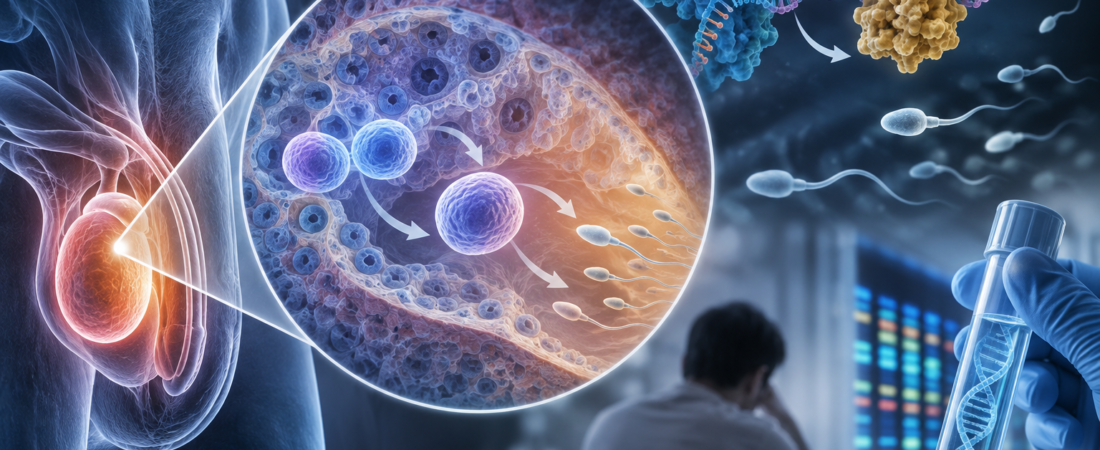
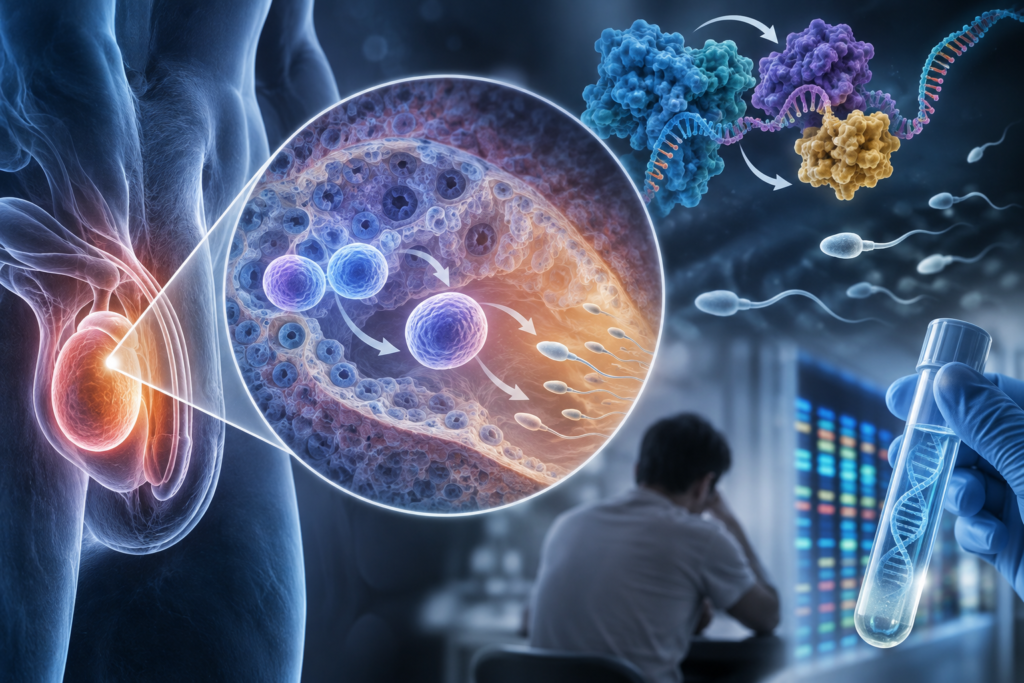
How can a man’s testes continuously produce sperm throughout his lifetime? At the starting point of this process lies the spermatogonial stem cell (SSC). Put simply, these are the “seed cells” that continuously generate sperm. Because these cells self-replicate while a subset differentiates into mature sperm, sperm production can be maintained indefinitely.
What happens, however, if these seed cells fail to function properly? The entire process of sperm production can grind to a halt.
Recently, researchers uncovered a critical molecular pathway involved in this process. Notably, by analyzing the exomes of 2,028 patients with non-obstructive azoospermia (NOA)—the most severe presentation of male infertility, where the testes fail to produce sperm—they confirmed related genetic variants in actual patients.
The research findings were published online on September 15 in the international journal Cell Death & Differentiation.
How the Sperm’s ‘Seed Cells’ Survive Continuously
Spermatogonial stem cells, the foundation of spermatogenesis, have two vital responsibilities: self-renewal, which involves continuously replicating themselves to preserve the stem cell pool, and differentiation, which entails developing down the pathway toward mature sperm.
Maintaining a balance between the two is essential. If only self-renewal occurs, normal sperm cannot be formed; conversely, if stem cells are depleted excessively, the fundamental source for future sperm production can vanish entirely.
The protein that caught the researchers’ attention was SMC1A.
Examining human spermatogonial stem cells revealed that the SMC1A protein does not function in isolation. Moving in tandem with another protein named YBX1, it helps ensure that the regulatory instructions of the HMGA2 gene are sustained inside the cell over time.
For a gene to instruct a cell to perform a task, it requires messenger RNA (mRNA) to carry that message. Think of mRNA as an instruction memo delivering genetic commands to the cellular machinery. The researchers confirmed that SMC1A and YBX1 work cooperatively to stabilize this instruction memo for HMGA2, preventing it from degrading easily.
Put simply:
For the spermatogonial stem cells that generate sperm to survive and proliferate, biochemical signals within the cell must be transmitted properly. In this study, SMC1A and YBX1 were shown to protect HMGA2 signaling from dissipating prematurely.
In essence, it acts as a molecular safeguard preserving the critical commands needed to maintain the “seed cells” of sperm production. The researchers designated this sequential biological pathway the ‘SMC1A–YBX1–HMGA2 axis.’
Disrupting SMC1A Impaired Spermatogonial Stem Cells
Moving beyond in vitro cellular assays, the investigators conducted animal studies to evaluate the functional role of SMC1A in active spermatogenesis.
When spermatogonial stem cells with inhibited SMC1A function were transplanted into the seminiferous tubules of germ cell-depleted mice, their capacity for homing and colonization fell, and defects emerged in normal differentiation.
Furthermore, conditionally knocking out the Smc1a gene in mice resulted in spermatogenic arrest and a pronounced reduction in male fertility. This confirmed that the molecular mechanisms observed at the cellular level directly impact in vivo reproductive capacity.
Could the same perturbation be identified in human azoospermia?
Genetic Analysis of 2,028 Non-Obstructive Azoospermia Patients
This was a particularly notable component of the study.
The investigators analyzed whole-exome sequencing (WES) data from 2,028 patients with non-obstructive azoospermia. Whole-exome sequencing is a genomic test that selectively reads the protein-coding regions of human DNA to identify genetic variants.
Non-obstructive azoospermia differs fundamentally from obstructive azoospermia, where sperm is produced but cannot exit in the ejaculate due to physical blockages along the reproductive tract. In NOA, sperm production within the testes themselves is severely compromised or entirely arrested.
From this cohort, the researchers identified two potentially deleterious variants in SMC1A and one deleterious variant in HMGA2 among NOA patients.
In addition, testicular tissue from NOA patients with spermatogenic failure exhibited substantially lower expression levels of both SMC1A and HMGA2 compared to testicular tissue from obstructive azoospermia patients with intact, normal spermatogenesis.
This is meaningful because the disruption was not merely observed in laboratory cell models, but verified as a pathway anomaly in clinical male infertility patients.
Identifying 3 Genetic Variants Does Not Equal an Immediate Cure
However, it would be an overstatement to interpret this study as having “found the definitive cause of azoospermia” or “unlocked a new treatment.”
The etiology of non-obstructive azoospermia is remarkably complex and heterogeneous. Beyond chromosomal aberrations and single-gene mutations, multifactorial genetic and epigenetic mechanisms frequently intertwine. In this study as well, SMC1A or HMGA2 variants were not found across all 2,028 patients; rather, two deleterious SMC1A variants and one deleterious HMGA2 variant were confirmed.
Consequently, it is premature to claim that testing for SMC1A or HMGA2 in clinical settings will immediately diagnose the cause of azoospermia, or that targeting this pathway will restart sperm production.
The core value of this study lies not in delivering an immediate clinical treatment, but in delineating a novel molecular switch that governs how sperm-producing stem cells maintain their identity and survival.
SMC1A collaborates with YBX1 to maintain the stability of HMGA2 transcripts, directly influencing the self-renewal and viability of spermatogonial stem cells.
Male infertility research is advancing beyond simply counting how many sperm are present, moving deeper into tracing—at cellular and genetic resolution—why the manufacturing facility itself shuts down.
If these findings are replicated in diverse independent cohorts and the precise pathomechanisms linking each genetic variant to spermatogenic disruption are fully unraveled, this work could pave the way toward subtyping previously unexplained non-obstructive azoospermia and identifying novel therapeutic targets.
※ Study Source: Based on the research article published online on September 15, 2026, in the international journal Cell Death & Differentiation, titled “SMC1A is required for fate determinations of human spermatogonial stem cells and male fertility by interacting with YBX1 and stabilizing HMGA2 mRNA via an m5C modification” by Liu W, Du L, Zhu Y, et al. Whole-exome sequencing (WES) was analyzed across 2,028 patients with non-obstructive azoospermia. DOI: 10.1038/s41418-026-01872-w.
※ This article provides informational coverage of recent scientific research and does not constitute medical advice intended to diagnose individual causes of azoospermia or recommend specific treatments.
※ The images used in this article were generated using artificial intelligence (ChatGPT, OpenAI) as illustrative reference materials and do not depict real individuals.
※ Copyright © 2026 THE FERTILITY NOTES. All rights reserved. Unauthorized reproduction, duplication, distribution, scraping, AI training, or data utilization of all content, including articles, photos, and images, is strictly prohibited and subject to legal liability.