
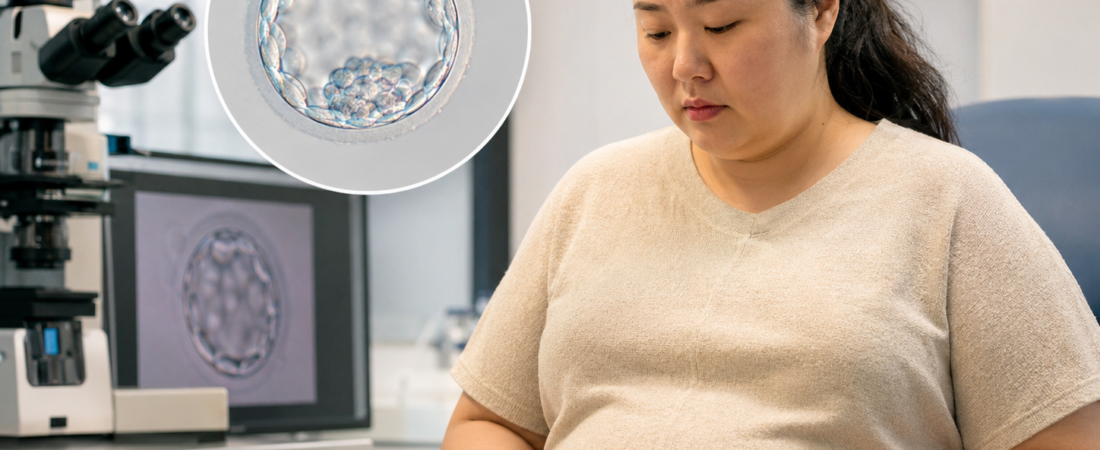
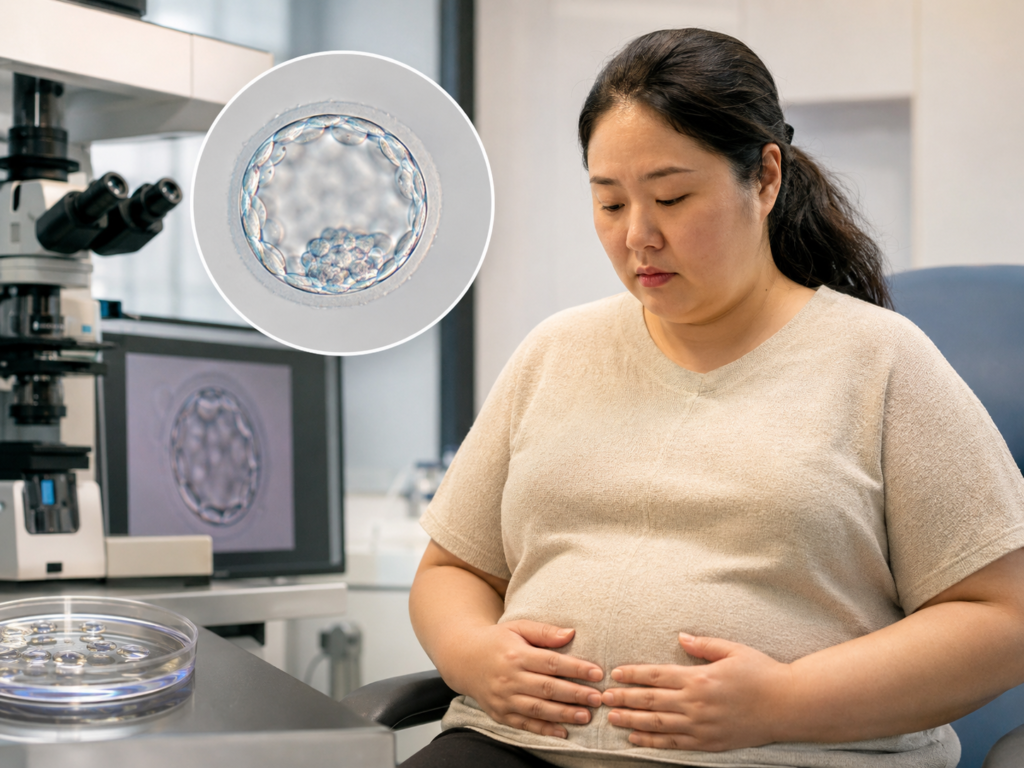
- Analysis of 14,990 First Single Euploid Frozen Embryo Transfers: Early pregnancy loss risk increases significantly from a BMI ≥30
- Implantation Rates Were Comparable, But Gaps Emerged During Pregnancy Maintenance and Delivery: Loss risk up to 42% higher for individuals with a BMI ≥40
- Controlling for Embryonic Aneuploidy Highlights Maternal Metabolic Factors: Euploidy alone does not eliminate maternal physiological risks
It is easy to assume that if an embryo is confirmed to be chromosomally normal, the risk of miscarriage is largely eliminated. Chromosomal aneuploidy is indeed the single leading cause of early pregnancy loss. However, a large-scale study demonstrates that even after controlling for embryonic chromosomal factors, maternal obesity independently affects the ability to maintain a viable pregnancy.
According to a study published in the August 2026 issue of the international journal Fertility and Sterility, patients with a Body Mass Index (BMI) of 30 or higher had a 19% higher risk of early pregnancy loss following single euploid frozen embryo transfer compared to non-obese patients. The significance of this finding lies in the fact that this disparity persisted after controlling for embryonic chromosomal aneuploidy via PGT-A.
Tracking 14,990 First Single Euploid Transfers
Researchers from a United States reproductive medicine network analyzed 14,990 patients across nine clinical centers between 2019 and 2024. All participants underwent their first single euploid frozen embryo transfer (SEET) using autologous oocytes after chromosomal euploidy was confirmed via Preimplantation Genetic Testing for Aneuploidy (PGT-A).
The cohort was categorized into:
- Non-Obese Cohort (BMI<30 kg/m2): 11,179 patients
- Obese Cohort (BMI≥30 kg/m2): 3,811 patients
After adjusting for maternal age and key clinical covariates, the results demonstrated a clear divergence:
- Adjusted Relative Risk (aRR) for Early Pregnancy Loss: 1.19 (95% CI: 1.14–1.24) in the obese cohort.
- A 19% elevation represents a 19% higher relative risk compared to non-obese patients, rather than an absolute increase of 19 percentage points in raw miscarriage rates.
Stepwise Risk Elevation Across BMI Classes
The risk of early pregnancy loss escalated in a stepwise pattern as BMI increased:
- Class 1 Obesity (BMI 30–34.9 kg/m2): ≈13% higher risk compared to normal-weight individuals.
- Class 2 Obesity (BMI 35–39.9 kg/m2): ≈20% higher risk.
- Class 3 / Severe Obesity (BMI≥40 kg/m2): ≈42% higher risk.
In contrast, patients in the overweight (BMI 25–29.9 kg/m2) and underweight categories exhibited no statistically significant difference in loss rates compared to the normal-weight reference group. In statistical modeling, the lowest projected probability of pregnancy loss centered around a BMI of approximately 25.3.
This mathematical nadir reflects an observational baseline rather than clinical proof that reducing weight to precisely 25.3 will guarantee treatment success.
Implantation vs. Maintenance: Where the Gap Emerged
A key finding of this study centers on the initial stage of implantation:
- Initial Implantation Rates: No statistically significant difference was observed between the obese and non-obese cohorts.
The divergence emerged primarily after implantation had taken place:
- The obese cohort exhibited significantly lower rates of clinical pregnancy and ongoing pregnancy.
- In adjusted analyses, the overall probability of achieving a live birth was approximately 8% lower in the obese cohort.
This indicates that maternal obesity does not necessarily prevent a euploid embryo from implanting initially, but rather impairs the physiological capacity to sustain that pregnancy through to live birth.
Maternal Metabolic Factors Beyond Chromosomal Normalcy
A primary goal of PGT-A is screening out numerical chromosomal aneuploidies. Because aneuploid embryos are responsible for the vast majority of implantation failures and early miscarriages, restricting an analysis exclusively to euploid transfers largely removes the major confounding variable of embryonic chromosomal errors.
The persistence of obesity-related disparities under these conditions confirms that pregnancy success does not rely solely on embryonic ploidy.
Potential biological mechanisms include:
- Chronic low-grade systemic inflammation
- Insulin resistance and altered metabolic signaling
- Impaired endometrial decidualization
- Alterations in early trophoblast invasion and placental vascular remodeling
Because this trial was not designed to isolate underlying molecular mechanisms, these remain prospective hypotheses rather than definitive causal proofs.
Study Limitations and Clinical Interpretation
Several methodological boundaries must be kept in mind:
- Study Design: This was a retrospective cohort study rather than a randomized controlled trial (RCT). While it establishes a strong epidemiological association, it does not directly prove that pre-transfer weight reduction interventions will linearly reverse miscarriage risks.
- Metric Limitations: BMI is an indirect surrogate marker that does not fully capture visceral adiposity, muscle mass, or individualized metabolic health.
- Population Specificity: The cohort was restricted to patients undergoing their first autologous single euploid frozen transfer, limiting direct generalization to fresh transfers, untested embryos, or spontaneous conceptions.
Conclusion
Securing a high-grade euploid embryo is a major milestone, but it does not serve as an unconditional guarantee of a live birth. Even when embryonic chromosomal integrity is verified, maternal metabolic and physiological health represents a critical biological axis.
As the clinical use of euploid transfers expands, the investigative focus is shifting: moving from simply asking “Is the embryo chromosomally normal?” to evaluating “Is the maternal intrauterine and metabolic environment optimized to sustain that normal embryo after implantation?”
Medical Source & Study Information
- Journal: Fertility and Sterility (Official Journal of the American Society for Reproductive Medicine, ASRM), August 2026 Issue.
- Study Title: Obesity is associated with an increased risk of early pregnancy loss after euploid frozen embryo transfer
※ This article was synthesized based on the study published in the August 2026 issue of Fertility and Sterility and related literature in reproductive endocrinology. It does not replace individualized clinical diagnosis or medical care, and specific treatment decisions should always be made in consultation with a qualified reproductive endocrinologist.
※ The images associated with this article were generated using generative AI (ChatGPT, OpenAI) as illustrative visual references and do not depict real individuals.