
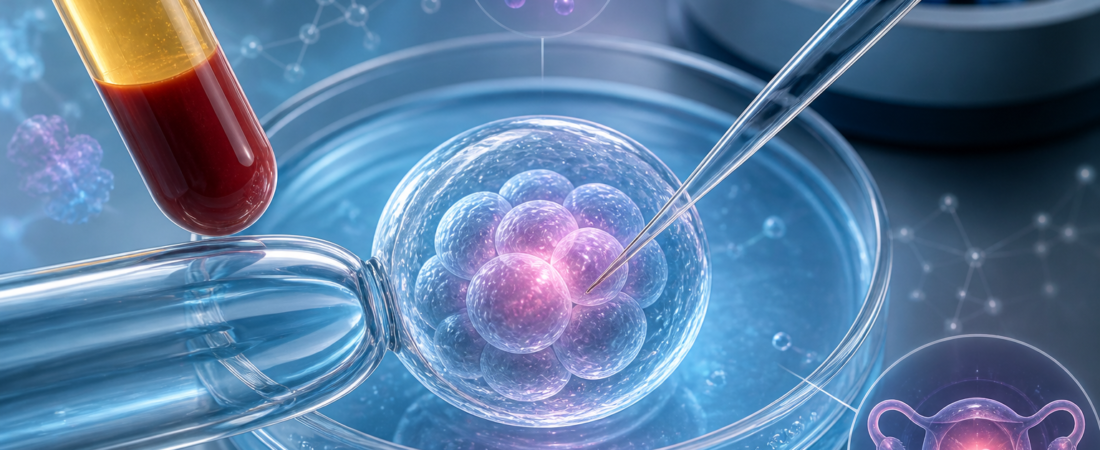
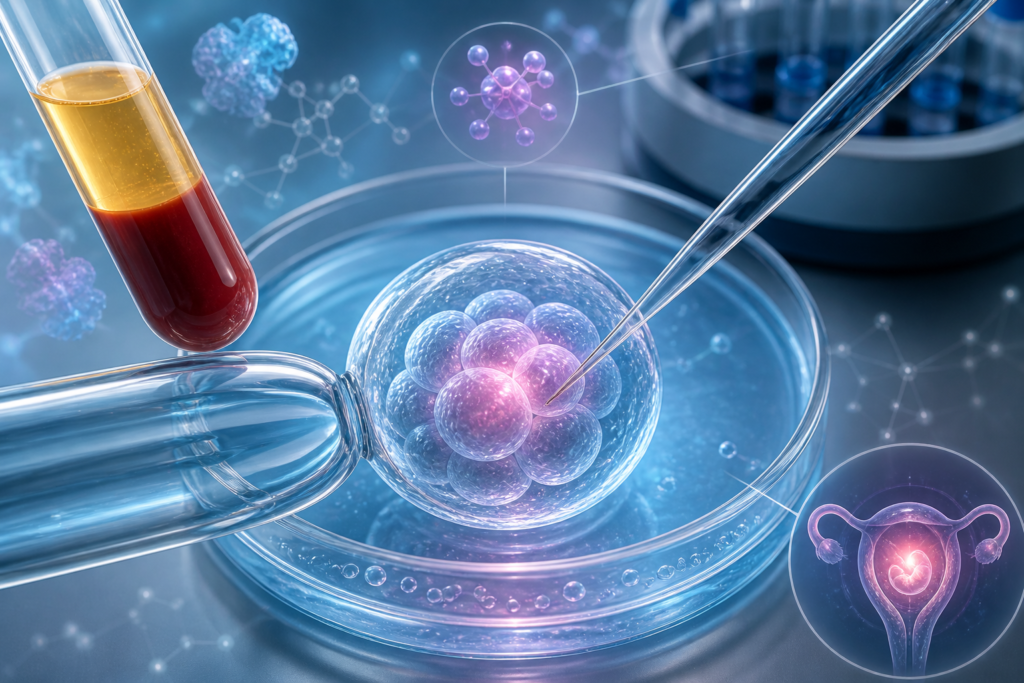
The trajectory of In Vitro Fertilization (IVF) is undergoing a fundamental transformation. For decades, the industry’s focus remained locked on the “selection” of the highest-grade embryo. However, the paradigm is shifting toward the “design” of the environment in which that embryo matures. Leading this movement is PRP (Platelet-Rich Plasma) culture, an innovative approach that treats the culture environment as an active participant in embryonic success.
PRP: Mimicking the Biological Cradle The core strategy of PRP-assisted culture is simple: utilizing the patient’s own blood plasma to enrich the culture medium. PRP is densely packed with growth factors and regenerative signaling molecules. By replacing traditional, standardized laboratory media with a medium that more closely mimics the natural maternal environment, we are not just observing embryonic development—we are actively supporting it with biological “cues” that aid cell survival and tissue recovery.
Why Selection is Not Enough For years, IVF success was viewed through the lens of morphology and chromosomal screening. Yet, clinicians frequently encountered a frustrating reality: embryos that appeared perfect under a microscope still failed to implant. This discrepancy suggested that the failure was not necessarily in the embryo itself, but in the disconnect between the embryo and its nurturing environment.
Embryonic implantation is a trifecta of variables: the genetic quality of the embryo, the receptivity of the endometrium, and the stability of the culture environment. PRP culture directly targets the third pillar—the one that was historically the most difficult to influence. Early clinical reports indicate that in patients with recurrent implantation failure (RIF), PRP-assisted culture may increase pregnancy success rates by up to 1.8-fold, suggesting that we are finally unlocking the hidden potential of the culture environment.
Evolution of the “Environment-First” Approach This shift is the culmination of years of innovation, including coculture with endometrial cells, low-oxygen incubation, and time-lapse monitoring systems. All these technologies share a singular philosophical goal: the embryo flourishes most where the conditions best mirror the human body.
The Path Forward: Evidence and Standardization Despite the excitement, the clinical community remains appropriately cautious. PRP culture is not yet a universal panacea. To transition from a promising experimental technique to a standardized clinical protocol, we require:
- Standardized Manufacturing Protocols: Ensuring that PRP preparation is consistent and reproducible across clinical settings.
- Large-Scale Clinical Data: Validating long-term safety and efficacy through randomized controlled trials.
Conclusion: A New Era for IVF The era of IVF defined solely by “picking the best” is fading. We are entering an era of “nurturing the potential.” This transition represents a major step forward, acknowledging that an embryo’s success is a dialogue between its genetic makeup and the environment we provide. As we move from selection to design, the ultimate goal becomes clear: to provide every embryo with the perfect cradle, ensuring that the technology of IVF is no longer just about observation, but about the art of survival.
Sources: ASRM Practice Committee Guidelines (2021); Williams Gynecology, 4th Edition (McGraw-Hill, 2020); Recent clinical research on PRP-based reproductive medicine.
Disclaimer: This content is provided for informational purposes, based on reporting on scientific advancements and public data. Medical judgments and treatment decisions must always be made in consultation with professional medical personnel. Image: AI-generated (ChatGPT, OpenAI) / Visual reference for illustrative purposes only.