
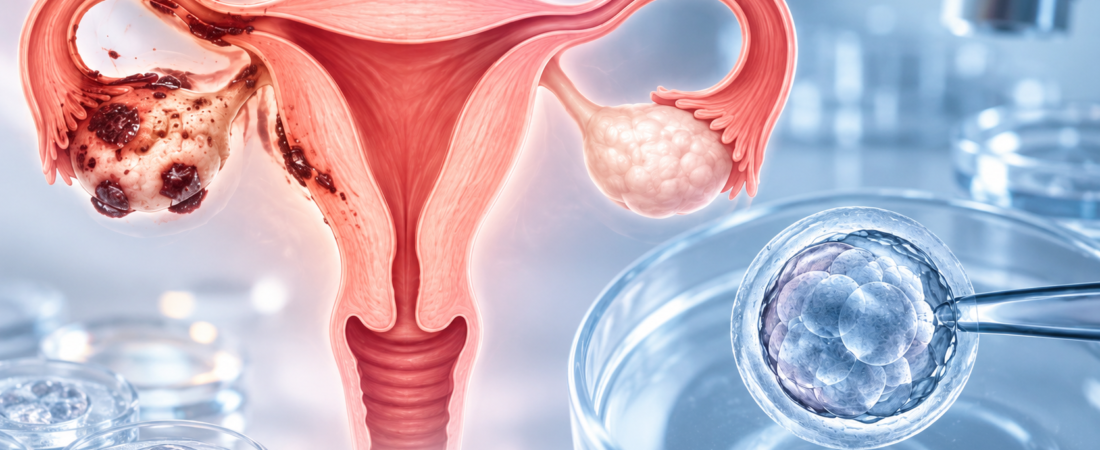
Does endometriosis reduce IVF implantation by making the uterine lining less receptive? A matched study of 195 women with endometriosis and 195 controls found similar cumulative clinical pregnancy rates—62% versus 61%—and live birth rates of 48% versus 49%. The retrospective findings do not mean endometriosis has no effect on fertility; they address a narrower question after embryo conditions were matched.
The study did not find a clear difference attributable to reduced endometrial receptivity and points to the importance of considering ovarian, embryo and other factors together.
Women with endometriosis often hear that an embryo may have difficulty attaching to the uterus even with IVF. Endometriosis is indeed a recognized cause of infertility. But a longstanding question remains: Is the problem necessarily that the endometrium cannot receive an embryo?
The new study examined that question directly. It did not identify clear evidence of impaired endometrial receptivity in the women with endometriosis who were included.
How can researchers separate embryo factors from uterine factors?
Endometriosis occurs when tissue resembling the uterine lining grows outside the uterus, including on the ovaries or peritoneum. It can cause inflammation and adhesions. Ovarian disease can also affect ovarian function or egg retrieval.
A poorer IVF result cannot therefore automatically be attributed to a “weak lining.” If a woman with endometriosis produces fewer eggs or fewer, lower-quality embryos, it is difficult to tell whether a lower pregnancy rate reflects the embryo, the uterus, or both. Our coverage of endometriomas and the number of eggs retrieved examines one ovarian aspect separately.
This study compared 195 women with endometriosis against 195 women without it, using one-to-one matching for age and the number and morphological quality of cryopreserved blastocysts.
A blastocyst is an embryo that has developed for around five or six days after fertilization and is approaching the stage at which it can implant.
In effect, the researchers asked: “When women of similar age have similar numbers and morphological quality of embryos, do outcomes differ depending on whether they have endometriosis?”
Clinical pregnancy was 62% versus 61%; live birth was 48% versus 49%
The cumulative clinical pregnancy rate was 62% in the endometriosis group and 61% in controls, with no statistically significant difference.
The result remained similar after adjustment for factors that differed between the groups, including body mass index, the total number of eggs retrieved, and the fertilization method.
There was also no significant difference in the more consequential endpoint of live birth.
The cumulative live birth rate—the proportion ultimately having a baby after sequential transfers of frozen blastocysts created from the retrieval—was 48% in the endometriosis group and 49% in controls.
At least within this matched population, there was no clear indication that the uterus of a woman with endometriosis was substantially less able to receive embryos once comparable embryos had been obtained. A lack of statistical difference is not proof that the outcomes are identical in every patient.
Does this mean endometriosis does not affect IVF?
This is the point that needs the most care. The study should not be read as showing that endometriosis has no effect on pregnancy or IVF.
Endometriosis can influence fertility through several routes, including ovarian reserve, the number of eggs retrieved, pelvic inflammation and adhesions. A separate 2026 systematic review and meta-analysis of ART outcomes reported lower live birth rates in women with endometriosis than in controls.
The present matched study asks a different question: after minimizing differences related to the ovaries and embryo supply, is there still evidence that the endometrium itself impedes implantation when women have similar numbers and quality of blastocysts?
It found no clear difference in answer to that specific question. The two types of study use different comparisons and do not establish that every effect of endometriosis can be assigned to one organ.
Why “endometriosis means a poorly receptive uterus” is too simple
The finding encourages a broader view of endometriosis-associated infertility. When IVF results are disappointing, explanations should not automatically stop at “the lining cannot accept an embryo.”
Ovarian function, eggs retrieved, the number and quality of embryos, and coexisting conditions such as adenomyosis all need consideration. Outcomes also extend beyond implantation; see our article on pregnancy follow-up in women with endometriosis and adenomyosis after IVF.
There are important limitations. This was a retrospective matched case-control study of previous treatment records, not a randomized trial. The women underwent freeze-all treatment and subsequent frozen embryo transfers at the Reproductive Medicine Unit of Cochin Hospital in France between September 2016 and September 2018. The result cannot be treated as a final conclusion for every woman with endometriosis.
Even so, endometriosis does not necessarily make the uterus an environment in which embryos cannot implant. Once comparable blastocysts have been obtained, endometrial receptivity may be better preserved than a simple diagnosis-based assumption suggests.
The useful question may therefore be less “Is my uterus unable to implant an embryo?” and more “Which factors are affecting pregnancy in my case—the ovaries, embryos, uterus, another coexisting condition, or a combination?”
Study sources
This article is based on “Is endometrial receptivity in women with endometriosis negatively affected? Insights from IVF frozen embryo transfer cycles,” published online on September 8, 2026, in the Journal of Endometriosis and Uterine Disorders. It was a retrospective case-control study matching 195 women with endometriosis one-to-one with 195 controls. DOI: 10.1016/j.jeud.2026.100185.
The broader 2026 review mentioned above is “Association between endometriosis and adverse reproductive and perinatal outcomes in women undergoing assisted reproductive technology: a systematic review and meta-analysis,” published in Frontiers in Medicine. DOI: 10.3389/fmed.2026.1630529.
Individual outcomes: IVF results can vary with the location and severity of endometriosis, ovarian reserve, coexisting adenomyosis, age, and embryo characteristics.
Image disclosure: The image used in this article was created using generative artificial intelligence (ChatGPT, OpenAI). Any people depicted are fictional, not real individuals.
Copyright © 2026 Fertility Information TokTok · Fertility News | THE FERTILITY NOTES. All rights reserved. Unauthorized republication, reproduction, redistribution, scraping, AI training, and data use of any content, including articles, photographs, and images, are strictly prohibited. Violations may result in legal liability.