
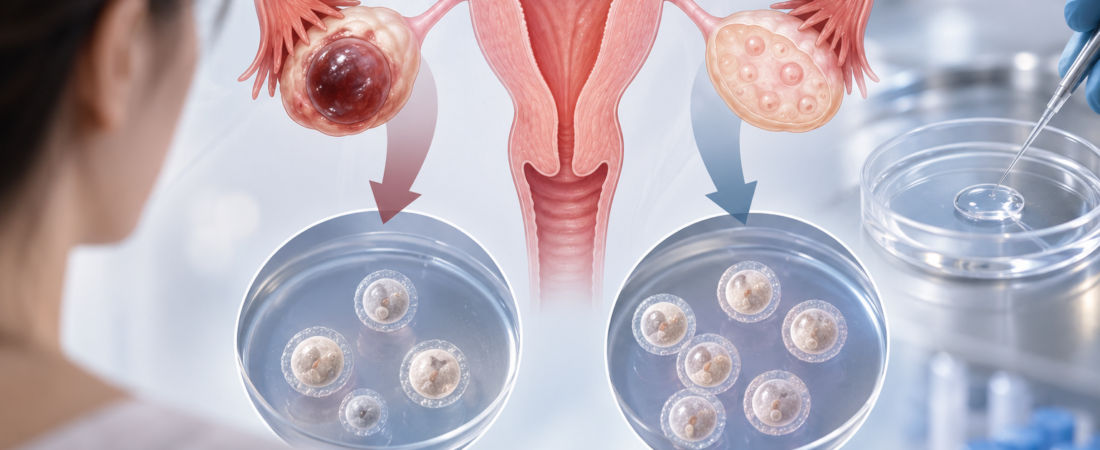
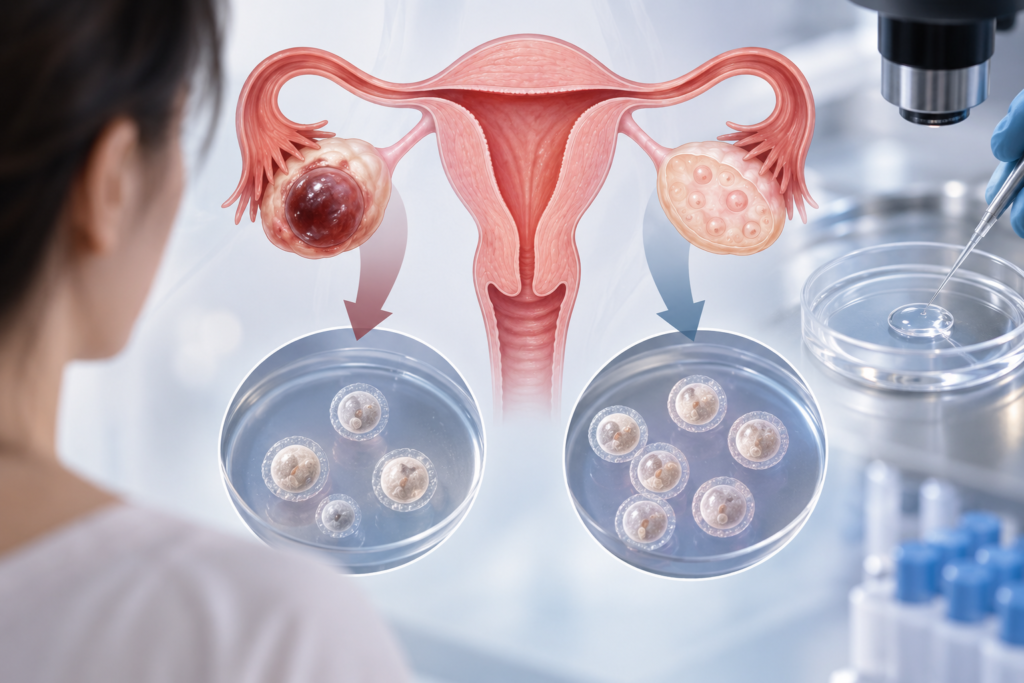
Direct Comparison Between the Affected Ovary and the Intact Contralateral Ovary: ‘No Significant Difference’ in Retrieved Oocyte Count
Comprehensive Analysis of 13 Studies: Mature Oocytes and Good-Quality Embryos Also Similar, Though Total Embryos Formed Decreased
Researchers: “Particularly for Small Endometriomas, the Need for Surgery Prior to IVF Must Be Weighed Carefully”
Ahead of fertility treatment, when an ultrasound reveals an ‘endometrioma’ in one ovary, one of the first concerns to arise is whether fewer eggs will be retrieved from the ovary with the cyst.
In fact, the possibility that endometriomas affect ovarian tissue and the follicular microenvironment has long been raised, and whether an endometrioma should be removed prior to in vitro fertilization (IVF) has been a subject of ongoing debate.
However, in a recently published systematic review and meta-analysis, in women with an unoperated endometrioma in only one ovary, no statistically distinct difference was confirmed in the number of retrieved oocytes between the affected ovary and the normal contralateral ovary. This means that one cannot definitively conclude that an ovary with an endometrioma fails to respond properly to ovarian stimulation.
Comparing the ‘Affected Ovary vs. Normal Ovary’ in the Same Woman
What makes this study particularly interesting lies in its comparison methodology.
Generally, comparing women with endometriomas to those without introduces numerous variables that can influence outcomes—such as age, ovarian reserve, etiology of infertility, and stimulation protocols. However, the researchers pooled existing studies focused on women who had an unoperated endometrioma in only one ovary. In other words, they directly compared the ovary with the endometrioma to the healthy contralateral ovary within the same individual.
The researchers searched the PubMed and Cochrane databases up to May 1, 2025, reviewing a total of 2,903 studies, and ultimately included 13 observational studies meeting their criteria in the systematic review and meta-analysis.
The primary outcome measure was the actual number of oocytes retrieved from each individual ovary, while the number of mature oocytes (MII), fertilization rate, number of formed embryos, and number of good-quality embryos were also analyzed.
Difference in Oocyte Count Was an Average of 0.72… Not Statistically Significant
The most notable finding centers on the actual number of retrieved oocytes.
Analyzing 11 studies covering 560 women, an average of 0.72 fewer oocytes were retrieved from the ovary with an endometrioma compared to the healthy contralateral ovary. Looking purely at the numerical value, it appears that slightly fewer eggs were retrieved from the affected side.
By the numbers, oocytes retrieved from the ovary with an endometrioma were fewer by an average of 0.72 compared to the opposite normal ovary. At first glance, one might think, “having an endometrioma means fewer eggs.”
In the researchers’ statistical analysis, however, the possibility that this difference occurred by chance could not be ruled out. In other words, while slightly fewer eggs were retrieved on average, the difference was not large enough to conclude with certainty that the endometrioma reduced the egg count.
The same applied to mature oocytes. An analysis of 149 women across 6 studies showed an average of 0.60 fewer mature oocytes in the ovary with an endometrioma, but this was likewise not a statistically significant difference. Simply put, this study found no clear evidence that “ovaries with an endometrioma yield definitively fewer eggs.”
No Difference in ‘Good-Quality Embryos’… A Signal in Total Embryo Count
Just as important as how many eggs are retrieved is how well they develop into embryos afterward. The study revealed no distinct difference in the number of good-quality embryos between the ovary with an endometrioma and the normal ovary.
However, a difference emerged in the total number of embryos formed. Pooling 4 studies revealed that an average of 0.72 fewer embryos were formed from the ovary with an endometrioma compared to the healthy ovary. While there was no definitive difference in oocyte count, a possibility appeared that the affected side may face slight disadvantages during post-fertilization embryonic development.
Still, it is premature to conclude that “embryos do not form well if an endometrioma is present.” This is because the number of studies included in this analysis was small, and results varied across studies.
Ultimately, while this study showed that an ovary with an endometrioma does not definitively yield fewer retrieved oocytes, mature oocytes, or good-quality embryos, a signal of a modest reduction in total embryo count was observed. This is why one should not overinterpret the findings to mean that endometriomas have zero effect on oocytes and embryos.
Surgery First Just Because of an Endometrioma?… Greater Caution Needed
A more critical question this study poses to IVF patients is whether an ovarian endometrioma should be removed prior to IVF treatment.
While patients may consider surgery first due to anxiety over the endometrioma itself, one must also weigh the risk that ovarian surgery can compromise adjacent healthy ovarian tissue and diminish ovarian reserve.
Based on these findings, the researchers assessed that unoperated endometriomas generally appear to have little to no major effect on ovarian stimulation outcomes. In particular, they noted that for small endometriomas, whether to recommend surgical excision before IVF/ICSI requires much more careful deliberation. However, they cautioned that it remains difficult to clearly determine the impact of large endometriomas based on the current data alone.
Important Limitations Exist… The “0.72 Fewer” Cannot Be Completely Dismissed
There are also caveats to keep in mind when interpreting these study results. All included studies were observational, with 8 being retrospective. Outcome reporting methods across studies were inconsistent, and none of the included studies were preregistered.
In particular, between-study heterogeneity (I2) in the analysis of retrieved oocyte counts was very high at 97%. This suggests that patient characteristics, endometrioma sizes, and ovarian stimulation protocols likely varied considerably across studies.
Therefore, the core message of this study is not that “having an endometrioma causes zero issues.” A more accurate characterization would be: “even in the presence of an unoperated unilateral endometrioma, no evidence was confirmed that the number of oocytes retrieved after controlled ovarian stimulation is significantly reduced compared to the healthy contralateral ovary.”
Simply because an endometrioma is detected in one ovary prior to IVF, one does not need to prematurely assume that “scarcely any eggs will come from this ovary.” At the same time, decisions regarding surgery should be made by comprehensively weighing cyst size and location, presence of pain, ovarian reserve, prior surgical history, and accessibility for oocyte retrieval.
※ Study Source: Published August 31, 2026. Human Reproduction. D. R. Kalaitzopoulos et al. Title: “The impact of unilateral endometriomas on ovarian response to stimulation: a systematic review and meta-analysis.” DOI: 10.1093/humrep/deag137, PMID: 42672534.
※ The contents of this article do not replace individualized medical diagnosis or treatment. Treatment approaches may vary depending on the size and location of the endometrioma, ovarian reserve, pain symptoms, past surgical history, and fertility treatment plans. In particular, deciding whether to surgically remove an endometrioma prior to IVF should not be made solely on the premise of “removing a cyst because it is there”; rather, the potential benefits must be carefully weighed against the risks of damaging healthy ovarian tissue and diminishing ovarian reserve in consultation with an attending specialist.
※ The images used in this article were generated using artificial intelligence (ChatGPT, OpenAI) as illustrative reference materials and do not depict real individuals.
※ Copyright © 2026 THE FERTILITY NOTES. All rights reserved. Unauthorized reproduction, duplication, redistribution, scraping, AI training, or data utilization of all content, including articles, photos, and images, is strictly prohibited and subject to legal liability.