
For decades, reproductive medicine has been governed by an unquestioned dogma: as women age, the quality of their eggs inevitably declines. This single sentence has not only defined the limits of fertility but has also dictated the trajectory of clinical treatment.
However, this long-held premise is beginning to fracture.
At the center of this research breakthrough is a specific protein: Shugoshin-1 (SGO1). Think of SGO1 as the “safety belt” that holds chromosomes together during the critical stages of cell division. In the process of fertilization, an egg must precisely segregate its chromosomes; if this process is compromised, it leads to embryonic aneuploidy, implantation failure, or miscarriage. The core of the problem is that SGO1 levels plummet as a woman ages. From the moment this “safety belt” loosens, chromosomal errors begin to surge.
While this confirms our previous understanding of “egg aging,” the recent research goes a crucial step further. By supplementing SGO1 function, researchers observed a direct and striking result: chromosomal errors were reduced by nearly 50%. This is not merely a correlation; it is a change triggered by addressing a root cause.
This realization is fundamentally altering the lens through which we view reproductive science.
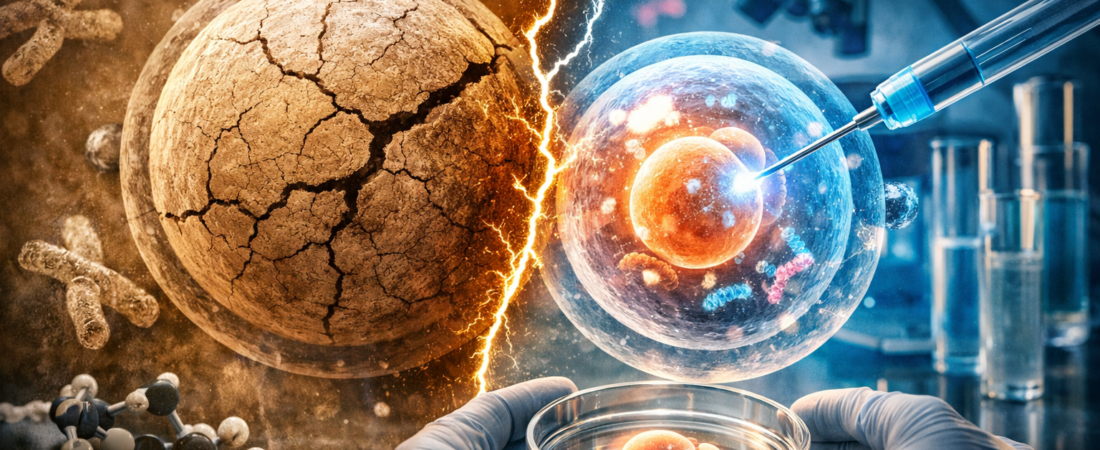
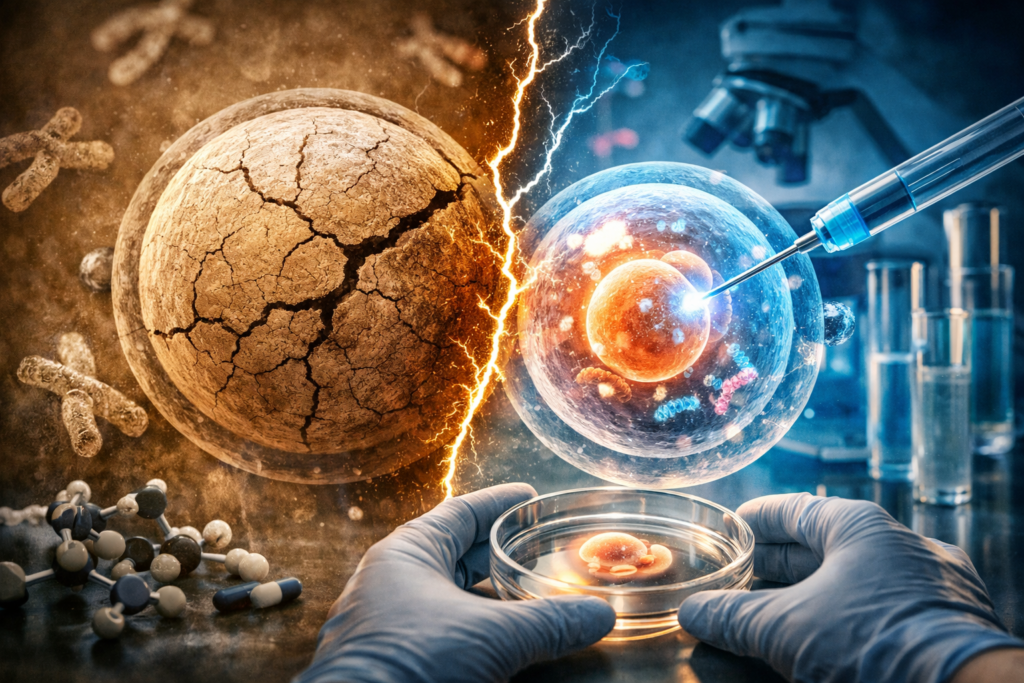
Until now, we treated the “aging” of an egg as a natural, immutable consequence of time. It was considered a condition to be accepted, not corrected. This research, however, offers a completely different interpretation: Eggs are not aging; they are breaking. And by definition, a “break” implies the possibility of repair.
This evolution is poised to transform therapeutic strategies:
- From Selection to Restoration: IVF has historically been an “art of selection”—choosing the best among an already limited cohort. We may soon move toward an era of restoring the functionality of compromised eggs.
- Redefining “Age”: Chronological age may become less relevant than cellular functionality. If we can maintain the integrity of specific proteins and structural components, the impact of time may be mitigated.
- The Technology of Results: IVF is evolving from a selection-based procedure into a curative technology that can alter clinical outcomes.
Of course, we must temper our excitement with caution. This research is still in its infancy, and it is too early to assert that this will automatically lead to higher clinical pregnancy or live birth rates. An egg is not a single-element system; it is a complex ecological environment influenced by blood flow, mitochondria, inflammation, and the ovarian microenvironment. Solving the SGO1 puzzle alone will not fix every variable.
From the perspective of a fertility-specialist journalist, the essence of this study is not just a technological advancement—it is a transformation of perspective. For far too long, maternal age has been used as the absolute benchmark of reproductive potential. Yet, that benchmark is slowly being dismantled. The problem was not the passage of time itself, but the structural degradation that occurs within that time. And structures, unlike time, can be intervened upon.
The ultimate message of this research is profoundly hopeful: Eggs do not age; they malfunction. And one day, that malfunction may become something we can repair. Or at the very least, we must remain committed to the belief that it can be.
Sources: Human Reproduction Update, Fertility and Sterility, Nature Reviews Endocrinology.
Disclaimer: This content is provided for informational purposes, based on reporting on infertility and various public data. Medical judgments and treatment decisions must always be made in consultation with professional medical personnel. Image: AI-generated (ChatGPT, OpenAI) / Visual reference for illustrative purposes only.