

GnRH agonist alone and dual triggering yielded averages of 15.2 versus 8.9 eggs in an unadjusted comparison.
Maturation rates did not differ significantly; ovarian reserve and follicular development were important factors.
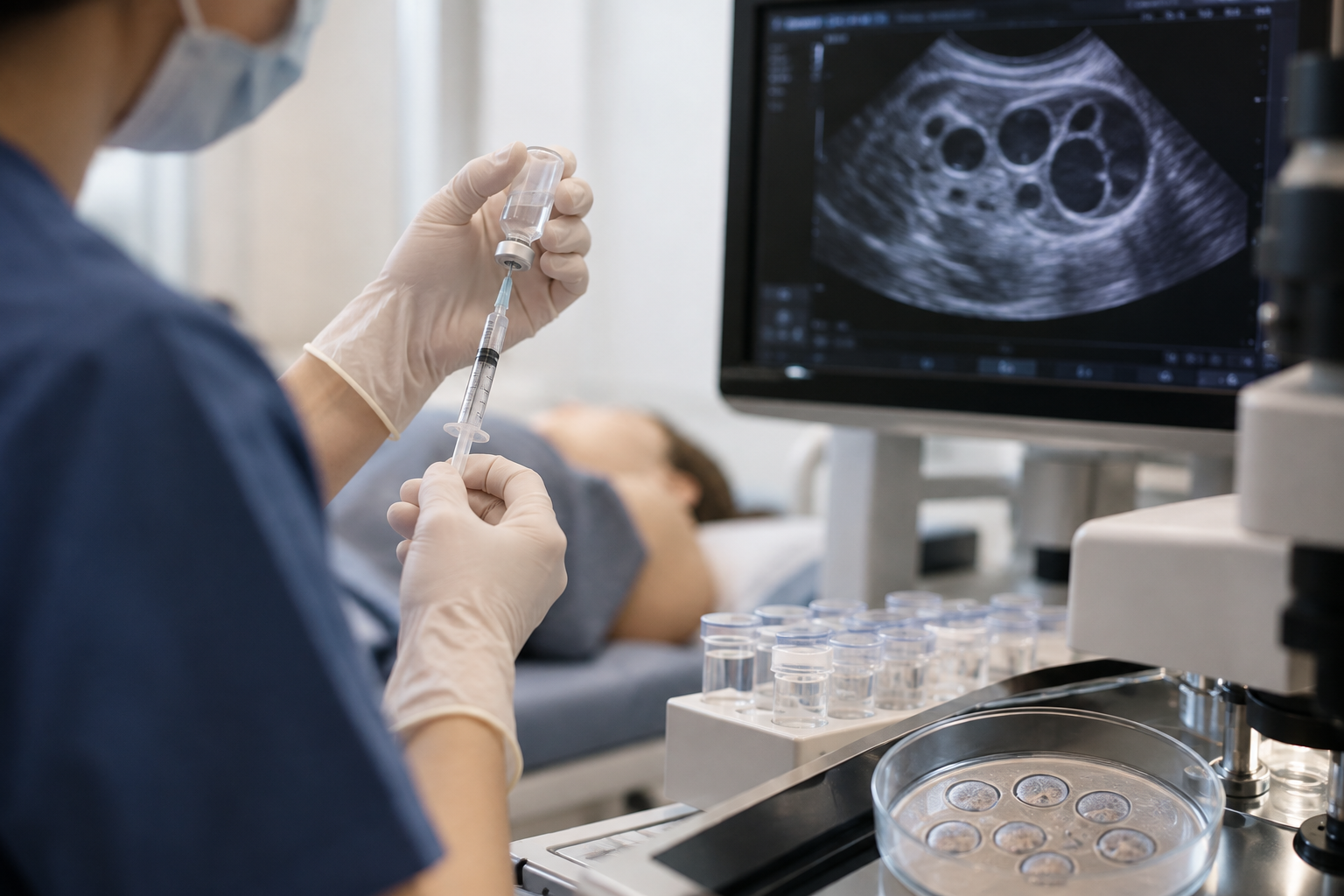
Does the type of final maturation injection given before egg retrieval affect the number or maturity of eggs obtained during egg freezing or IVF?
A study of 325 fertility-preservation cycles found differences in egg yield between trigger approaches. After accounting for ovarian reserve, follicular development and other factors, however, trigger type did not show an independent significant effect.
Published October 23, 2026 in Women's Health, the study suggests that ovarian reserve and the number and size of follicles developed during stimulation are important to retrieval outcomes, beyond the choice of trigger alone.
Why the final injection matters
During IVF or egg freezing, ovarian stimulation encourages several follicles to grow. Once they have developed sufficiently, a trigger induces final egg maturation before retrieval at a scheduled time.
Two approaches are a gonadotropin-releasing hormone (GnRH) agonist alone and a dual trigger.
A GnRH agonist induces a temporary pituitary release of luteinizing hormone (LH) and follicle-stimulating hormone (FSH), promoting final maturation. It is used in freeze-focused treatment such as egg freezing, in part because of advantages in reducing ovarian hyperstimulation syndrome (OHSS) risk.
A dual trigger combines a GnRH agonist with human chorionic gonadotropin (hCG). Combining their actions has been proposed as potentially helpful for obtaining mature eggs in some patients.
Which approach is more favorable may depend on ovarian function and response to stimulation.
Average egg yields of 15.2 versus 8.9
The researchers retrospectively analyzed 325 fertility-preservation cycles performed between 2020 and 2024. Of these, 130 were undertaken for medical reasons and 195 involved elective egg or embryo freezing.
GnRH agonist alone was used in 180 cycles and a dual trigger in 145.
The agonist-only group had an average of 15.2 eggs retrieved, compared with 8.9 in the dual-trigger group. Mean mature-egg counts were 11.0 and 6.5, respectively.
However, the proportion of retrieved eggs that were mature did not differ significantly: 75.1% with agonist alone versus 74.2% with dual triggering.
The higher unadjusted yield in the agonist-only group does not, by itself, establish that this approach is superior.
Trigger type was not the only difference
The two groups differed in ovarian reserve and follicular development.
Mean anti-Müllerian hormone (AMH), a marker of ovarian reserve, was 2.4 ng/mL in the agonist-only group and 1.0 ng/mL in the dual-trigger group. Patients with relatively higher reserve were therefore more represented in the agonist-only group.
Before retrieval, the mean number of follicles at least 17 mm in diameter was 4.15 versus 2.75. Counts of 14–16 mm follicles were 4.32 versus 2.66, respectively.
After statistical adjustment for these variables, trigger type was not independently significantly associated with either total or mature-egg yield.
AMH and the number of follicles reaching relevant sizes were significantly associated with total egg yield. AMH, female age and the number of 14–16 mm follicles were important factors for mature-egg yield.
The findings indicate that trigger type alone cannot reliably predict retrieval results; ovarian reserve and stimulation response also need consideration.
Individualized egg-freezing strategies
For women considering egg freezing, the study suggests that choosing a trigger does not necessarily determine the number of eggs obtained.
It does not prove that the two approaches have identical effects. This was a retrospective analysis of clinical records, not a randomized trial assigning trigger methods.
In practice, clinicians consider ovarian reserve, follicular development, stimulation response and OHSS risk when choosing a trigger. Differences between patients at baseline may therefore have influenced the results.
The study did not directly assess OHSS incidence or compare survival after warming, subsequent pregnancy or birth outcomes.
The authors emphasized individualizing the trigger according to patient characteristics and ovarian response rather than choosing one approach uniformly. Prospective research is needed to clarify their comparative effects.
Egg freezing involves more than maximizing the number retrieved. The number of mature eggs available for fertilization, and outcomes after warming, fertilization and embryo development, also matter.
For women with low ovarian reserve or a high proportion of immature eggs in a previous retrieval, follicular development and injection timing warrant consideration alongside trigger type.
The study supports a strategy tailored to ovarian function and follicular development, rather than assuming one trigger method will improve outcomes for everyone.
Source: This article is based on “Fertility preservation cycles: Comparing GnRH agonist and dual triggering effects on oocyte retrieval and maturation rates,” by Chen Nahshon and colleagues, published online October 23, 2026 in Women's Health. The retrospective study compared retrieval and maturation outcomes in 325 fertility-preservation cycles from 2020–2024. DOI: 10.1177/17455057261484065. PMID: 42913492.
Image disclosure: The image was created using generative AI (ChatGPT, OpenAI); any people depicted are fictional, not real individuals.
For background on ovarian reserve, semen analysis and when additional investigations may be considered, see our guide to the first fertility clinic visit.
Copyright © 2026 Fertility Information TokTok Fertility News | THE FERTILITY NOTES. All rights reserved. Unauthorized reproduction, copying, redistribution, scraping, AI training, and other data use of any articles, photographs, images, or other content are strictly prohibited. Violations may result in legal liability.