

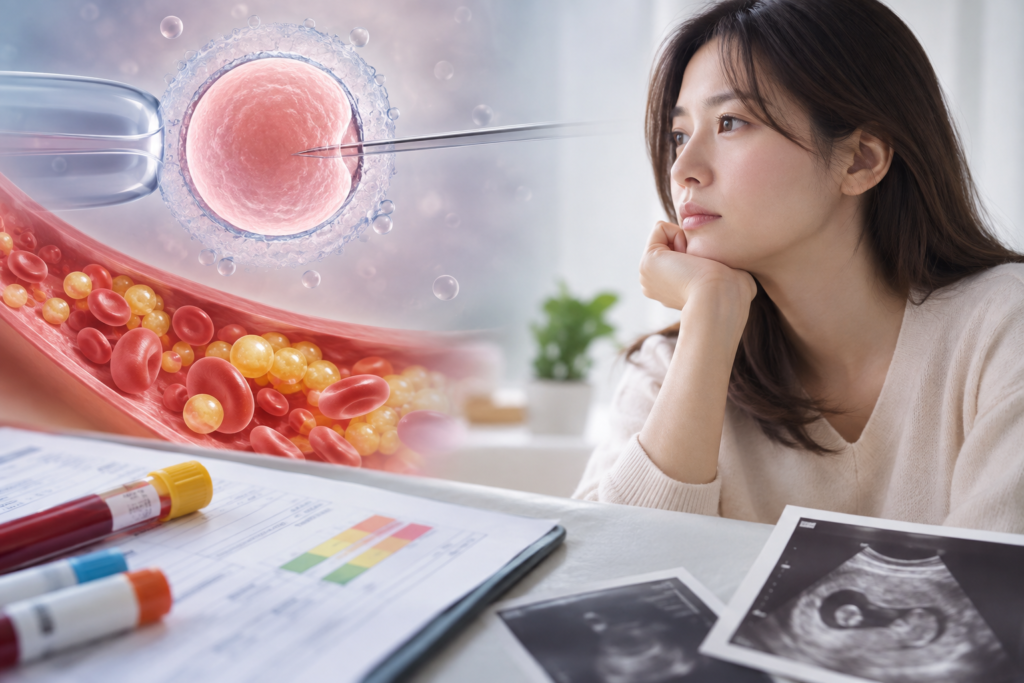
- Dyslipidemia in subfertile women linked to oocyte, pregnancy, and neonatal outcomes: Latest study published September 9 in RBMO
- Elevated total cholesterol, LDL, triglycerides, and low HDL under the spotlight: Prior study of 5,030 patients also identified drops in live birth rates
- Caution urged against simplistic assumptions that “high cholesterol guarantees IVF failure”: Age, obesity, and systemic metabolic factors must be evaluated together
For women preparing for In Vitro Fertilization (IVF), the most familiar clinical metric is Anti-Müllerian Hormone (AMH). Patients track follicle counts, retrieved egg numbers, and endometrial thickness with meticulous care. But what about the routine cholesterol panel from an annual health checkup? Could elevated total cholesterol, high LDL, or high triglycerides influence IVF success rates?
Recent research suggests this question warrants serious clinical attention.
On September 9, 2026, the international journal Reproductive BioMedicine Online (RBMO) published an online study titled “Dyslipidemia is negatively associated with fertility, pregnancy, and neonatal outcomes in women undergoing IVF treatment.” Conducted by researchers at the Reproductive Medicine Center of Peking University Third Hospital, the paper features prominent leaders in reproductive medicine, including Professor Jie Qiao and Professor Ben W. Mol, as co-authors.
The paper’s title delivers an unmistakable message: circulating lipid profiles—long viewed primarily as markers of cardiovascular risk—may have measurable links to oocyte quality, pregnancy progression, and neonatal outcomes in assisted reproduction.
Why Is Cholesterol Linked to the Egg?
Here, dyslipidemia does not refer merely to an isolated elevated lab reading. It encompasses a broader spectrum of lipid imbalances: elevated total cholesterol (TC), high low-density lipoprotein cholesterol (LDL-C, or “bad cholesterol”), high triglycerides (TG), or abnormally low high-density lipoprotein cholesterol (HDL-C, or “good cholesterol”).
The biological issue is that lipids are not confined strictly to the vascular bloodstream. Within the ovarian follicle where an oocyte matures, the follicular fluid contains an array of fatty acids, cholesterol fractions, and active metabolites.
An oocyte does not mature in isolation; it depends on continuous nutritional and paracrine signaling from surrounding somatic granulosa cells and cumulus cells. When this metabolic microenvironment is severely disrupted, local oxidative stress and endoplasmic reticulum (ER) stress can rise, which may interfere with normal oocyte nuclear and cytoplasmic maturation.
This is not a simplistic claim that “cholesterol physically blocks the egg.” Rather, elevated circulating lipids often signal a broader shift in whole-body metabolic equilibrium—a systemic alteration that can influence the follicular fluid microenvironment, early embryo development, and endometrial receptivity.
Prior research has likewise demonstrated that an overly lipid-rich follicular environment can provoke oxidative stress within the cumulus-oocyte complex (COC) and impair oocyte nuclear maturation.
Tracking 5,030 Patients: Notable Differences Above 200 mg/dL Total Cholesterol
A major clinical study previously published in RBMO brought real-world weight to this question.
That large-scale study analyzed clinical records from 5,030 subfertile women undergoing their first IVF or ICSI cycle, comprising 1,903 women with dyslipidemia and 3,127 normolipidemic controls. The researchers performed extensive statistical adjustments to minimize baseline differences between the cohorts, including age and body mass index (BMI).
The findings were striking.
Women with dyslipidemia experienced significantly lower term birth rates and lower overall live birth rates compared to the normal lipid cohort. Even after rigorous multivariate adjustment for potential confounding variables, baseline dyslipidemia and elevated total cholesterol remained independently associated with a reduced probability of taking home a baby.
The key clinical threshold identified was a total cholesterol of 5.20 mmol/L or higher—roughly 200 mg/dL. In the analysis, women at or above this cutoff had lower odds of achieving a live birth than those below it. As circulating lipid levels climbed from normal to borderline and into elevated ranges, researchers observed progressive differences in late pregnancy loss, term deliveries, and live birth outcomes.
A routine lab value often dismissed during an annual physical as “just slightly elevated cholesterol” may not be entirely irrelevant to assisted reproduction.
Not Just Implantation, but Carrying to Full Term
What makes these studies critical is that they looked beyond a positive pregnancy test or an initial gestational sac on ultrasound.
In IVF, a substantial gap exists between achieving a clinical pregnancy and successfully delivering a baby. An embryo can fertilize and divide without implanting; it can implant and subsequently result in miscarriage. Therefore, the definitive benchmark for assessing treatment efficacy remains the live birth rate.
The 2021 large-cohort study noted that women with dyslipidemia experienced higher rates of late miscarriage alongside reductions in term births and live births. Crucially, after controlling for multiple confounding factors, elevated total cholesterol remained independently linked to lower live birth rates.
Another study published in 2026 revealed a consistent trend.
Analyzing 209 couples undergoing fertility care, researchers observed that when the female partner had dyslipidemia, the cumulative risk of pregnancy loss was significantly higher, and the cumulative live birth rate was lower. After statistical adjustments, female dyslipidemia was associated with an approximate 4.5-fold higher odds of cumulative miscarriage, while the odds of cumulative live birth were roughly one-third that of women with normal lipid profiles. Because this was a smaller retrospective cohort, the specific numerical ratios should not be generalized uncritically.
Interestingly, paternal lipid profiles were not entirely exempt. In the same couple study, male dyslipidemia was adversely associated with the number of fertilized oocytes, usable embryo yields, and fertilization rates, trending toward lower cumulative live birth rates. When both partners exhibited dyslipidemia, reproductive outcomes were the least favorable.
LDL or Triglycerides? Identifying the Primary Driver Is Still Ongoing
Between total cholesterol, LDL, and triglycerides, which lipid fraction matters most?
Current research suggests it is difficult to isolate a single metric as the sole culprit. Total cholesterol has shown the most consistent independent association with poorer live birth rates, while LDL appears closely linked to embryo development parameters.
In the 2026 couple study, increasing maternal LDL levels correlated with a reduction in the number of usable embryos. The investigators’ regression model estimated that for every 1 mmol/L increase in serum LDL, the number of usable embryos decreased by approximately 0.57.
However, this does not mean that artificially lowering LDL in isolation will automatically generate more embryos. Chronological age, BMI, insulin resistance, and dietary habits are all deeply intertwined.
Triglycerides are equally critical. Especially in women presenting with abdominal adiposity, insulin resistance, or impaired glucose tolerance, elevated triglycerides often serve not as an isolated pathology, but as a systemic biomarker of broader metabolic dysfunction.
In reproductive medicine, evaluating a comprehensive lipid profile—total cholesterol, LDL, HDL, and triglycerides together—offers far more clinical insight than fixating on a single isolated number.
Elevated Cholesterol Does Not Mean Automatic IVF Failure
An essential clinical boundary must be drawn here: these findings should never be translated into an assumption that “any woman with high cholesterol is destined to fail IVF.”
The vast majority of literature published to date consists of observational studies. They do not represent randomized controlled trials proving that dyslipidemia directly and causally terminates embryo implantation.
Women with high cholesterol often present with a higher average BMI, underlying insulin resistance, non-alcoholic fatty liver changes, or Polycystic Ovary Syndrome (PCOS). These overlapping metabolic variables can exert simultaneous, independent effects on oocyte developmental competence and endometrial biology.
In the 209-couple study, women with dyslipidemia had higher baseline body weights and BMIs than controls. While investigators adjusted for these factors statistically, observational models can never fully eliminate residual confounding from lifestyle and baseline metabolic health.
The clinical takeaway is not that “lowering cholesterol guarantees an IVF pregnancy.” Rather, it demonstrates that for women preparing for assisted reproduction, lipid status deserves to be evaluated alongside blood pressure, blood glucose, and body composition.
Ovarian Stimulation Itself Can Transiently Elevate Triglycerides
Another factor for clinicians to monitor is the physiological impact of ovarian stimulation itself.
In a scientific statement addressing assisted reproductive technology and cardiovascular risk, the American Heart Association (AHA) highlighted that serum triglycerides can climb noticeably for approximately two weeks following gonadotropin stimulation. While fluctuations in total cholesterol and LDL vary across protocols, elevations in Lipoprotein(a) [Lp(a)] have also been documented post-stimulation, typically returning to baseline when pregnancy does not occur.
This transient endocrine-metabolic shift underscores why pre-cycle cardiovascular and lipid assessments are particularly valuable for patients with severe baseline hypertriglyceridemia, familial hypercholesterolemia, or elevated baseline cardiovascular risk.
Modern fertility care is gradually moving beyond asking “how many eggs can we retrieve” to managing the patient’s systemic health so her body can safely support and sustain a pregnancy.
Why We Shouldn’t Look at AMH Alone When Preparing for IVF
Ahead of an IVF cycle, a slightly low AMH reading can cause acute distress, and an ultrasound showing one fewer follicle can trigger anxiety. Yet, when reviewing blood panels, elevated cholesterol or triglycerides are frequently dismissed with the thought: “I can deal with that through internal medicine later.”
Emerging science shows that these two domains are far more connected than previously appreciated.
An oocyte does not develop in isolation from the rest of the body. It matures inside the ovary under the constant influence of systemic blood perfusion, circulating endocrine hormones, and metabolic signaling. The endometrium that must receive the embryo operates under those exact same systemic influences.
For women preparing for IVF, optimal preparation involves more than just aiming to collect a high number of eggs. Checking blood glucose, blood pressure, body weight, and smoking status alongside a complete lipid profile—and addressing abnormalities during the preconception window—represents a holistic, evidence-based approach.
However, a high cholesterol reading is not a reason to start over-the-counter supplements or abruptly stop prescribed medications without medical guidance. The use of lipid-lowering therapies (such as statins) during conception and early pregnancy carries distinct pharmacological considerations and safety profiles, requiring coordinated consultation between a reproductive endocrinologist and an internist.
The overarching takeaway is straightforward: IVF success does not hinge on the ovaries and uterus in isolation. That routine “cholesterol” value sitting on your annual health checkup deserves a thoughtful look during fertility planning.
※ This article was written based on the study “Dyslipidemia is negatively associated with fertility, pregnancy, and neonatal outcomes in women undergoing IVF treatment,” published online ahead of print in Reproductive BioMedicine Online (RBMO) on September 9, 2026. The researchers evaluated the associations between circulating maternal lipid fractions (total cholesterol, LDL, HDL, and triglycerides) and assisted reproductive treatment parameters, pregnancy progression, and neonatal outcomes. It does not replace individualized clinical diagnosis or medical care, and specific pharmacological and lifestyle decisions should always be made in consultation with a qualified reproductive endocrinologist and internal medicine specialist.
※ The images associated with this article were generated using generative AI (ChatGPT, OpenAI) as illustrative visual references and do not depict real individuals.
※ Copyright © 2026 THE FERTILITY NOTES. All rights reserved. Unauthorized reproduction, duplication, distribution, scraping, AI training, or data utilization of all content, including articles, photos, and images, is strictly prohibited and may result in legal liability.