
“Does ‘Atosiban’ Given Before Embryo Transfer Truly Aid Implantation?”… Pregnancy Rate Jumps from 38% to 58%
- 20% percentage-point increase in clinical pregnancy rate in a 2026 ESHRE randomized trial
- Biological rationale: suppressing uterine contractions to facilitate embryo attachment… Limitations of a 100-patient single-center study
- Large-scale 1,100-patient RCT showed no statistically significant difference in live birth rates
Among patients undergoing In Vitro Fertilization (IVF), some receive an injection called atosiban shortly before embryo transfer. In patient communities, it is commonly referred to as a “uterine contraction suppression shot” or an “implantation shot.” Patients are told that dampening uterine movement right before transfer helps the embryo implant stably, but how much it truly increases the chances of pregnancy has long remained ambiguous.
However, a randomized controlled trial presented at this year’s Annual Meeting of the European Society of Human Reproduction and Embryology (ESHRE) demonstrated a significantly higher clinical pregnancy rate in women treated with atosiban compared to controls, putting the drug back under the clinical spotlight. Still, because the study cohort was small and earlier large-scale trials failed to confirm a definitive increase in live birth rates, it is premature to conclude that this medication benefits all fertility patients.
Administering 6.75 mg 30 Minutes Before Transfer… Clinical Pregnancy: 58% vs. 38%
Researchers from a fertility center in New Delhi, India, randomized 100 women undergoing frozen embryo transfer (FET) between February and September 2025 into two equal groups. The participants were aged 23 to 35, had a body mass index (BMI) under 30, possessed a normal uterine cavity, and exhibited an endometrial thickness of at least 7 mm. All patients underwent the transfer of two good-quality blastocysts.
Fifty women received an intravenous infusion of 6.75 mg of atosiban 30 minutes before embryo transfer, while the remaining 50 underwent standard frozen embryo transfer.
The findings were striking: the clinical pregnancy rate—confirmed via ultrasound visualization of a gestational sac—reached 58% in the atosiban cohort compared to 38% in the control group, a 20 percentage-point difference that achieved statistical significance.
The implantation rate was also higher in the atosiban group at 33.3% versus 23.8% in controls—an absolute difference of approximately 9.5 percentage points—though this gap did not reach statistical significance (P = 0.12). Early first-trimester miscarriage rates were 17.2% in the atosiban group and 21.1% in the control group, another numerical difference that was not statistically significant.
Why Suppressing Uterine Contractions Might Aid Implantation
Atosiban is an oxytocin receptor antagonist. It acts by blocking the action of oxytocin—which stimulates uterine contractions—thereby dampening the mechanical motility of the myometrium.
The theoretical rationale behind using atosiban is that if the uterus contracts excessively at the moment of embryo transfer, the transferred embryo may be displaced from its optimal position or prevented from establishing stable apposition against the endometrial lining. Indeed, past observational studies have suggested that a higher frequency of uterine peristalsis and contractions during embryo transfer correlates with reduced clinical pregnancy rates.
In particular, a previous randomized trial in patients with endometriosis reported a clinical pregnancy rate of 58.3% following atosiban administration compared to 38.3% in controls, alongside a significant difference in implantation rates (41.0% vs. 23.4%).
The issue, however, is that research findings across the broader literature remain inconsistent.
In a 1,100-Patient Study, Live Birth Was 49.5% vs. 44.7%… Not Significant
When evaluating the true efficacy of atosiban, there is a landmark study that must be considered: a large-scale, 1,100-patient randomized controlled trial published in Human Reproduction in 2025.
That trial compared atosiban directly against placebo in women undergoing frozen blastocyst transfer who had experienced at least one prior implantation failure. On the most definitive clinical metric—the live birth rate—the atosiban cohort achieved 49.5% compared to 44.7% in the placebo group. While numerically 4.8 percentage points higher, this difference was not statistically significant (P = 0.10).
There was, however, an intriguing signal: when the investigators performed a subgroup analysis restricted exclusively to women with abnormally high uterine contraction frequencies, the live birth rate was 51.9% with atosiban versus 39.3% in the control arm—a 12.6 percentage-point difference. Yet, even this gap failed to cross the threshold of statistical significance.
Ultimately, this suggests that rather than serving as a blanket medication needed by all patients, further targeted research is required to determine whether atosiban specifically benefits individuals with documented uterine hyper-peristalsis or distinct underlying causes of implantation failure.
Premature to Label It a Definitive ‘Implantation Shot’
The ESHRE trial draws attention because it was conducted as a randomized trial under well-defined frozen embryo transfer conditions and observed a substantial difference in clinical pregnancy rates.
Nevertheless, significant methodological limitations remain: the trial was conducted at a single center and enrolled only 100 participants. Furthermore, the study population was restricted to women with a relatively favorable baseline prognosis—aged 23 to 35, normal uterine cavities, endometrial thickness >= 7 mm, and receiving two top-grade blastocysts. These findings cannot simply be extrapolated to women of advanced maternal age or patients suffering from recurrent implantation failure (RIF). The authors themselves emphasized the need for larger, multicenter randomized trials.
Most importantly, the ultimate measure of success in assisted reproduction is not just a positive pregnancy test or gestational sac on ultrasound, but the delivery of a healthy, living child.
Therefore, based on the totality of current evidence, rather than branding atosiban as “the shot that boosts implantation if taken before transfer,” it is more accurate to describe it as an adjunctive therapy that may optimize the mechanical implantation environment by dampening uterine contractions, but one whose ability to universally improve live birth rates remains unproven.
For patients navigating IVF, the meaningful question is not simply “Should I get an atosiban shot?”, but rather “Is uterine hyper-contractility an actual identified issue in my case, and is there an expected clinical benefit to adding atosiban?”
While the 58% figure from this latest trial is undeniably eye-catching, a single small-scale study does not mean that every embryo transfer will see its success rate climb by 20 percentage points.
※ This article was written based on research presented at the 2026 Annual Meeting of the European Society of Human Reproduction and Embryology (ESHRE) and published in the July 2026 Supplement of Human Reproduction (Volume 41, Supplement 1): “Atosiban administration before frozen embryo transfer is associated with higher clinical pregnancy rates: a randomized controlled trial” (Presentation L26/P-504, Abstract deag083.837, DOI: 10.1093/humrep/deag083.837). It does not replace individualized clinical diagnosis or medical care, and specific pharmaceutical decisions should always be made in consultation with a qualified reproductive specialist.
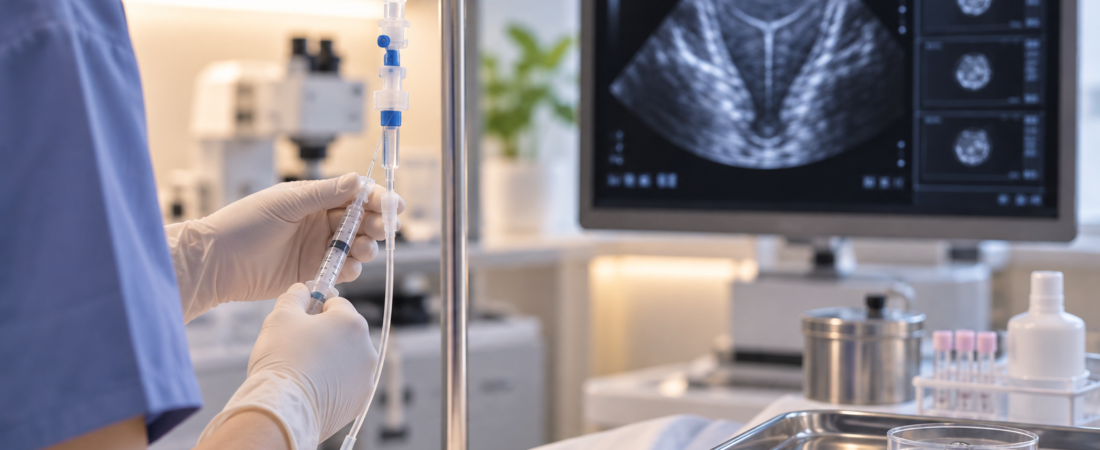
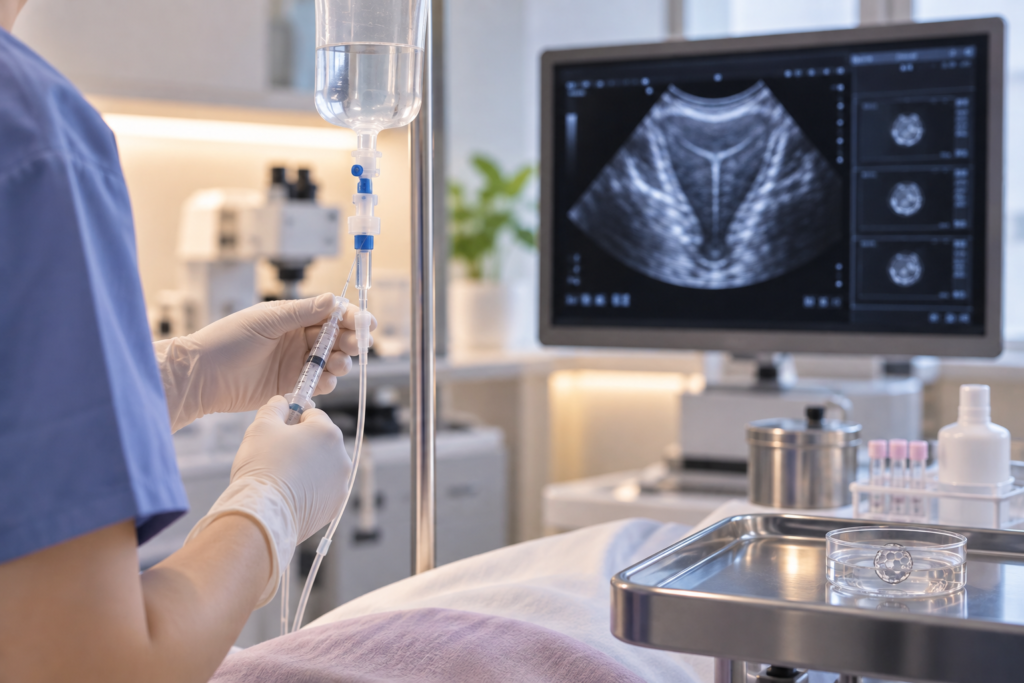
※ Image: AI generated (ChatGPT, OpenAI) / For illustrative reference only.