

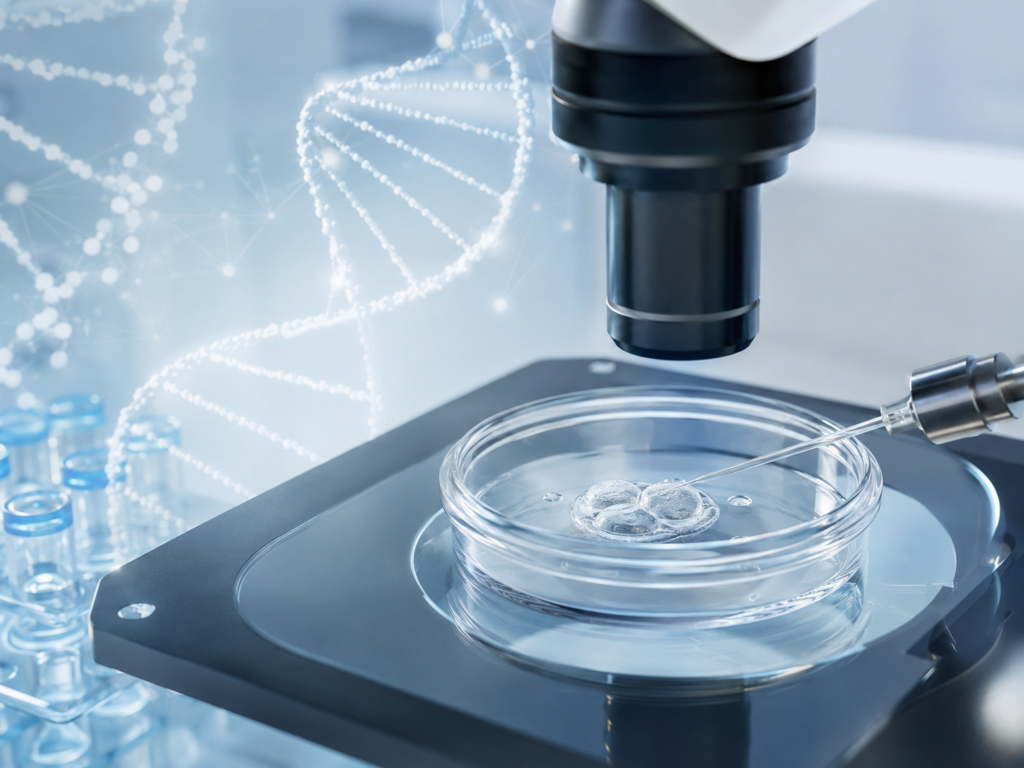
“Do ICSI and Ovarian Stimulation Leave Genomic Traces?… 24,000-Individual WGS Analysis Evaluates De Novo Mutations in ART Offspring”
- Whole-Genome Sequencing (WGS) of 7,851 Families (24,030 Individuals): ART offspring carried an average of +2.48 additional de novo mutations (DNMs) compared to naturally conceived peers (~4% increase over the ~61.6 baseline)
- Specific Protocol Correlations: ICSI associated with +1.0 paternal DNM, GnRH antagonist protocols with +1.69 maternal DNMs, and frozen blastocyst culture with +1.23 early post-zygotic mosaic mutations
- Reassuring Genomic Safety: 99.66% of mutations occurred in non-coding regions (only 0.34% in coding sequences); no broad increase in congenital anomalies or 1-year neurodevelopmental delays
- Reframing Reproductive Safety: Highlights the need to reduce non-indicated ICSI and minimize in vitro laboratory stress rather than viewing ART as inherently mutagenic
Couples undergoing assisted reproductive technology (ART) often wonder whether invasive laboratory procedures—such as injecting a single sperm via Intracytoplasmic Sperm Injection (ICSI), ovarian stimulation protocols, and multi-day in vitro culture—leave detectable footprints on their child’s genome.
A large-scale genomic study published in Nature Medicine (August 7, 2026) addressed this question by analyzing whole-genome sequencing (WGS) data from 7,851 trios/families (24,030 total individuals), systematically cataloging spontaneous de novo mutations (DNMs) across naturally conceived and ART-conceived offspring.
Baseline Human Genetics vs. The ART Differential
Every human being is born with spontaneous de novo mutations that were not present in the somatic tissues of either parent. These mutations arise naturally during male and female gametogenesis and during the earliest mitotic divisions of the zygote:
- Baseline Human Mutation Rate: Children in the cohort carried an average of $\approx 61.6$ spontaneous single-nucleotide DNMs.
- The ART Delta: Offspring conceived via ART presented with an average of 2.48 additional DNMs compared to naturally conceived offspring.
This represents a modest $\approx 4\%$ relative shift above baseline spontaneous mutagenesis. ART does not introduce thousands of genetic errors; rather, it introduces a subtle statistical increment in single-nucleotide variations across the 3 billion base pairs of the human genome.
Specific ART Protocols and Parental Lineage Divergence
By phasing the parent-of-origin for each mutation, the research team dissected how specific clinical interventions correlated with maternal, paternal, and post-zygotic variations:
| ART Phase / Intervention | Genomic Association | Hypothesized Biological Mechanism & Confounders |
| Fertilization: ICSI | +1.0 Paternal DNM | Underlying sperm factor subfertility (elevated sperm DNA fragmentation, defective chromatin protamination) vs. mechanical microinjection stress. (Conventional IVF showed no paternal DNM elevation). |
| Stimulation: GnRH Antagonist | +1.69 Maternal DNMs | Accelerated multi-follicular recruitment rescuing lower-quality oocytes that had accumulated unrepaired baseline DNA damage. Exhibited a modest dose-response relationship. |
| Culture: Frozen Blastocyst | +1.23 Post-Zygotic Mosaic Mutations | Extended in vitro culture to Day 5–6 exposing cleavage-stage blastomeres to metabolic and oxidative stress before blastocoel expansion and vitrification. |
Pathogenicity: Are These Mutations Harmful?
For clinical practice, the central question is whether an increase of 2.48 mutations translates into elevated disease risk. The data indicates that it does not:
- Predominantly Non-Coding: 99.66% of all identified DNMs localized to non-protein-coding genomic regions. Only 0.34% occurred within functional coding exonic sequences.
- Extreme Rarity of Pathogenic Alleles: Documented deleterious or disease-causing clinical variants were exceptionally rare and did not differ statistically between ART and natural conception cohorts.
- Perinatal and Neurodevelopmental Outcomes:
- Paternal DNMs exhibited a minor statistical correlation with shorter gestational length and lower birth weight, though DNMs accounted for only $\approx 4\%$ of the total variance in ICSI-associated gestational differences.
- No significant associations were observed between overall mutation loads and major congenital malformations or 1-year global neurodevelopmental delays.
Methodological Boundaries and Confounder Control
While the genomic cohort size is large, critical methodological factors must be considered:
- Association vs. Causation: This was a retrospective observational birth cohort. Disentangling the biological effects of ART procedures from the underlying genetics of parental subfertility remains challenging. For example, men requiring ICSI frequently carry baseline defects in spermatogenesis, DNA repair enzymes, and chromatin packing, which independently contribute to paternal DNMs.
- Survival Bias: The study evaluated live-born infants. Blastomeres or embryos harboring severe, lethal genetic aberrations arrest during early cleavage or fail to implant, excluding them from neonatal cohorts.
- Follow-Up Duration: Neurocognitive assessments at 1 year of age are preliminary; longitudinal tracking into childhood and adolescence is required to assess subtle cognitive and metabolic traits.
Clinical Implications: Refining the “Genomic Footprint” of IVF
This study does not suggest that IVF or ICSI is unsafe or that standard ovarian stimulation protocols should be abandoned. GnRH antagonist protocols remain vital for patient safety by reducing Ovarian Hyperstimulation Syndrome (OHSS), and ICSI remains essential for severe male-factor infertility.
Rather, the findings mark a shift toward evaluating the genomic micro-stressors of assisted reproduction:
- Prudent Use of ICSI: Discouraging routine, unindicated ICSI for non-male factor couples when conventional IVF achieves equivalent fertilization.
- Optimizing the In Vitro Environment: Continuing to refine physiological culture media, reduce incubator oxidative stress, and minimize unnecessary culture manipulation.
- Patient Reassurance: Providing clear data that while ART interventions may leave minor molecular signatures, they do not broadly elevate the risk of hereditary diseases or major developmental defects.
Medical Source & Study Information
- Journal: Nature Medicine (Published August 7, 2026)
- Study Title: Large-scale whole-genome sequencing reveals the landscape and health implications of de novo mutations
- Institutions: State Key Laboratory of Reproductive Medicine and Offspring Health, Nanjing Medical University, China
- DOI: 10.1038/s41591-026-04585-2
※ This article was synthesized based on the study published in Nature Medicine (August 2026) alongside literature in clinical genomics, reproductive genetics, and pediatric ART outcomes. It does not replace individualized clinical diagnosis or medical care, and specific treatment decisions should always be made in consultation with a qualified reproductive endocrinologist or medical geneticist.
※ The images associated with this article were generated using generative AI (ChatGPT, OpenAI) as illustrative visual references and do not depict real individuals.